
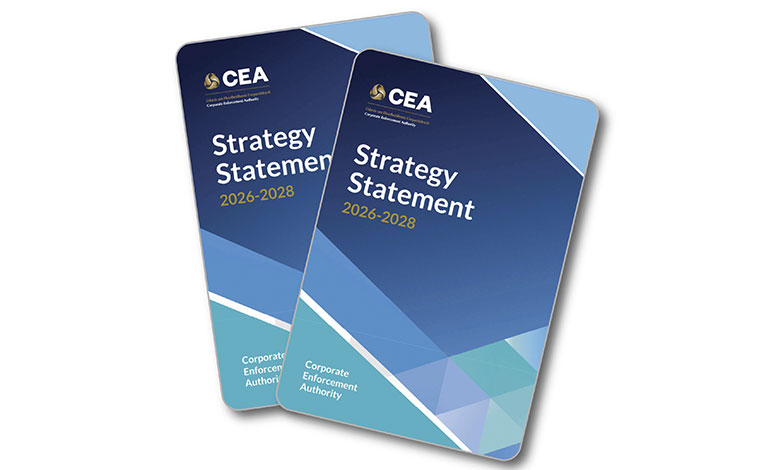
The Corporate Enforcement Authority (CEA) is pleased to have launched its Strategy Statement for the period 2026-2028.
Against a backdrop of there now being in excess of 324,000 companies on the register, this strategy, which was developed following a substantial stakeholder consultation exercise, is rooted in the Companies Act 2014.
For the period 2026-2028, the CEA has set itself the overarching strategic objective of increasing impact and providing further value to stakeholders. The CEA will achieve that objective by pursuing three strategic goals over the period.
Context
The White Paper on Enterprise 2022-2030 sets out the context within which the CEA operates in the following terms: “A well-functioning regulatory environment is an essential condition, underpinning a competitive and productive economy. Ireland has long been considered a conducive environment for enterprise to develop and grow and we continue to perform well across a range of indicators for the business and regulatory environment.”
The Programme for Government includes a commitment to publish a new enterprise strategy, Enterprise 2035, which will detail a long-term ambition for enterprise growth and job creation over the coming decade.
This strategy will supersede the White Paper, maintaining a focus on building on Ireland’s strengths as an open economy with strong trade and foreign direct investment, a vibrant innovation ecosystem, and a resilient labour market, while also adapting to new challenges in an increasingly uncertain world. That document strategy is expected to be published in the first half of 2026.
These documents serve to underscore the importance of the CEA’s role in contributing to the provision of a robust and effective model of corporate enforcement, which is supportive of enterprise and competitiveness while safeguarding the interests of stakeholders and the public.
Mission, vision, and values
Distilling the foregoing, the CEA has set itself the mission of promoting and serving the public interest by ensuring high levels of compliance with company law through effective advocacy and proportionate, robust, and dissuasive enforcement.
The CEA’s vision for the future is to be an enforcement agency, that is trusted by the public and highly regarded by its stakeholders and counterparts, whose work contributes to public protection and to Ireland being regarded as a safe and well-regulated economy in which to invest and create employment.
Strategy 2026-2028 is the means by which the CEA proposes to move towards that vision. In pursuing that vision, the core values to which the CEA subscribes are professionalism, integrity, and independence.
Strategic focus 2026-2028
The overarching focus of this, the CEA’s second strategy, is on increased impact and added value. The CEA proposes to achieve this overarching objective through three principal strategies, namely by:
1. Optimising delivery of effective enforcement: The CEA will continue to develop its operational effectiveness and resilience through a commitment to quality and continuous improvement, by continuing to leverage technology, and through the provision of high-quality advice and feedback to the Minister for Enterprise, Tourism and Employment and his department on company law matters.
2. Empowering stakeholders: The CEA will achieve this by enhancing its position as a trusted source of high-quality and impartial information on company law and related matters, by continuing to build and develop relationships with domestic and international peers and counterparts, by advancing its standing as a recognised and respected voice on the regulatory and enforcement landscape, and by continuing to enhance the impact of its communications with stakeholders.
3. Investing in people: The CEA will achieve this through continuing to enhance its standing as an employer of choice, by nurturing diversity, equity, and inclusion, and advancing its value proposition to prospective staff through a longstanding and deeply-held belief in, and commitment to, lifelong training, development, and education.
Further information
Further information about the CEA, including its functions, guidance material for company directors and secretaries, and how to make a complaint, can be obtained on the CEA’s website, outlined below.
In this regard the CEA has published its latest information note providing practical guidance for companies and their directors, and members on the lawful and effective conduct of virtual general meetings under the Companies Act 2014. The aim of this note is to support companies in meeting governance requirements while promoting transparency, fairness, and ease of understanding in how meetings should be conducted.
The recent amendments to the Companies Act 2014 enable more flexible and technology-enhanced general meetings. However, compliance depends on deliberate planning, clear communication, and a strong commitment to fair and inclusive participation. Companies that embrace these principles will be better positioned to strengthen governance, transparency, and member engagement.
Companies are reminded to:
- ensure members have the same rights whether attending in person or online;
- provide extra assistance for less digitally literate members if a company is aware of such assistance being required to ensure a reasonable opportunity to participate;
- use secure platforms that meet requirements under section 176A (5);
- issue notices in compliance with section 181, including clear online access instructions;
- regularly review the company’s constitution and update meeting rules for virtual or hybrid formats;
- if necessary, consider investing in user-friendly platforms and offer training or guidance for participants;
- remedy any technical issues as soon as possible once meetings commence;
- attendees must be able to hear the chairperson and any person introduced by the chairperson; and
- attendees must be able to speak and submit questions or comments during the meeting (as permitted by the company’s constitution).