Delivering EV infrastructure
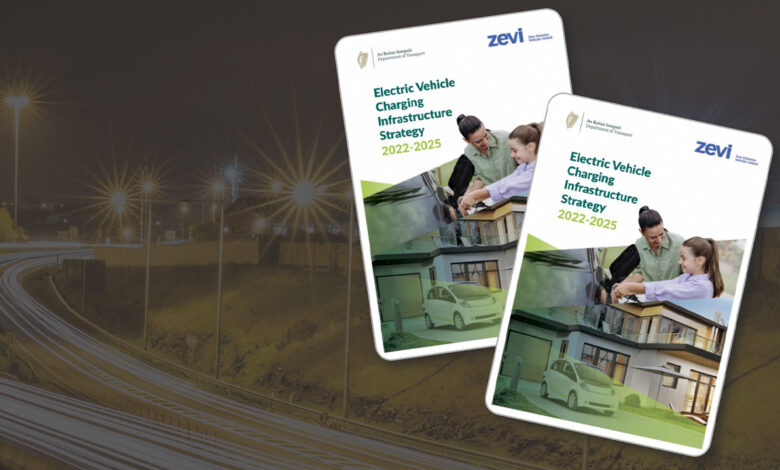
Harry McGoldrick analyses the Electric Vehicle Charging Infrastructure Strategy 2022-2025 ahead of the publication of the 2026-2028 strategy.
The forthcoming strategy, which underwent public consultation between February and April 2026, aims to contribute to the Climate Action Plan target of 30 per cent of all private cars in Ireland being electric by 2030.
The draft National EV Charging Infrastructure Strategy 2026-2028 outlines the Government’s ambition to stay ahead of demand and maintain delivery of EV infrastructure, while meeting the requirements of the Alternative Fuels Infrastructure Regulation (AFIR).
The Government established the Zero Emission Vehicles Ireland (ZEVI) office in July 2022 as its hub for the delivery of policy to support zero-emission vehicles in Ireland. The office has assisted the Government to surpass its Climate Action Plan targets for 2025, with over 204,000 EVs registered in Ireland, 9,000 vehicles over the initial target of 195,000.
When the 2022-2025 strategy was initially released, former Transport Minister Eamon Ryan called the project in 2022 “a roadmap for creating an entirely new infrastructure across the country”.
One of the main aims of the 2022-2025 strategy was the delivery of a supply plan for en-route charging and residential and destination charging. The National Road Network EV Charging Plan 2024-2030 includes plans to have high-powered chargers being located every 60km on the core TEN-T network.
There are now 131 high-powered charge points across 17 locations in counties Louth, Laois, Tipperary, Kildare, Westmeath, Wicklow, Clare, Limerick, Galway, Kilkenny, and Meath. The average distance between recharging pools is 45km, 15km below the minimum as set out within the strategy of 60km.
However while the total amount of electric cars are being sold is increasing at a rapid rate (204,000), the same cannot be said about increasing EV charging points, with 3,237 publicly accessible chargers nationwide, which equates one charger for every 63 EVs, and while an increase of 43 per cent in the number of operational high power CCS connectors according to the Irish Electric Vehicle Association (IEVA) sounds like success, EV supply is outproducing the supporting infrastructure.
Ongoing work continues on light duty vehicle (LDV) charging programmes, with over 3,000 kilometres of national road being targeted. The work aims to add 162 additional charging hubs, and 516 high-powered and fast charge points. To date, €11 million has been committed for LDV1 (motorways) and LDV2 (national primary roads), with €8.8 million expected for LDV3 (national secondary roads) in 2026.
The strategy also availed of 10 schemes of work to break down aims into localised targets. One of the main schemes was the shared island sports club scheme.
The all-island scheme, aimed to install EV charging infrastructure at sport clubs across Ireland, was established in January 2023 and accepted expressions of interest until February 2023.
As of 2024, 227 sports clubs were eligible for charging points, as of June 2026, no clubs that availed from the scheme has been announced.
Although demand for passenger-sized EVs is strong, demand for other vehicle types is weaker, in part due to vehicle models and numbers available, with lacking charging infrastructure being another drawback.
Nearly 99 per cent of all heavy-duty vehicles (HDVs) in Ireland are still diesel-powered and are responsible for 20 per cent of total emissions in Ireland, making the transport sector hard to decarbonise.
The electrification of HDVs in Ireland has also proven quite difficult. As of Q3 2025, only 370 eHDVs have been registered in Ireland; 300 eBuses and 70 electric heavy-good vehicles (eHGVs). This figure is well under the CAP target of 700, however it is on track with the CAP levels for 300 EV buses.
In March 2026, 132 electric buses, with a combined cost of €66 million, were not being used as there was a lack of facilities to charge HDVs, with Sinn Féin’s John Brady TD, chair of the Public Accounts Committee, calling it a “systemic failure”.
“At a time when people are crying out for reliable public transport, this level of waste and incompetence is simply unacceptable. It is yet another example of a do-nothing government failing to plan and failing to deliver,” Brady said.
Transport represents the second-largest source of greenhouse gas (GHG) emissions in Ireland, with over 11.6 million tonnes of GHG being emitted in 2024, equating to 21.7 per cent of total emissions, an increase of 113.7 per cent since 1990, according to the Environmental Protection Agency (EPA).
Minister for Transport, Darragh O’Brien TD says: “This strategy builds on the successful foundations laid by the Department’s 2022-2025 strategy and reflects the Government’s continued ambition to stay ahead of demand, meet the requirements of the Alternative Fuels Infrastructure Regulation (AFIR) and deliver infrastructure that meets the evolving needs of EV users.”