Why light rail matters in today’s cities
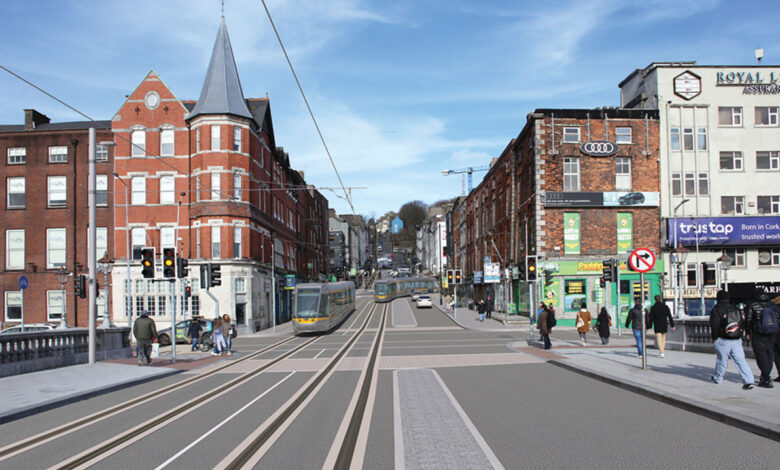
Cities today face a convergence of pressures: growing populations, constrained road space, climate commitments, and the need for reliable access to jobs and services. Against this backdrop, light rail has re-emerged as a critical component of modern urban transport systems, writes Dave King, Jacobs Regional Director – Ireland and Northern Ireland.
It is a high capacity, high quality transport mode well suited to dense urban corridors, where dependence on private cars is neither sustainable nor efficient. Light rail’s benefits extend well beyond moving people from A to B. It provides fast, reliable, and accessible public transport that can attract users away from private vehicles, helping reduce congestion, emissions, and noise.
Its permanence gives certainty to residents, businesses, and investors, supporting compact growth, regeneration, and creating walkable, transit oriented communities. By combining efficiency, environmental performance, and placemaking benefits, light rail is vital in creating more liveable, competitive and resilient cities.
Cork Metropolitan Area
The Cork Metropolitan Area (CMA) is in an exciting phase of its development. It is envisaged that Cork will become the fastest-growing city region in Ireland with a projected 50-60 per cent population increase in the period to 2040. This projected population and associated economic growth will result in significantly increasing travel demand.
This demand needs careful management to safeguard and enhance Cork’s attractiveness to live, work, visit and invest in. There is limited capacity within the existing CMA transport network to cater for additional private car traffic, and this remaining capacity requires more efficient allocation.
Cork’s main approach corridors are congested, inefficient, and dominated by low occupancy private car traffic, resulting in unreliable bus services, suppressed public transport usage, poor active travel conditions, and an inability to accommodate future growth within the existing street space due to physical constraints.
These corridors need to reallocate priority to high capacity, low carbon modes to maximise person throughout, improve reliability, and support sustainable urban development. Cork’s geography does not make it easy. The river Lee, the historic street pattern, and the city’s tight urban core limits how many cars and buses can be pushed through the centre.
Continuing to funnel more vehicles into the same constrained space is not a strategy. Light rail offers something fundamentally different: a high capacity, reliable system that moves large numbers of people efficiently without competing endlessly for road space.
Light rail is not just about transport, but its transformative impact on cities. Fixed rail urban schemes create certainty. They reshape travel behaviour, support development where needed most, and signal that a city is ready to prioritise people over traffic. When delivered, a light rail system in Cork would enable continuous and sustainable city growth.
Light rail will not solve every problem that Cork faces, but it can be the backbone of an integrated urban transportation network within Cork working seamlessly with BusConnects, heavy rail services, and active travel networks.
Light rail has an anchoring effect that other modes rarely achieve. Around stops, higher density housing becomes viable. Offices and shops gain confidence and cluster together. Streets are redesigned not just to carry vehicles, but to invite people to linger. In Cork, that could mean suburbs and growth areas becoming more self-contained, less car dependent, and more connected to city life.
Transport is one of the largest sources of emissions in Ireland’s cities, and Cork is no exception. Climate action plans are focused on percentages and targets, but in simple terms, if most trips are made by car, emissions will not fall at the pace required.
That leaves Cork with an unavoidable task of large scale modal shift by making sustainable travel the most practical choice for everyday journeys. Walking and cycling are critical, but they cannot carry peak hour demand across longer corridors. Buses are essential, but in constrained city centres they can struggle to deliver reliability at scale. Cork needs public transport to carry lots of people, all day, every day, and to do so competitively with the car.
This is where light rail can be the workhorse. With its high capacity, it can shift significant numbers of people out of private cars and onto a cleaner, shared system that competes on speed, reliability, and certainty.
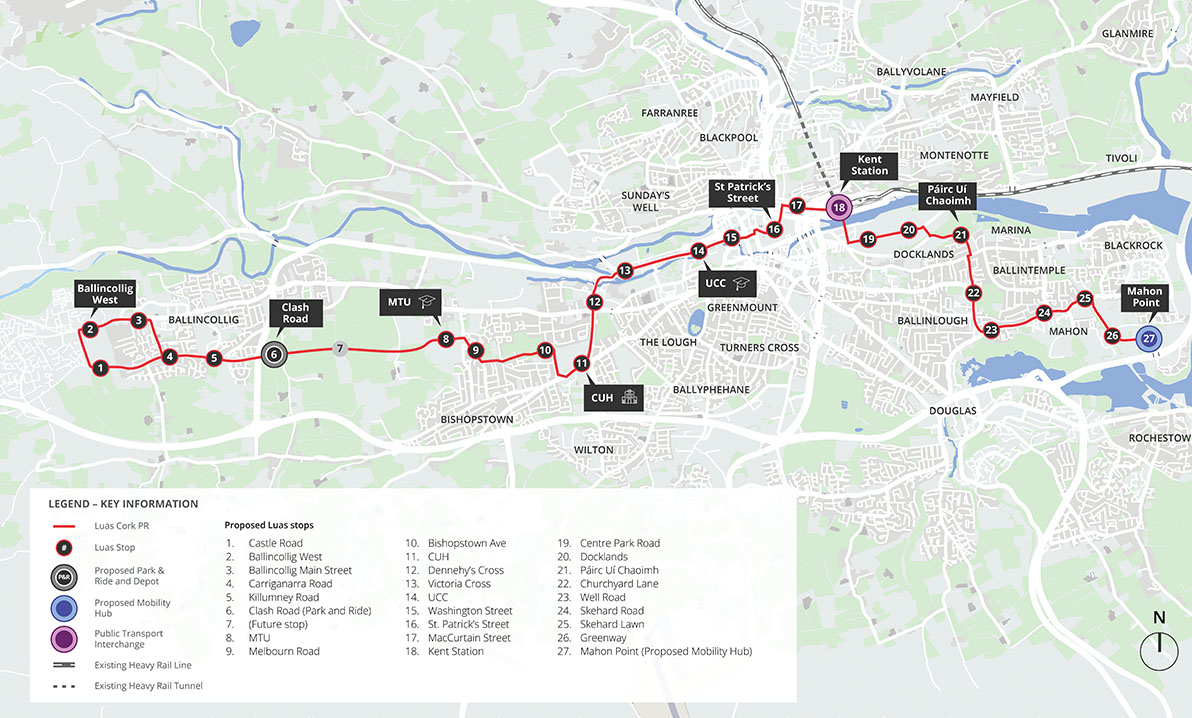
Luas Cork is the proposed light rail line for Cork running from Ballincollig to Mahon Point, connecting key destinations such as MTU, Cork University Hospital, UCC, Cork city centre, Kent Station, Cork Docklands, Páirc Uí Chaoimh, Blackrock, and Mahon.
It is a central part of the Cork Metropolitan Area Transport Strategy (CMATS) that will deliver an integrated public transport network including BusConnects, heavy rail improvements, and enhanced cycling and walking infrastructure. When implemented it is expected to:
- reduce traffic and carbon emissions, unlock housing and jobs growth, creating a liveable, walkable, and vibrant city;
- bring people to work, education, healthcare, sport, and cultural events efficiently and comfortably;
- offer more reliable journey times than other travel forms, and encourage people to leave their cars behind, reducing city congestion;
- create interchange opportunities with regional and intercity bus services from various locations, including Cork City Bus Station at Parnell Place, and with intercity and commuter rail services at Kent Station, while the ongoing rollout of BusConnects Cork has also been considered in tandem with Luas Cork;
- provide opportunities to widen the catchment via a 1,000-space park and ride to enable commuters from the N40 and N22 switch from car or bus to Luas, and a smaller mobility hub at the terminus in Mahon Point.
At both locations, there will be car and taxi set-down, secure bike parking and bike-share stands;
- be safe and accessible to all; and
- transport an estimated 18 million passengers in the opening year.