Strength in unity

Our native language, Irish, one of the oldest written languages in Western Europe, was first written in Ogham in the 4th–5th centuries, writes an Coimisinéir Teanga, Séamas Ó Concheanainn.
This piece was originally written in Irish. Please click here to access the Irish language version.
The Irish language is accorded special status under the Irish Constitution of 1937 as both the national and first official language. The constitution also enshrined the right of individuals to conduct interactions with the state exclusively in the Irish language.
However, in practice, the State often failed to make adequate provision for delivering public services in Irish, and in some cases, members of the public had little choice but to resort to the courts to obtain their constitutional right to access public services in Irish.
Successive Irish Governments recognised the need for an overarching statutory framework to increase the availability of public services in Irish and to improve their standard in a systematic manner. The Official Languages Act 2003 provided that framework, obliging public bodies to deliver certain public services in Irish.
The roles of An Coimisinéir Teanga and Oifig an Choimisinéara Teanga were also established under the 2003 Act. The office functions as an independent statutory body, serving dual roles as both an ombudsman service and a compliance monitoring agency.
A key responsibility of my office is to inform the public about their language rights and guide the 500 public bodies covered by the legislation on their duties under the Act.
The 2003 Act has been amended by the Official Languages Act (Amendment) 2021 to further strengthen the language rights of the Irish-speaking community by obliging public bodies to deliver more public services in Irish.
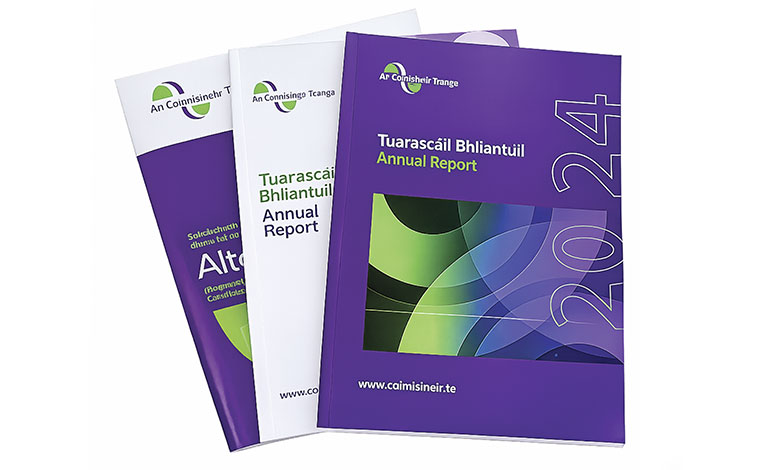
A very positive result of the amended 2021 language rights legislation has been the significant increase in advertising by public bodies in Irish as a result of a provision contained in the amended Act. Audit results from a recent report published by my office indicate that public bodies spent €19 million on advertising in the Irish language in 2024.
In a relatively short period, the provision on advertising has significantly boosted the visibility of Irish across various media, playing a vital role in promoting the language’s vibrancy and everyday use.
A national approach
The Government launched the first-ever National Plan for Irish Language Public Services in the history of the State in October 2024. This is a very important milestone that must be commended. The main aim of the plan is to set out a clear pathway for the public sector in Ireland to build capacity for significantly improving public services in the Irish language.
Ongoing oversight, monitoring, and reporting on the implementation of the National Plan by the advisory committee established by government to develop and implement it is a critical issue.
The National Plan will be underpinned by two cornerstones. Firstly, the statutory provision that 20 per cent of staff recruited to the public service will be proficient in Irish. The second cornerstone is the language standards system, which will set out the services that public bodies will be required to provide in Irish, and the level of Irish-language proficiency that the staff providing those services must have.
Major existing deficits
The Irish language community’s conviction that the State is not currently providing fair and equitable public services in Irish is borne out in the quantity and nature of complaints received by my office each year. A considerable number of the complaints my office receives each year relate to the lack of basic public services in Irish, such as customer support and online services, and addressing this is critical to improving Irish-language public-sector provision.
While the availability of online public services is increasing rapidly, the quality of services in Irish lags significantly behind those in English.
That is not to mention the need for sufficient Irish-speaking staff to work in the public service, in education, local government, health, and policing, for example, to provide services in the language of their choice for the Gaeltacht and the Irish-speaking community nationally. The shortfalls in current public services demonstrate the urgent need to implement the new language standards system set out in the Official Languages (Amendment) Act 2021.
The Irish Government’s 2023-2030 Public Service Transformation Framework emphasises the principles of honesty, fairness, openness, responsiveness, and trustworthiness in improving public services.
The OECD recognises these principles as vital for fostering confidence, learning from international best practices, and benchmarking against global standards in improving public services. These principles are also central to improving public services in Irish and must be embedded in the planning of public services to ensure that the contemporary needs of Irish speakers are met.
Due to the scale and diversity of the public service, a national university-sector initiative will be required to provide sufficient graduates proficient in Irish across a variety of disciplines, ensuring the success of the 20 per cent provision of recruits proficient in the Irish language by the end of 2030.
There will be an urgent need for a continuous stream of graduates in the following sectors: administration and public policy, corporate governance, organisational management, language planning, strategic planning, primary and post-primary teacher training, and education for healthcare professionals.
Language rights are a fundamental aspect of human rights worldwide, enabling language communities to communicate with the state in their preferred language. I consider language rights essential to our efforts to cultivate Irish as a modern, vibrant, and inclusive language that showcases the diversity and richness of Irish society, identity, and culture.
In conclusion, I warmly invite any readers who believe my office can be of assistance to contact us.
Ní neart go cur le chéile.