The future of transport and mobility planning in Ireland

“There is a need to enhance the skillset, capabilities and capacity for both public and private service tasked with transport and mobility planning, and climate action, with a focus on how we engage communities in planning processes,” says Dean Phelan, a research fellow at the School of Geography at University College Dublin (UCD).
The CONUNDRUM project, of which Dean Phelan is co-investigator, aims to reimagine how transport outside of major cities is examined. The project is led by Niamh Moore-Cherry from UCD in partnership with Brian Caulfield and researchers at Trinity College Dublin, and TASC, the think tank for action on social change.
Phelan says: “We need to think about our transport systems as larger, integrated pieces of infrastructure and governance processes, and in countries like Ireland, where two-thirds of our populations do not live in our cities, this is particularly important.”
The CONUNDRUM approach involves co-creating community-led mobility strategies with diverse stakeholders. As of June 2026, the project has engaged with over 570 diverse stakeholders, all with lived experiences of challenges affecting local communities across Ireland.
Stakeholders include people within the case study towns, such as residents, community groups and business leaders, as well as service providers and members of local, regional and national governance.
Phelan says that traditional approaches to planning in Ireland are imperfect as they often fail to capture the complexity of local challenges, with traditional top-down approaches excluding the expertise of local communities and businesses which can result in “solutions being implemented that are controversial, poorly understood by residents, and do not enable behavioural change”.
Phelan, however, explains that people need to be central in planning sustainable mobility and transportation futures so as to not further marginalise or distance communities in efforts to achieve decarbonisation.
“The need for just transitions is not just about the need to decarbonise for the sake of the environment, but we also need to think about people as being at the forefront of this because we know that moves to decarbonise transportation can, and very often do, further marginalise already vulnerable communities,” Phelan says.
CONUNDRUMS aim, as Phelan describes it, is to “democratise planning and democratise governance through co-creation”. Phelan describes the projects approaches as “routed in participatory action research and community engaged geographies”.
Case studies
The project’s first case study was in the town of Enniscorthy, County Wexford, which was the focus of the research project during its first two phases of funding under Research Ireland’s Sustainable Communities Challenge. Since then, the project has replicated its approach and validated it in additional towns including Tramore, County Waterford and Youghal, County Cork.
“Throughout those first three phases, we engaged more than 570 diverse stakeholders, from communities and business owners to local and national governance. Our approach is iterative, so while some of these 570 stakeholders engaged with us just once, most of these people were engaged on multiple occasions throughout the process.”
The case studies included conducting interviews with stakeholders and running community mapping workshops which Phelan describes as “key” in identifying the place-specific challenges facing local communities, and for enabling local authorities, with limited capacity and resources, to better direct their resources.
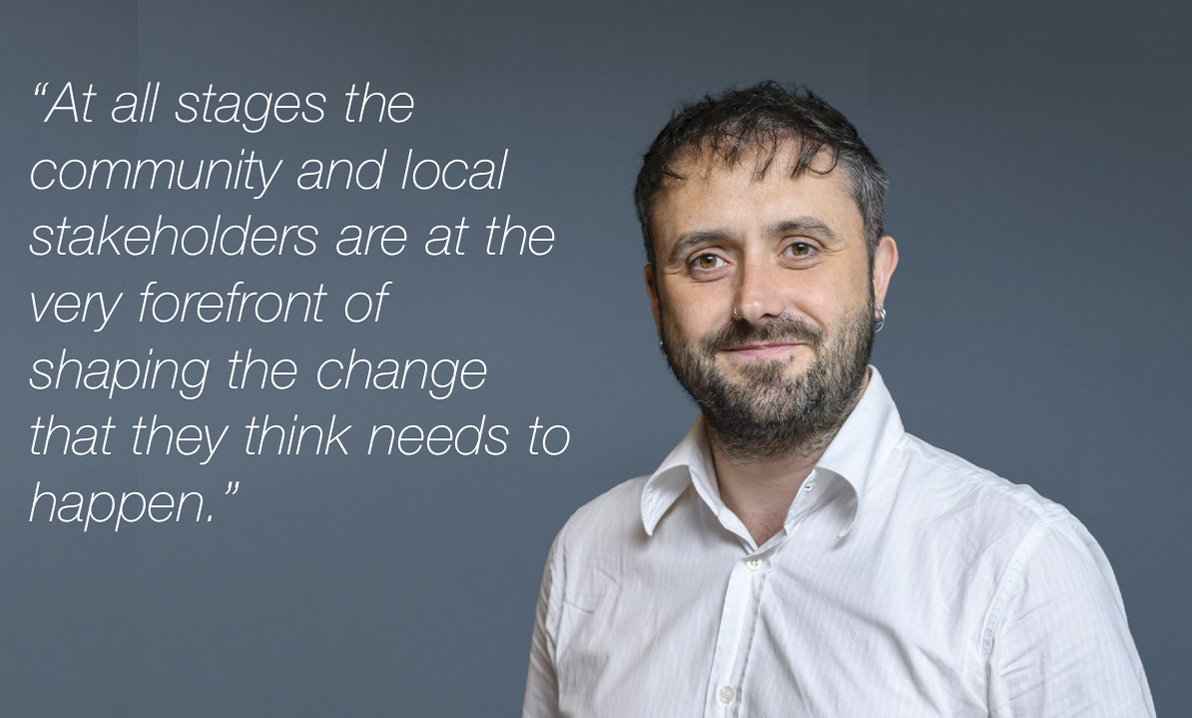
“Importantly, throughout the process, a large number of opportunities were identified, which we then condensed into solutions. We then invited stakeholders, including people from the community, to rank these possible solutions based on what they think is most important for their town. At all stages the community and local stakeholders are at the very forefront of shaping the change that they think needs to happen,” Phelan says.
At the end of the mobility strategy, Phelan describes how the project team suggest nine actions which they believe could be implemented to improve issues raised by the communities. Phelan reveals that in Enniscorthy, within three months, all nine of the actions suggested were in the process of being implemented or under consideration by local stakeholders.
Phelan acknowledges that all three case studies to date have taken place in the Southern Regional Assembly area, however, he notes that work is commencing on the replication of the process in additional case studies across Ireland.
Phelan explains: “In this next phase of funding, we are going to begin replication over the summer in two new case study towns; one in the Northern and Western region and one in the Eastern and Midlands region.”
Looking forward, Phelan talks of the continued development of the project, with the main aim being to scale the project nationally, and the continued testing and validating of the process through replication in additional case study towns. Additionally, the team are developing a digital tool (www.TownsMatter.ie) for supporting planners to replicate this process themselves.
“Ultimately what we are developing here is a process that we hope will help to enable upskilling and capacity building for public and private sector actors who are involved in the planning process for transportation and mobility in Ireland, or indeed cross-sectorally,” Phelan says.
Concluding, Phelan talks about the frustration felt by communities, local businesses and local authorities in Ireland in regard to traditional government mechanisms.
Speaking about transport mobility planning, he says: “We are really fantastic at a national level for coming up with new frameworks and policies, but we lack supports at the local authority level for enabling integrated and inclusive planning, or for linking local actions with national level ambition. This is something that the CONUNDRUM process can help to address”.