
The benefits of better public services across the justice system
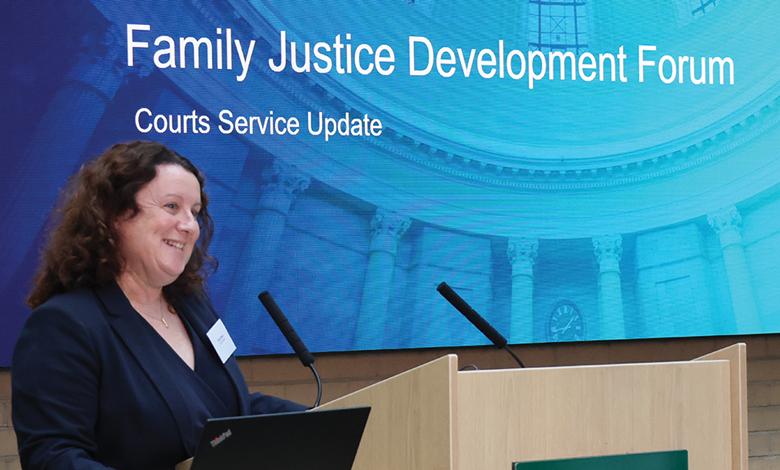
After five years of sowing modernisation seeds, the Courts Service is beginning to realise user benefits.
“Advocacy groups and member representative organisations are starting to feed back that our approach to co-designing information and services with users in mind is making a difference,” says Emer Darcy, Head of Strategy and Reform Directorate in the Courts Service.
Legacy technology, fragmented systems, paper-based processes, and inconsistent user experiences were limiting the organisation’s ability to meet the expectations of a modern society. Today, those foundations are starting to enable the delivery of more accessible, efficient, and user-focused services.
Darcy continues: “Modernisation is not simply about introducing technology. It is about improving how people experience and interact with the courts system. Whether users are working in the courts every day or attending for one day, our objective is the same: to make the courts system easier to understand, easier to access, and easier to use.”
Making the court system easier to understand
The Courts Service redesigned courts.ie with users for users. It applied accessibility standards and redeveloped the website to be fully responsive across all devices. The Courts Service worked with the National Adult Literacy Agency and rewrote its information pages in plain language. Legal terms, where essential, were given plain language explanations.
The redeveloped courts.ie received a 100 per cent accessibility score from the National Disability Authority in its 2025 EU Web Accessibility Directive report. The average reading age on courts.ie is 13 years (down from 21 years) on the 50 busiest pages, making the information more accessible to more users. Users also now stay on information pages longer.
Improving access to probate
A busy area for the Courts Service is probate, which at some point has an impact on most families. Every year, over 20,000 applications for probate are lodged and most deal with the sale of property. The Government’s Housing for All plan identified the long processing times for probate as one issue which impacted on the housing situation. One of the main problems with the probate process was the paper-based system, with a lot of potential for errors.
With government support, the Courts Service prioritised the digitalisation of grants of probate applications on their new online Courts Portal to address some of these issues and reduce errors.
Data sharing between Revenue and Courts Service systems has also reduced the complexity of the application process for users. Taking an incremental approach, the new online Courts Portal was launched on 2 June 2026 to solicitors to apply for grants of probate.
Within 100 days of the launch date, 45 per cent of all grants of probate applications are being filed online by solicitors. The error rate on these applications has dropped by 50 per cent with online applications being processed within five weeks.
Owen Harrison, Chief Information Officer of the Courts Service, says: “By the end of the year we will include applications for intestacy on the Courts Portal. This will mean that solicitors will be able to file the vast majority of probate application types online. We are encouraged by the strong uptake of the new online service, which reflects the time and effort solicitors have put into helping shape an online journey that works not only for the Courts Service, but also for them.”
Improving access to justice
Harrison continues: “At the moment, we have Circuit Court family law and grants of probate applications on the portal. We are continuing to roll out our unified case management system (UCMS), which supports the portal, across more of our internal operational areas.
“Already, 48 of our 148 legacy back office systems have been transitioned to our new system, up from just one in 2023. This month, our legacy Circuit Court crime system is transitioning to UCMS.

“We are starting to see real, positive change for court users, and we will continue building on this momentum.”
“Crime is a complex area, with many interdependencies across the justice sector. This is, therefore, a significant enabling step in modernising the courts and supporting future reform across the criminal justice system.
“Following the transition of Circuit Court crime, we will move to other areas and continue expanding capabilities on the portal. We are starting to see real, positive change for court users, and we will continue building on this momentum.”
Making the court system easier to use
From user insights, the Courts Service understood that family law forms for protection orders, domestic violence, and maintenance in the District Court were difficult for people to understand. Taking a service design approach, they redesigned new forms with internal and external users.
The Courts Service worked with the rules committees to ensure a legal basis for the new forms.
Speaking about the introduction of the new forms, Darcy says: “We understand from our Civic Society members that users are now filling out these forms themselves, without having to retell and relive their trauma. This is a real and impactful benefit for users. We have taken a similar approach with updating the relatively new civil restraining order forms, which we hope to introduce later this year.”
The Courts Service has also invested heavily in courtroom technology in recent years, with 176 courtrooms now video enabled. This gives court users more options in how they engage with the courts and helps to remove barriers to access to justice. The same
user-centred approach is reflected on courts.ie, where the availability of virtual views of courtrooms is helping people better understand what to expect before attending court.
Speaking about these supports, Harrison says: “Practical supports can make a real difference. Whether it is giving a vulnerable witness the option to provide evidence from outside the courtroom, or helping someone see the building, courtroom, and supports available in advance, the focus is on making the courts more accessible, understandable, and easier to engage with.
“Our investment in technology is not about technology for its own sake; it is about improving access to justice and better supporting the people who use the courts.”
Looking ahead
Angela Denning, Chief Executive Officer of the Courts Service on taking up the role seven years ago, envisaged with her senior management team “a modern, transparent, and accessible courts system that would be more efficient, easier to use, and designed around the needs of the people it serves”.
She says: “Our foundational achievements have enabled the Courts Service to deliver practical benefits, making meaningful improvements for court users, practitioners, justice sector partners, the judiciary, and society as a whole.”
W: www.courts.ie