
Commissioner Michael McGrath: Protecting rights in a changing Europe
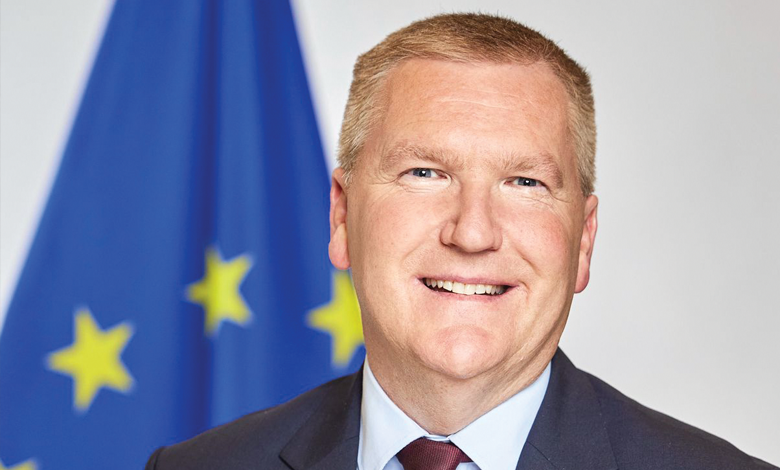
In 2025, more than 379,000 new criminal matters were presented to the Irish courts. Behind every case is a person, a victim, or a family relying on the justice system to work effectively and fairly, writes European Commissioner for Democracy, Justice, the Rule of Law and Consumer Protection Michael McGrath.
Ensuring that it does is not simply a national responsibility. In an increasingly interconnected Europe, it also depends on how well we work together.
As European Commissioner for Democracy, Justice, the Rule of Law and Consumer Protection, I see every day how much Europeans rely on justice; people expect their rights to be protected, courts to be fair and independent, and public power to be exercised according to the law. That trust is precious. It underpins our democracies.
At the start of my mandate, I committed to strengthening Europe’s justice systems around two key areas: modernising justice for the digital age and strengthening judicial cooperation across borders.
Making justice fit for the digital age
Digital tools and AI offer real opportunities to make courts more efficient and improve access to justice. They can support document management, communication, and legal research, allowing judges, prosecutors, and court staff to work more effectively.
But innovation must never come at the expense of fundamental rights. Decisions affecting people’s lives must remain subject to meaningful human oversight, with appropriate safeguards for privacy, data protection, and non-discrimination. AI can support justice, but it cannot replace human judgement or deliver justice on its own.
Our task at EU level is to help member states harness these opportunities responsibly. Through our DigitalJustice@2030 Strategy, we are supporting the digitalisation of national justice systems. Under the next Multiannual Financial Framework (MFF), we also intend to make funding available for national projects that advance this work.
Technology alone, however, will not deliver modern justice. Judicial professionals need the skills and confidence to use new tools responsibly. This is why more than 30 per cent of the European Commission’s current justice programme budget is devoted to judicial training. We have also proposed a higher allocation for the programme under the next EU budget.
Strengthening cooperation across borders
My second priority is to ensure that national authorities and EU bodies have the tools and cooperation mechanisms they need to tackle crime that crosses borders.
Organised crime operates across all 27 EU member states and extends worldwide. It generates an estimated €139 billion in illicit profits annually in the EU, yet only around 2 per cent of criminal proceeds are confiscated. These figures illustrate the scale of the challenge. Criminal networks exploit differences between national systems, move money across borders, and adapt quickly to new technologies. No member state can tackle these threats alone.
Ireland has long recognised the importance of tackling organised crime at its source: the money it generates. As Ireland’s Criminal Assets Bureau approaches its 30th anniversary, its establishment in response to rising levels of serious and organised crime is a reminder that effective law enforcement means not only prosecuting offenders, but also depriving them of the proceeds of their crimes.
That same principle must guide our work at European level. Criminal networks do not stop at national borders, and our response cannot stop there either. We need closer cooperation between national authorities and EU agencies such as the European Union Agency for Criminal Justice Cooperation (Eurojust) and the European Union Agency for Law Enforcement Cooperation (Europol).
In our recent proposals to revise the mandates of both agencies, we have sought to strengthen their governance, operational capacity, and analytical capabilities, enabling them to respond more effectively to increasingly complex and transnational criminal activity.
Cooperation must also extend beyond the EU. We are working to strengthen judicial cooperation with third countries. Our latest initiative is a recommendation to authorise negotiations on Eurojust cooperation agreements with eight third countries: Bolivia, Canada, Chile, Costa Rica, Ecuador, Panama, Peru, and the United Arab Emirates.
We are also working to improve the tools available to national authorities, including the European Arrest Warrant and the European Investigation Order. The proposed revision of the latter would make it easier for suspects, accused persons, and victims to participate in criminal proceedings by video conference.
Following the evidence in a digital world
Electronic evidence is now central to almost every criminal investigation. Communications, financial transactions, and other traces of criminal activity increasingly exist in digital form, often held by companies established in another country. Obtaining that evidence can be difficult and time-consuming. Investigators need timely access to relevant evidence across borders. Otherwise, criminals can exploit gaps between national systems to evade justice.
The EU’s new e-evidence rules, applicable since August 2026, are an important step forward. They allow judicial authorities, under the conditions set out in the legislation, to send European Production or Preservation orders directly to a service provider’s legal representative in another member state. Data must be provided within 10 days or within eight hours in urgent cases.
Ireland has a particular stake in making this framework work effectively. As home to many major digital service providers, it occupies an important position at the intersection of the EU’s digital economy and cross-border criminal investigations.
But justice is not only about investigating and prosecuting crime. It is also about ensuring that victims are heard, protected, and able to exercise their rights in practice. The EU’s work on victims’ rights is an important part of this commitment.
The measures adopted in June 2026 aim to make reporting crimes easier and improve access to support, including through an EU-wide helpline. The revised Victims’ Rights Directive strengthens protections relating to personal data, access to legal aid, and the enforcement of compensation decisions. We are also developing a Victims’ Rights Strategy to build on this work and help ensure that victims can exercise their rights effectively in practice.
The foundation: the rule of law
Neither digital innovation nor stronger cooperation can succeed without respect for the rule of law. These are not separate concerns; they are the foundations on which effective justice depends. Independent courts, accountable institutions, and the protection of fundamental rights are essential to ensuring that justice works in practice.
The European Commission’s annual Rule of Law Report supports this work by assessing developments across member states and encouraging reforms.
Ultimately, Europe needs justice systems that are modern, resilient, and capable of responding to new threats without losing sight of the values that define our Union. That means embracing technology responsibly, equipping our authorities to cooperate effectively across borders, and ensuring that the rule of law remains at the heart of everything we do.
The test of our work is not the number of strategies we publish or laws we adopt. It is whether people can rely on justice when they need it most.