Reforming transport infrastructure delivery
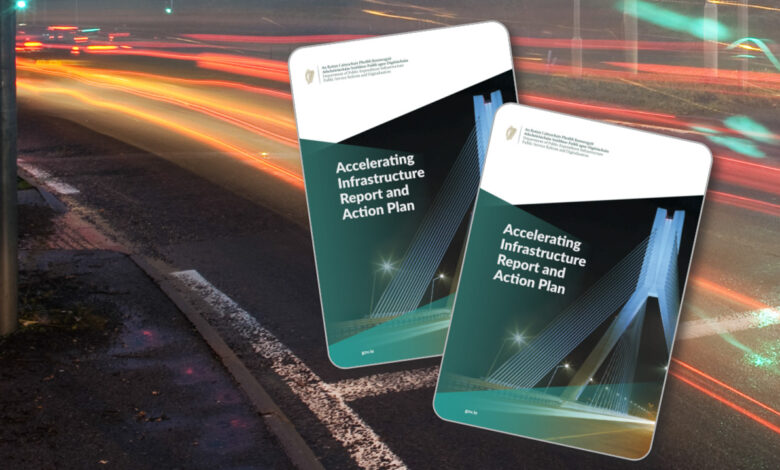
The Government’s Accelerating Infrastructure Report and Action Plan states that reforming planning, consenting, and coordination systems are essential to accelerating transport infrastructure delivery in Ireland.
The report, published in December 2025, states that the current transport development cycle is “linear and siloed”, with statutory bodies and regulators frequently engaging only after major design decisions have already been made. This often results in redesigns, delays, and repeated assessments throughout the lifecycle of projects.
Transport projects are also subject to multiple layers of approvals and regulatory processes. Depending on the scale and nature of a project, approvals may involve local authorities, An Coimisiún Pleanála (ACP), the Environmental Protection Agency (EPA), the Maritime Area Regulatory Authority (MARA), Inland Fisheries Ireland, and several other statutory bodies.
According to the report, these approvals are often sequential, meaning that one consent process cannot begin until another has concluded. This creates uncertainty around project timelines and increases delivery risk.
The report identifies transport infrastructure projects as particularly vulnerable to these delays because of the scale and complexity of road, rail, and active travel schemes.
Planning and judicial review
A significant part of the Action Plan relates to the impact of judicial reviews on infrastructure delivery. The Government argues that increasing legal challenges are contributing to longer timelines, rising costs, and greater risk aversion across the planning system.
The report states that even relatively minor procedural errors can result in projects being delayed for several years. This has led to what the Government describes as a “defensive” planning culture, with increasing levels of documentation and assessment intended primarily to reduce legal exposure.
The report also highlights inconsistency in planning decisions and timelines across different consenting authorities. Competing policy priorities and varying interpretations of planning guidance are identified as key drivers of uncertainty for transport agencies and developers.
To address these challenges, the Government proposes a series of legal and regulatory reforms intended to streamline approvals and improve certainty for nationally significant infrastructure projects.
Coordination and approvals
The report identifies insufficient coordination between agencies as another significant barrier to transport delivery. Utility diversions, environmental licensing, and overlapping consent requirements are highlighted as recurring causes of delays on transport projects.
To improve coordination, the Government proposes the establishment of a joint utilities and transport clearing house (JUTCH). This structure is intended to improve engagement between transport bodies, utilities, and local authorities, while allowing approvals and project sequencing to be managed more effectively.
In parallel, the Government intends to strengthen central oversight of infrastructure delivery through an enhanced coordination role within the Department of Public Expenditure, Infrastructure, Public Service Reform and Digitalisation.
The report states that clearer prioritisation of transport infrastructure within future revisions of the NDP will also provide greater certainty for industry and support long-term investment planning.
Procurement and productivity
Procurement reform forms another key element of the Action Plan. Current procurement systems are described as overly rigid and compliance-driven, discouraging participation and reducing competition in public infrastructure projects.
The Government argues that lengthy tendering processes and excessive risk transfer have reduced incentives for investment in skills, productivity, and innovation across the construction sector.
To address this, the action plan proposes reforms to public procurement processes alongside measures aimed at improving standardisation, professionalisation, and training within infrastructure delivery.
The report also highlights construction sector capacity as a major challenge for transport delivery. Ireland’s construction workforce remains below pre-financial crisis levels despite significant increases in infrastructure and housing demand.
The Government estimates that up to 80,000 additional construction workers may be required if productivity levels remain unchanged. However, this requirement could be significantly reduced through efficiency improvements, digitalisation, and greater use of modern methods of construction.
Public acceptance
The report identifies public acceptance as a critical factor affecting transport infrastructure delivery. While the benefits of projects such as road upgrades, public transport expansion, and active travel infrastructure are widely dispersed, local impacts are often concentrated within affected communities.
According to the report, this imbalance contributes to opposition, delays, and legal challenges throughout the planning process.
To address this challenge, the Government proposes enhanced communication around the societal and economic value of infrastructure investment. The development of a benefits realisation framework is intended to improve public understanding of how transport infrastructure supports housing, economic growth, and climate objectives.
The action plan also proposes stronger leadership and engagement at both national and local government level to build support for critical infrastructure projects.
In a joint foreword, Taoiseach Micheál Martin TD, Tánaiste Simon Harris TD, and Minister of State at the Department of Transport Seán Canney TD say: “By accelerating infrastructure delivery, we will unlock the homes that families need, the transport networks that connect communities, and the energy systems that power our economy and drive our decarbonisation.”