Mol an óige: Senator Patricia Stephenson
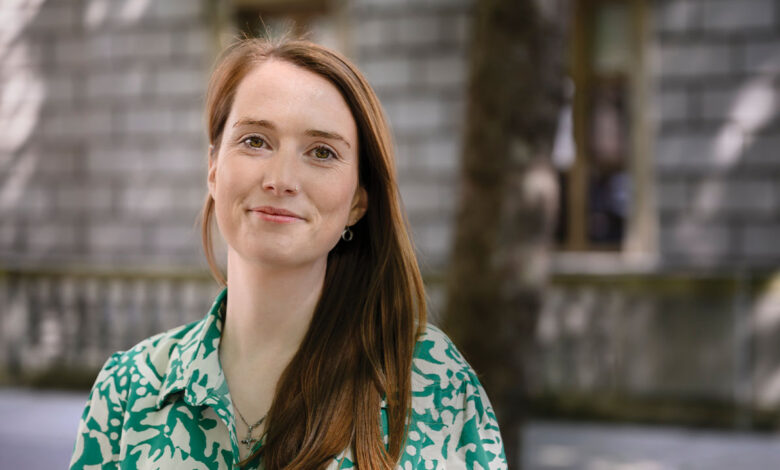
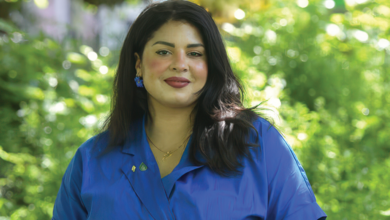
Patricia Stephenson is a 33-year-old Social Democrats Senator on the Labour Panel. She sits down with Ciaran Brennan to discuss the realities of drafting legislation, measures needed to tackle domestic, gender-based, and sexual violence, and her future ambitions.
Despite growing up in a highly politically engaged household on the Lisburn Road in south Belfast, entering politics was “never” on Senator Patricia Stephenson’s agenda.
Her late father, Jonathan, was a trade unionist and former Belfast City councillor who was the first ever press officer of the SDLP and served as chairperson of the party at the time of the Good Friday Agreement. Stephenson’s mother, Marga Foley, was also heavily involved in the party and previously ran in local elections in Belfast, albeit unsuccessfully.
The Senator asserts that, because she carries the Stephenson name, her mother’s influence on her political career is often “erased” from the story. She comes from a long line of British diplomats on her father’s side, but Stephenson asserts that this family connection to diplomacy has not influenced her politics.
Her grandfather, Hugh, was a diplomat who served as British ambassador to Vietnam, consul general in New York City, and British High Commissioner in both South Africa and Swaziland. Her great-grandfather, also
named Hugh, was one of the last heads of the Indian Civil Service during the British colonial administration.
“My mother’s family have had a major bearing on who I am,” says Stephenson. “Whilst there was this kind of highfalutin family on my dad’s side, I did not really know them.”
She identifies Nobel laureate John Hume as a political idol, stating that she admires the pro-European stance he took. She identifies civil rights activist and former MP Bernadette McAliskey as another political idol.
Asserting that what McAliskey did in the North was “really incredible”, Stephenson indicates that what made her particularly impressive were her efforts to progress civil rights beyond Ireland.
Political origins
Prior to entering politics, Stephenson earned an undergraduate degree in history from Oxford and a postgraduate degree in the political economy of violence, conflict, and development from the SOAS University of London. Following this, she was employed as an aid worker, working in multiple countries including South Sudan, Somalia, and Uganda.
After returning to Dublin after working in Africa, she joined the Social Democrats. While in Dublin, she leafletted for Social Democrats TD for Dublin Central Gary Gannon before moving to the Carlow-Kilkenny border. She paused her activity in the party at this time as she focused on renovating an old parish hall and converting it into a house.
After the 2024 local elections, Stephenson decided to reengage with Social Democrats and ran unsuccessfully in the 2024 general election: “You meet a lot of people who share the same vision and ideals as you and I thought it would be a good way to make friends effectively and the branch were looking for someone to run and I said I would do it if they needed someone on the paper.”
When asked what drew her to the Social Democrats, Stephenson points to the party’s “clear messaging about public services”. When moving from the North to the South, Stephenson says she saw “how ineffective a lot of the systems were”.
Stephenson says her dissatisfaction with public services influenced her decision to run for the Social Democrats. She adds: “You can complain and complain but it is about putting your money where your mouth is.”
“I would say that there is a lot of ‘othering’ of communities across the island because they do not know each other and they have not had the chance to speak to each other.”
Senator Patricia Stephenson
Seanad experiences
Stephenson emphasises her ambition to “pursue good, decent legislation” as a Senator. In October 2025 she introduced the Domestic Violence (Free Travel Scheme) Bill 2025. It was aimed at establishing a scheme for domestic violence survivors which would provide them and their dependents with a free travel pass which would be accepted across the State’s transport bodies.
On foot of this, the Department of Social Protection announced the introduction of the Domestic Violence Travel Supplement, which came into effect in May 2026. Under the measure, applicants can avail of a travel supplement without the need for a means test during the first three months. After this has passed, a person may be provided with an extension, subject to a means assessment and a review of their eligibility.
“It is quite an unusual thing to happen for a government to take an opposition idea and implement and give them credit so fair dues to [Minister for Social Protection] Dara Calleary, he was under no obligation to do that and he did,” says Stephenson.
She is speaking prior to introducing the Air Navigation and Transport (Amendment) Bill 2026. It is aimed at providing greater powers to prevent munitions being flown through Shannon Airport and Irish airspace, and other measures which seek to prevent ICE deportation flights stopping in Ireland. Stephenson explains that the bill is designed to provide the Government with the ability “to conduct on-spot inspections of flights”.
However, she states that the reality of introducing legislation to government as an opposition Senator can be frustrating. Stephenson says “there is a feeling that they are not really interested in what you have to say sometimes”, adding that she feels her contributions are “falling on deaf ears”.
“It does not really feel like we are having a discussion. It just feels like they have their idea, I have got my idea, and we are not meeting in the middle.”
Occupied Territories Bill
Stephenson indicates that she felt this frustration most acutely during the development of the Occupied Territories Bill, aimed at prohibiting the import of goods from Israeli settlements in the occupied Palestinian territories. The text of the legislation was passed by the Cabinet in May 2026 but does not include a ban on services.
Taoiseach Michéal Martin TD says a ban on services is “not implementable”, a statement Stephenson claims has “no basis on facts”. She explains that this is because the Irish Government implemented a ban on services in Crimea in 2014 when Russia invaded the area. She says this indicates “there is no practical reason” as to why it cannot be done in the occupied Palestinian territories.
When demonstrating the need for services to be included in the Occupied Territories Bill, Stephenson recounts testimony from a foreign affairs committee meeting in 2025: “The Department of Foreign Affairs’ legal adviser has said on record that if we do not include services, we are not fully compliant with international law.”
Stephenson says this poses a broader question for the Government’s relationship with Oireachtas committees: “It kind of comes down to, what is the point in parliamentary committees? Are we just producing these reports just to sit on a shelf? We did that scrutiny. The Government asked us to do that scrutiny. We did that scrutiny and that was the outcome and it feels like it has not been taken into account at all.”
Domestic, gender-based, and sexual violence
“We are not stamping out those cultures and those norms which precipitate and lead to domestic, sexual, and gender-based violence.”
Senator Patricia Stephenson
Stephenson is also a prominent voice on women’s health and domestic, gender-based, and sexual violence. When analysing the Government’s performance on tackling domestic, gender-based, and sexual violence, Stephenson says “there is lots of great rhetoric”, but adds that “it is just too slow”.
She indicates that there needs to be greater emphasis placed on prevention, stating that this can be achieved through education and improving safety in the online space.
“It is toxic out there. We saw the Grok scandal where images of sexual child abuse material were just being generated, for children and then for also adults, at pace.”
She says the Government condemned this, but that “they did not go ahead and regulate those companies that are doing that”. She continues: “France immediately opened a criminal case and the Government’s response was: ‘We need to wait for EU collective action’.
“The consequence of that is we are not stamping down out those cultures and those norms which precipitate and lead to domestic, sexual, and gender-based violence.”
Stephenson says online abuse “has become an accepted part” of political life. She continues: “It can be really cruel and can have a big impact on your sense of self and the work that you do, and a lot of people just think: ‘Why would I put myself out there?’ That has a chilling effect then, because we want more diversity in political life.”
However, she asserts that there are measures that can be taken to make online spaces safer: “We can actually regulate these platforms. There is lots of ways to do that, but we are not doing it.”
The Social Democrats Senator suggests that enforcement fines could be introduced for those breaching content rules, that content rules could be strengthened, and that proper enforcement should be enacted to penalise social media companies that fail to monitor their platforms effectively.
North-south relations
Stephenson is one of four northern-born politicians in the Oireachtas along with Sinn Féin Senator Conor Murphy, Sinn Féin TD Donn McGettigan, and Fine Gael TD Emer Currie.
When asked about southern Oireachtas members’ understanding of the North, Stephenson says: “I think the further away you get, there is a lack of understanding about the North and northern communities and dynamics, and I think it is such a space for growth for us.
“I would say that there is a lot of ‘othering’ of communities across the island because they do not know each other and they have not had the chance to speak to each other.”
This leads Stephenson on to the matter of Irish unity, saying that the Social Democrats “would like to see proper plans being put in place” for it. The Senator says the party wants to see citizen assemblies established to discuss the matter.
Stephenson says: “We need to be much more prepared when it comes to questions of the constitutional status of the island.”
Future ambitions
Stephenson says she intends to run in the next general election in the constituency of Carlow-Kilkenny. When asked what areas she must focus on to acquire a seat, she says: “Showing that I have the capacity to deliver. It is easier when you are in government to deliver things in your constituency. It is about listening to people in your communities and advocating for them on different issues.
“That is a limit I have as an opposition Senator. I cannot pull the levers of power, but I can give them the solutions.”
The Social Democrats were involved in government formation talks following the 2024 general election but ultimately decided against entering a coalition government. When asked about how she would feel about the Social Democrats entering a coalition government with Fianna Fáil and Fine Gael, Stephenson says: “We have always said that it is going to be about our red lines.”
She asserts that these “red lines” – including the introduction of a minister for disability, commitments on housing delivery targets, and climate commitments – were not met during those talks.
Concluding, Stephenson outlines why she thinks young people should become politically involved: “Politics is every single element of your life, even though it does not feel like it.
“When you are walking down the street, you can see decisions that have been made based on political decisions.”
“The more young voices are in decision-making spaces, the more their priorities will be reflected.”