
The potential of quantum computing
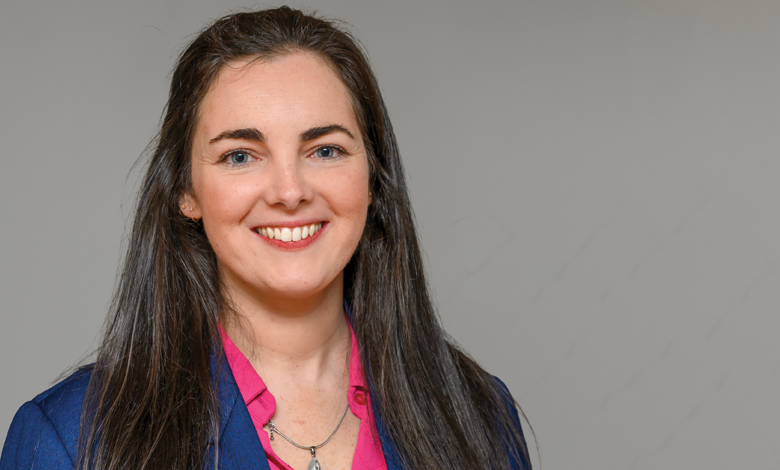
Hazel Murray, chair of cybersecurity at Munster Technological University, discusses quantum computing’s potential impact on security in the future, and what is being done to prepare for it.
Hazel Murray outlines the narrative surrounding quantum computing. She states that there are numerous published articles which claim that quantum computers “are going to break cryptography” with implications for online communications, banking, and shopping.
Murray explains that information on regular computers and laptops utilise “classic” bits which are stored in zeros and ones. Classic bits can only be on or off. However, quantum bits, stored in an atom, can also be “somewhere in between” zero and one.
“For example, it could have a 30 per cent chance of being zero and a 70 per cent chance of being one,” says Murray.
The cybersecurity chair says this is an “exciting way of presenting information”. She elaborates: “We no longer have the binary of definitely on or off, we have this probabilistic data.
“Because quantum computing builds in this probability, it makes possible computing we did not think was possible before.”
Murray explains that if someone observes what the value of a quantum bit is, it collapses. She says: “If you try to ‘observe it’, it has to choose whether it is zero or one because, in our physical world, it cannot just be floating in between.”
The cybersecurity expert says this has potential benefits for communications. At present, if somebody eavesdrops on a message sent over a fibre optic cable it is impossible to detect.
However, if a message is transmitted using quantum information and someone eavesdrops, the whole message collapses. Murray says the sector is taking fundamental physics guarantees such as this and turning them into security guarantees.
Horse and cart
Murray asserts that there is a misunderstanding regarding quantum. She demonstrates the progress people believe would be achieved with the advent of the quantum computer by comparing it to developments in transport methods. If classic computers are viewed as a horse and cart, in this interpretation, quantum computers would be viewed as a car.
However, Murray dispels this way of thinking: “It is actually a completely different way of travelling. If before we were able to travel on a road, suddenly we have figured out that we may be able to go in water too.
“There are certain problems it will solve really well, but it will not replace classical computers.”
Quantum computing could have significant impacts on areas including AI, financial modelling, and drug and chemical research. Much of this arises from its ability to represent probabilistic data.
She outlines identified benefits of quantum computing including the ability to represent probabilistic data, solve optimisation problems, secure communications, and solve difficult mathematics problems.
“Because quantum computing builds in this probability, it makes possible computing we did not think was possible before.”
Breaking cryptography
However, Murray says experts are “worried” about quantum computing’s potential to solve difficult mathematical problems as “that is what our modern cryptography is based on”.
“In normal cryptography, I want to keep something secret. I have a function that is easy for me to compute as I have the secret information to do the calculation, but it is hard for someone who does not have the secret information.”
She explains this using a simple mathematical formula. If someone is provided with a calculation in the form X * Y = Z where X and Y are known but Z is not, it is easy to find Z. However, if Z is known but X and Y are not, then it is very difficult to figure out what X and Y are. This is the premise of cryptography.
There are two types of cryptography, one of which included encrypted files and passwords. Murray asserts that quantum computing “will not really make a huge difference” to this type of cryptography.
While a quantum computer will somewhat speed up guessing passwords and finding secret keys for encrypted files, Murray adds: “All we need to do is double the size of the security and we are secure against that one.”
The type of cryptography experts are worried about is asymmetric cryptography which pertains to communications, authentication, and digital signatures. Demonstrating the potential scale of the problem, she says it would take around eight billion years to crack the 2048 bit RSA key using current methods. She adds: “A quantum computer could do it in eight hours.”
However, Murray illustrates that this is not an immediate problem: “Coming back to our analogy of the horse and cart versus the boat, the point we are at is that we have figured out we can travel on water, but have not built the cruise liners. We just know it is theoretically possible.”
However, there is one immediate concern related to quantum computing. She states that malicious actors may be storing information now which they know can be used when it is possible to encrypt with a quantum computer.
Solutions
Concluding by outlining solutions to this problem, she says guarantees of fundamental physics properties can be leveraged to build more secure algorithms. An example of this is quantum key distribution which uses quantum properties to provide eavesdropping security for distributing secret keys.
She asserts that Ireland “has invested in huge quantum key distribution networks”. Murray adds that some countries are already using it to secure electronic voting and banking systems.
The second solution is improving classic algorithms. She states that these are no longer based on mathematically difficult problems which are vulnerable. Murray concludes: “They are instead based on new guarantees we have come up with specifically to be secure against quantum computers.
“There is a rollout plan for those new algorithms that involves each company considering what cryptography they are using that is vulnerable and working to replace them with these new algorithms.”