The enlargement agenda
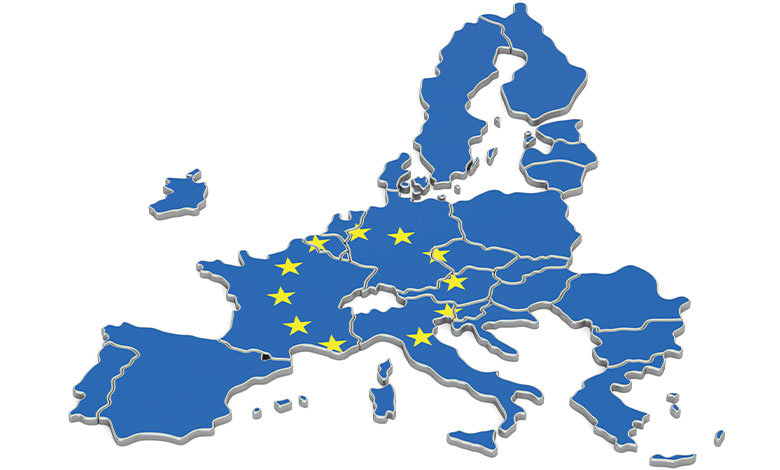
Among the most significant issues facing Ireland during its EU Presidency is the Union’s enlargement agenda. eolas Magazine examines the potential for further enlargement of the EU.
Writing in eolas Magazine ahead of Ireland’s presidency in June 2026, Minister for Foreign Affairs and Trade Helen McEntee TD said: “We will continue to support progress on EU enlargement, helping countries such as Ukraine, Moldova, and partners in the Western Balkans advance on their European path where they meet the necessary conditions.”
To join the European Union, a country submits an application to the Council of the EU. The European Commission then assesses the application and, following a positive opinion, the Council may grant candidate status. Once the necessary conditions have been met, the Council must unanimously agree to open accession negotiations.
The candidate must then align its laws and institutions with EU rules across 35 negotiating chapters, covering areas ranging from the rule of law and the environment to competition policy and agriculture. Once negotiations have been completed, the European Commission issues a final assessment and the European Parliament must give its consent. The accession treaty must then be approved unanimously by the Council and ratified by every existing member state and the candidate country.
The Copenhagen criteria require prospective members to have stable institutions guaranteeing democracy, the rule of law, human rights, and minority protection; a functioning market economy; and the ability to adopt and effectively implement EU law and the obligations of membership.
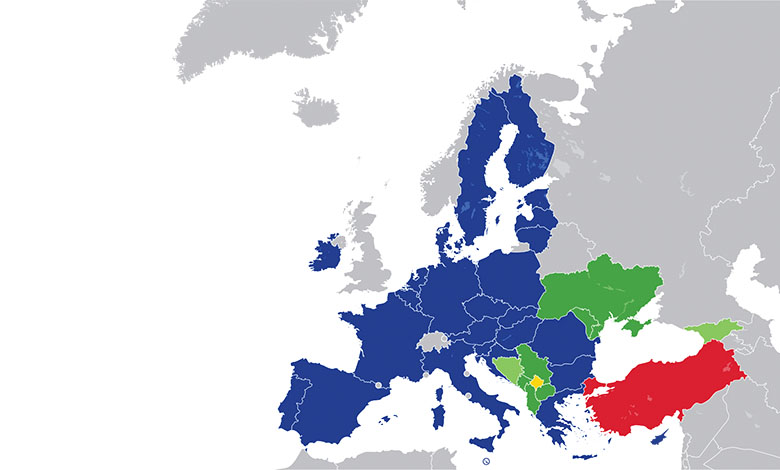
There are currently 22 independent states in Europe which are not members of the European Union, accounting for around 45 per cent of Europe’s sovereign states.
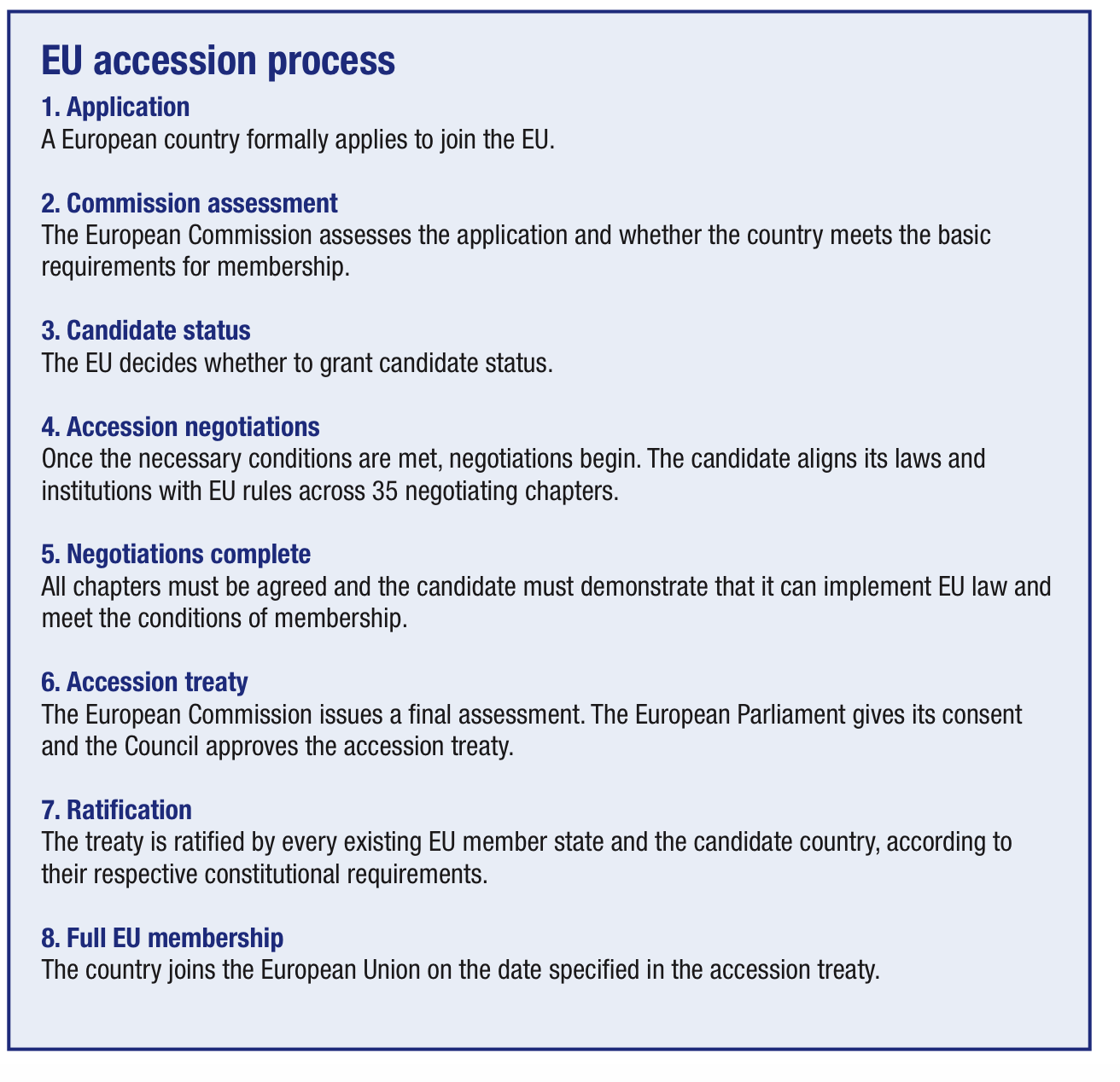
Ten non-EU European states have submitted membership applications and remain within the EU’s enlargement framework. The enlargement agenda can broadly be divided into three groups:
- Western Balkans: Albania, Bosnia and Herzegovina, Kosovo, Montenegro, North Macedonia, and Serbia.
- Associated Trio: Georgia, Moldova, and Ukraine.
- Turkey.
Western Balkan states
Membership of the Western Balkan states has been on the EU’s agenda since the 2003 European Council summit in Thessaloniki, Greece, which committed to the region’s eventual integration into the Union. All these states apart from Albania are former Yugoslav republics. Slovenia and Croatia subsequently joined the EU in 2004 and 2013 respectively.
Albania, Bosnia and Herzegovina, Montenegro, North Macedonia, and Serbia have all been granted EU candidate status. Montenegro and Serbia opened accession negotiations in 2012 and 2014 respectively, while Albania and North Macedonia opened negotiations in 2022. Bosnia and Herzegovina formally opened negotiations in March 2024, although its accession process remains at an earlier stage.
The EU has identified 2030 as a possible target for further enlargement, although this is a political ambition rather than a guaranteed accession date. The pace of each country’s progress remains dependent on meeting the accession criteria and completing negotiations.
Kosovo applied for EU membership on 14 December 2022 and is considered a potential candidate. Its path is complicated by its disputed status, as Kosovo is not recognised as an independent state by five EU member states (Cyprus, Greece, Romania, Slovakia, and Spain) while Serbia continues to claim sovereignty over the territory. Kosovo has therefore not received candidate status and has not begun accession negotiations.
Accession trio
Three states currently under partial military occupation by Russia – Ukraine, Georgia, and Moldova – have applied to join the EU.
By January 2021, Georgia and Ukraine were preparing to formally apply for EU membership in 2024. However, following Russia’s full-scale invasion of Ukraine, Ukraine submitted its application for EU membership on 28 February 2022, followed by Georgia and Moldova on 3 March 2022.
On 23 June 2022, the European Council granted candidate status to Moldova and Ukraine, while recognising Georgia as a potential candidate. Georgia was subsequently granted candidate status in December 2023. For Ukraine and Moldova, the European Council made the opening of accession negotiations conditional on addressing a series of reforms concerning the rule of law, corruption, democratic institutions, and governance.
Ukraine and Moldova formally opened accession negotiations in June 2024 and have since begun the process of screening and negotiating the EU acquis. Neither has yet provisionally closed a negotiating chapter.
Georgia’s trajectory has been considerably less straightforward. Following the October 2024 parliamentary election, the EU raised serious concerns about democratic backsliding and restrictions on civil society and political rights. In November 2024, the Georgian government announced that it would suspend efforts to open accession negotiations until 2028. The EU has subsequently described Georgia’s accession process as “de facto halted”, although the country remains an EU candidate.
Turkey
Turkey has been an EU candidate country since 1999, with formal accession negotiations beginning in 2005. Its accession process has subsequently become effectively frozen amid sustained concerns over democracy, the rule of law, human rights, and the independence of the judiciary.
The failed coup attempt of July 2016 and the Turkish Government’s response marked a significant deterioration in EU-Turkish relations.
Before the process stalled, Turkey had opened 16 of the 35 negotiating chapters, with only one provisionally closed. The last chapter was opened in 2016.
States not on the agenda
The most notable European states outside the current enlargement process are the UK and Russia. Other European countries outside the process include Norway, Switzerland, and Iceland, while Armenia and Belarus have pursued closer integration with Russia rather than EU membership. San Marino and other European microstates also have no current accession process.
Russia’s relationship with the west was considerably less distant during the early years of Vladimir Putin’s presidency. Putin raised the possibility of eventual Russian membership of NATO, telling BBC interviewer David Frost in 2000 that he would not rule it out. The following year, he said Russia could envisage joining the alliance if it were treated as an equal partner.
The possibility of Russian EU membership was also openly discussed, although it was not Putin’s stated policy objective. In April 2002, then-Italian Prime Minister Silvio Berlusconi said the EU should open itself to Russia and include it in its enlargement. Berlusconi subsequently described Russian EU membership as a possible next step in Russia’s integration with the west. Putin instead favoured much closer integration without formal membership, including the development of “common spaces” between Russia and the EU covering economic affairs, security, foreign policy, and research and education.
Today, Russian EU membership is not a realistic prospect. Beyond the geopolitical consequences of Russia’s imperialism in Ukraine and its conflicts with neighbouring states, EU membership requires stable democratic institutions, the rule of law, human rights protections, a functioning market economy, and the ability to implement EU law.
Article 237 of the 1957 Treaty establishing the European Economic Community provided that “any European state” could apply for membership. When Morocco applied to join the European Communities in 1987, the Council rejected the application on the grounds that Morocco was not a European state.
The provision was subsequently incorporated into the Treaty on European Union (TEU) and is now found in Article 49 TEU, which states that any European state that respects and promotes the EU’s fundamental values may apply for membership. The treaty does not, however, define precisely what constitutes a “European state”.
This leaves a number of geographically ambiguous cases as Azerbaijan and Kazakhstan have territory on or close to the conventional geographical boundaries of Europe, but neither has a meaningful prospect of EU membership. Turkey demonstrates that “European state” is not interpreted purely by geography: despite most of its territory being in Asia, its eligibility for membership has long been accepted by the EU.
Outside Europe, there have occasionally been proposals or speculation about membership for countries including Israel and Cape Verde, based partly on their historical and apparent cultural links with Europe.
More recently, a small but vocal movement has emerged in Canada advocating closer integration with Europe, including the idea of EU membership. The debate has gained visibility amid Canada’s efforts to reduce its economic and strategic dependence on the United States since Mark Carney became Prime Minister. Such proposals remain entirely outside the EU’s enlargement agenda, however.
Under the existing treaties, non-European states cannot simply join the Union without a change to the EU’s legal framework. The current enlargement process therefore remains concentrated on European states that have formally applied or are recognised as candidates or potential candidates.
EU law provides precedents for territorial changes involving existing member states, most notably German reunification in 1990. Three potential cases are particularly relevant: Irish reunification, Romanian-Moldovan unification, and the reunification of Cyprus.
In the case of Ireland, the 2017 ‘Kenny text’ agreed by the European Council recognises that, following a united Ireland achieved through the mechanism provided for in the Good Friday Agreement, the entire country would become part of the EU. This is based on the precedent of German reunification, rather than requiring the North to undergo the standard accession process.
A Romanian-Moldovan union would present a different scenario. Moldova was part of Romania until 1940, when the Soviet Union occupied and annexed Bessarabia, much of present-day Moldova, incorporating it as the Moldavian Soviet Socialist Republic. Moldova is now an EU candidate country and is progressing through the accession process, meaning that any unification would raise questions about how its accession process interacted with Romania’s existing membership.
Cyprus presents the most complex case. Cyprus joined the EU in 2004 despite the island remaining de facto divided between the Republic of Cyprus and the Turkish Republic of Northern Cyprus since the island was invaded by Turkey in 1974. The UN-backed Annan Plan, which proposed a reunification of the island as a bi-zonal, bi-communal federation, was approved by 65 per cent of Turkish Cypriot voters but rejected by 76 per cent of Greek Cypriot voters, in simultaneous referendums on 24 April 2004.
As a result, the whole island is legally EU territory, but EU law is suspended in the north, where the Republic of Cyprus does not exercise effective control. The EU supports reunification and has sought to reduce the isolation of the Turkish Cypriot community, including through financial assistance and measures to prepare for the eventual application of EU law across the island. Turkish Cypriots remain EU citizens through their citizenship of the Republic of Cyprus.