Commissioner Jessika Roswall: Protecting the European environment
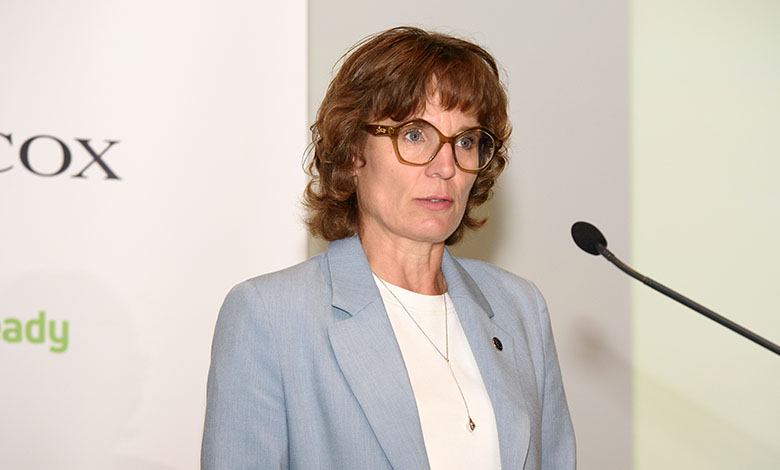
Jessika Roswall, European Commissioner for Environment, Water Resilience and a Competitive Circular Economy, outlines how member states must invest in nature, maximise limited resources, and adapt to increasing extreme events to address climate change.
Commissioner Roswall sets the scale of the challenge climate change poses to society and the economy: “We are at the end of a scorching summer. Tens of thousands of people died during five brutal heat waves.
“Devastating wildfires raged as far north as Finland and as far south as Crete. And much of Europe is gripped by intense drought. The Rhine and the Danube, two of the great arteries of the global economy, were so low that navigation was almost impossible in places.”
Noting that nature is vital for food, water, energy, health, and economic security, Roswall states that its destruction has become a security issue. She says the cost of the devastation seen during summer 2026 “will run into the tens of billions”, adding that “it will continue to grow”.
Investing in nature
Despite the significant challenge, Roswall states that solutions begin with increasing investment in landscapes, nature, and water.
The Commissioner says EU member states are currently preparing draft plans to restore degraded ecosystems under the Nature Restoration Regulation. Roswall notes that the State submitted its draft Nature Restoration Plan in September 2026.
These plans are intended to “increase biodiversity, boost Europe’s resilience, and prevent natural disasters”. Roswall asserts that the Commission is supporting these goals through investment.
She says: “We have mobilised €3 billion from the current EU regional policy for water to be used by next year. The European Investment Bank has committed another €15 billion for water resilience between 2025 and 2027 and we have proposed that 35 per cent of the next EU budget should be spent on climate and the environment.”
Saying member states must look beyond traditional public funding to address climate challenges, she encourages them to build private funding into nature restoration plans.
Maximising resources
Secondly, Roswall identifies a need to “maximise limited resources in a world of competing priorities”. In line with this, the Commission is encouraging member states to take restoration measures that contribute to other objectives such as climate adaptation and security.
Roswall says it is critical that EU environmental legislation is implemented. She adds that lengthy and complex planning and permitting processes “are one of the biggest cost factors in large-scale nature restoration projects”. Roswall states that the Commission needs to “make it easier to make a difference”.
She continues: “Let me also be very clear about what all this means. We are not retreating from our environmental objectives. Instead, we want to make our legislation work better in practice. Simplification, done right, is not the enemy of ambition. It is what brings ambition to life. “
Adapting
The Commissioner indicates that member states must prepare for increasing climate change and the clean transition as cities grow, rural populations shrink, and geopolitical challenges abound. She also states that this must be done in a landscape where water is scarce, and societies are being reshaped by data and artificial intelligence.
She says: “Protecting nature in today’s world cannot be about statically preserving existing ecosystems. It must be about ensuring that ecosystems are healthy and resilient, and adapt to change.
“After this summer, it is clear that we need forests that are resilient to drought and wildfires, and we need better forest and land management to limit the build-up of vegetation and lower fire risk.”
Roswall identifies the need to keep water “front and centre in our policies and our planning”. She states that she will discuss drought management plans with member states. The Commission will also continue with the rollout of the Water Resilience Strategy and is to present a new plan for climate resilience and risk management later in 2026.
Roswall adds that the Commission is currently assessing how it can more easily adapt the protection status of specific species to changes in their conservation status under the stress test of the nature directives.
Cooperation
The Commissioner states that the stress test enables member states to examine climate change together. To improve intelligence and analysis, she says better science, and the strategic use of AI and digital tools are needed. She adds: “I see a clear case for European coordination on these matters, and I see a clear case for global cooperation.
“Irish people have always had a powerful connection to the land. I have a vision where that connection becomes even more concrete. Where Ireland and Europe become global leaders in nature protection and environmental resilience, and where caring for ecosystems becomes second nature.”
Concluding, Roswall says: “We need to demonstrate that environmental responsibility does not stunt economic development; it supercharges it.
“Let us strengthen where necessary and simplify where possible. Let us listen more carefully to those most directly affected. Let us invest more ambitiously and cooperate more widely.
“Let us ensure that European citizens inherit a future where nature thrives alongside people, a Europe that is prosperous because it is resilient, and a Europe that is united because it protects what its citizens value the most.”