Seán Kelly MEP: ‘A new world order is emerging’
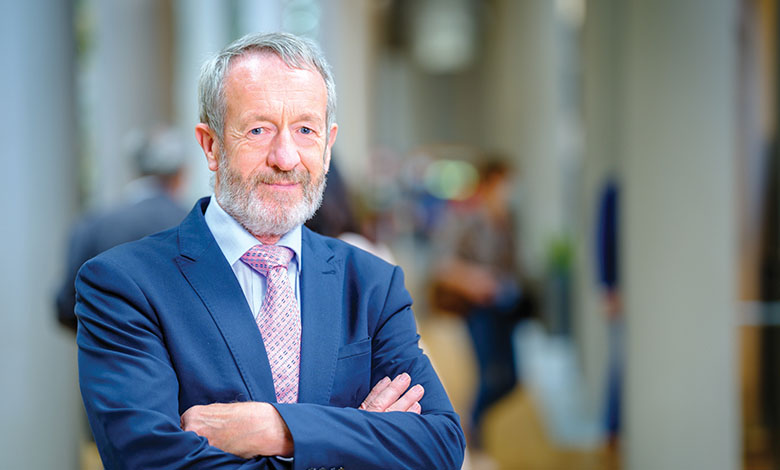
Seán Kelly, MEP for Ireland South and leader of Fine Gael in the European Parliament, discusses how Canada’s proposed associate membership of the EU signals a “new world order” and what the State could do to adapt to this new context.
European Commission President Ursula von der Leyen used her annual State of the European Union address to make Canada an offer no non-member state has ever received: associate membership of the EU, a theoretical deepest tier of partnership short of joining outright.
The Prime Minister of Canada, Mark Carney, later addressed the European Parliament and accepted the offer, highlighting its potential and importance.
It is exactly the “banding together” Carney called for eight months ago in Davos when he set out his blueprint for how ‘middle powers’ can survive in a world run by superpowers: stop denying what is happening, build new relationships, and band together.
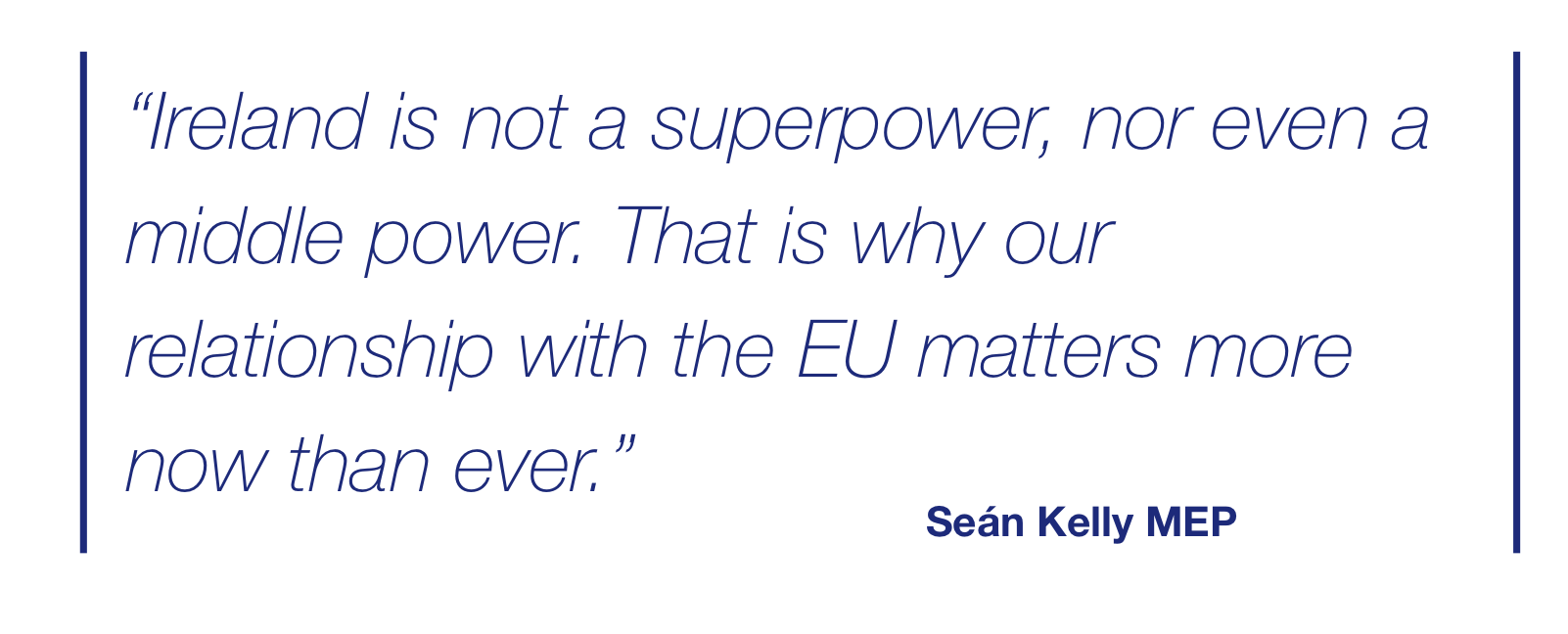
Ireland is not a superpower, nor even a middle power. That is why our relationship with the EU matters more than ever, and why a more resilient, stronger EU with strengthened ties to capable and like-minded partners is our best chance to prosper and stay secure in an ever-worsening threat landscape.
For decades, Ireland has enjoyed and benefited greatly from its place in the world as a small, open economy with an FDI-led growth model. Our historical links with the United States combined with our EU membership enabled us to establish ourselves as an important gateway to the European market for the United States, its businesses, and investors.
The success of this model speaks for itself, providing a quarter of a million jobs today and contributing an enormous boost to the exchequer, especially in recent years.
However, there are trade-offs in any economic strategy. Today, as we increasingly see moves away from the liberal, rules-based free trading order of the past 30 or 40 years, there is no doubt that Ireland is left particularly exposed to shocks from tariffs and protectionism.
Similarly, the global security and defence landscape is evolving before our eyes. For years we could get by with minimal defence spending, feeling safe in the assumption that the Americans or the British would come to our aid militarily should the unthinkable ever come to pass.
Increasingly, however, American leadership looks unwilling, and British military capability has been subject to its own domestic scrutiny in recent times.
Building relationships
This all begs the question: what can we do, as a small, defenceless island, if actually threatened; whether that be economically, militarily, or otherwise?
There are populist voices who would have us withdraw altogether from international trade and EU co-operation. Similarly, Sinn Féin’s poor voting record in the European Parliament on things like solidarity with Ukraine and its vocal opposition to all major trade deals suggest it is firmly in the same camp. The party will also happily give the UN Security Council – which counts Russia, China, and the United States as permanent members – a veto over the deployment of Irish troops.
The so-called ‘pulling up the drawbridge’ approach, as Carney puts it, whereby we become increasingly inward-looking, would strangle our economy over time and deprive us of the resources we need to survive.
Instead, we must adopt Prime Minister Carney’s blueprint going forward. Face the new reality, build new relationships, and band together with our like-minded partners.
First, we must call a spade a spade by acknowledging that there are bad actors on the UN Security Council and remove the ‘triple lock’ to regain control of our foreign policy. We must recognise that we face real dangers through weaponised economic dependence and cyber and kinetic threats.
This is not abstract. Russia is scaling up its hybrid war across Europe through cyberattacks, drone incursions, and interference with subsea cables. The Russian vessel Yantar – officially an “oceanographic research” ship but widely assessed by Western intelligence to be a spy vessel – has spent considerable time lurking above cables in the Irish Sea.
Meanwhile, we have major economic dependencies, particularly on things like critical raw materials from China, which has the willingness to exploit its control to pursue its broader geopolitical goals. Our reliance on external actors for everything from critical raw materials to technology to energy weakens our ability to assert our own sovereignty and strategic autonomy.
Building new relationships means diversifying Irish trade. This does not mean a rapid decoupling from the United States but instead hedging to avoid overreliance on any single trading partner. Banding together means deeper EU integration: the single market, enlargement, defence, and working together to reduce all of our strategic dependencies.
Looking forward
There is cause for optimism. We have already made progress, with the EU having recently concluded trade deals with India, Singapore, Indonesia, the UK, and Australia. As we develop what Canada’s associate member status means in practice, we should seek to extend it to Australia, New Zealand, and, in time, the UK. This will help us strengthen supply chains and adopt a common approach in areas such as critical raw materials, defence production, and AI.
All this better enables the EU, and Ireland within it, to stand up for itself in trade and diplomatic confrontations.
The EU is fundamentally a peace project and has stood up for liberal democracy for decades, most notably now as Ukraine continues to fight against Russia’s illegal war of aggression. In a world of increasingly malignant forces, if Ireland is to remain true to defending these values, we must redouble our commitment to the EU.
No one in Brussels or elsewhere is forcing us to abandon our neutrality, but as long as we continue to allow ourselves, through the triple lock and our strategic dependencies, to be dictated to by foreign powers, we cannot be truly independent or autonomous.
Ireland is best served in a stronger EU, where we have come together with the likes of Canada to assert our ability to protect ourselves, our values, and our prosperity.
This new world order is dangerous, but there is no point denying it is here.
President von der Leyen has set out where the Commission wants to take the Union. Prime Minister Carney has shown how far a friendly outside power will go to stand alongside it.
The question for Ireland is whether we see ourselves as an active partner in this stronger, more sovereign, and more prosperous coalition, or a reluctant quasi-member, content with ever-weakening sovereignty. Our answer must be to choose the former, and to chart our own fate.