Budget 2027: Record spending, little ambition

Presented to the Dáil on 6 October 2026, Budget 2027 comes as the global economy experiences a sustained period of rising costs and high energy prices, driven by the US-Israel war in Iran.
Describing his first budget as Minister for Finance, Simon Harris TD said: “No one budget can achieve all the things that a government wants, but it can set us on a path, a trajectory, a way forward. The path we are setting out here today is an optimistic one for Ireland.”
Fiscal outlook
Budget 2027 provides a record package of €8.65 billion, comprising €7 billion in additional public spending and €1.65 billion in income tax changes. Total state expenditure for 2027 is set to reach €125.6 billion, up €7.1 billion on 2025.
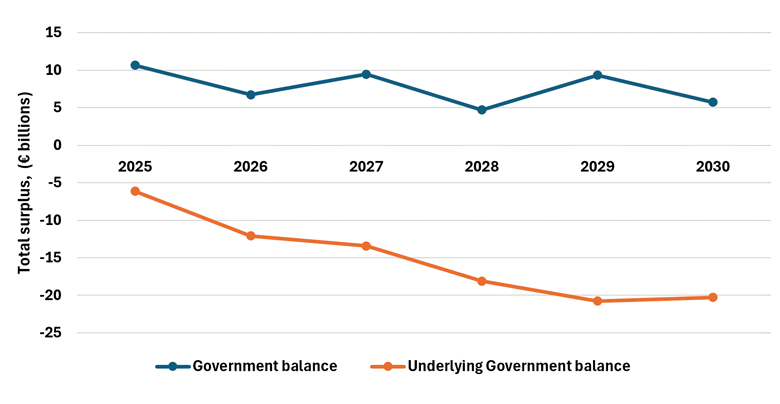
Despite the record spending, the general government surplus is forecast to be €9.5 billion in 2027.
Although this is a strong monetary position, the Irish Fiscal Advisory Council (IFAC) says Budget 2027 puts public finances on a “worse trajectory” by “repeatedly breaking established spending limits”.
A sustainable limit of 5 per cent for spending increases net of tax measures, was set in 2021. However, governments have since budgeted for increases of 6 per cent before delivering an average of 10 per cent.
IFAC calculates that if overruns continue at their current pace, expenditure could increase by almost 9 per cent in 2026.
Ireland’s reliance on corporation tax receipts to fuel its surplus is another cause for concern. The Department of Finance reports that almost half of corporation tax paid in 2025 came from just three multinationals, widely believed to be Apple, Microsoft, and Eli Lily.
“No one budget can achieve all the things that a government wants, but it can set us on a path, a trajectory, a way forward.”
Simon Harris TD, Minister for Finance
The Department estimates that potentially transitory corporation tax receipts, money which is taxed in Ireland related to activity abroad, will account for €22.9 billion of corporation tax in 2027. Excluding these receipts, the €9.5 billion headline surplus becomes an underlying deficit of €13.4 billion.
Additionally, IFAC report that approximately six in every seven euros raised through corporation tax is being spent, largely on current expenditure measures.
Although the Government is allocating €7.8 billion to long-term investment funds, IFAC argues that more of these receipts should be saved to meet future pressures and help the State weather the next recession.
Tax
Budget 2027 contains several changes to the tax system, with a focus on income tax.
The threshold for entering the higher 40 per cent rate will rise by €2,500 to €46,500 while the personal tax credit, employee tax credit, and earned income tax credit will all increase by €125.
These changes to income tax are the Budget’s most expensive measure, costing €1.48 billion to 2027.
Additionally, Budget 2027 increases the upper threshold of the 2 per cent Universal Social Charge (USC) by €1,600, rising to €30,300.
The benefits of these changes will mostly be felt by medium- and high-income earners, having little impact on lower earners.
An individual earning €46,500 or more annually will save €766 in 2027, a €15 a week saving, while an individual on €40,000 will save €266 a year, €5 a week
The increase in pay-related social insurance (PSRI) contributors’ rate by 0.15 per cent in October 2026 reduces these gains, leaving a person earning €40,000 only €206 better off in 2027, equivalent to €4 a week.
Sinn Féin finance spokesperson, Pearse Doherty TD, has called the changes an “insult” to the over 1.5 million workers who will receive less than €250 in tax reductions.
“Time and time again, this government leaves ordinary Irish people behind, those who keep Ireland moving, those who work hard, and who are trying to build a life.”
With the Consumer Price Index rising by 4.1 per cent between September 2025 and September 2026, weekly savings of between €4 and €15 will provide little relief to those who are struggling.
The Budget’s second most expensive tax measure is the reduction in the standard capital gains tax rate from 33 per cent to 31 per cent, costing €186 million to 2027.
Minister Harris says this change will “reward risk and facilitate the scaling-up of home-grown Irish firms”.
Again, however, the benefits of this measure are likely to be concentrated on the wealthiest Irish citizens.
Central Bank of Ireland data for Q1 2026 found that financial assets accounted for 21.3 per cent of the total assets of households in the wealthiest decile, compared to 4 per cent among those in the bottom five deciles.
Energy
The Government has introduced measures to ease fuel and energy costs, but this has come at the expense of its climate ambitions.
Temporary excise duty cuts on petrol and diesel, introduced in March 2026 in response to rising prices arising from the US-lsrael war in Iran, will remain in place until February 2027 rather than being removed in November 2026 as planned.
Annual projected government balance, with and without potentially transitory corporation tax, 2025-2030
From March 2027, the approximately 27 cent and 32 cent per litre reductions in petrol and diesel respectively will be gradually phased out to June 2027. The extension of these cuts will cost of €450 million.
The scheduled October 2026 increase in carbon tax on petrol and diesel has also been postponed, staying at €71 per tonne of CO2 rather than the planned €78.50. Increases are scheduled for May and October 2027 to maintain the trajectory towards €100 per tonne by 2030.
More significantly, the carbon tax on kerosene and natural gas has been cut from €63.50 to €48.50 per tonne of CO2, reversing a planned increase to €78.50 by May 2027. The Government has also committed to freezing this rate until 2029.
The tax would have gradually risen to encourage the use of alternative fuels and to fund investment in climate projects, such as retrofitting and transition supports.
While this reversal offers some relief to people reliant on home heating oil and gas, it weakens the incentive to move away from fossil fuels and raises questions about the Government’s commitment to decarbonisation.
The changes to the carbon tax will cost €25 million in 2026 and €177 million annually thereafter, totalling €556 million by 2029. The Government has not announced how it plans to recoup this loss, a concerning decision given the need to transition.
Seemingly validating this concern, the Sustainable Energy Authority of Ireland’s (SEAI) allocation for retrofitting is increasing by just €15 million (2 per cent) to €654.5 million in 2027, of which €647 million (97 per cent) comes from carbon tax receipts.
The Parliamentary Budget Office (PBO) has criticised the Budget’s broad-based energy supports, stating they “tend to be more costly to public finances than is strictly necessary”.
“Time and time again, this government leaves ordinary Irish people behind, those who keep Ireland moving, those who work hard, and who are trying to build a life.”
Pearse Doherty TD, Sinn Féin finance spokesperson
The ESRI has also been critical of the kerosene and gas carbon tax changes as it “reduces the incentive for households who can afford to decarbonise to do so”, adding that “targeted measures to support low-income households would maintain the incentive while protecting the most vulnerable groups”.
Budget 2027 does contain some targeted energy supports. The Fuel Allowance payment, which was used by around 465,000 people in 2025, is rising by €5 to €43 a week and the income threshold for the payment for single pensioners will increase from €534 to €641 a week.
However, these are the Budget’s only targeted energy supports, despite calls from Labour and Sinn Féin for targeted energy credits of €400.
Housing
Despite the ongoing housing crisis, the Government is offering few groundbreaking measures to address its scale. Budget 2027 allocates €9.1 billion to housing, a slight increase on the over €9 billion assigned in 2025.
This includes €3 billion for the delivery of 11,250 new social homes, slightly more ambitious than the €2.9 billion allocated for 10,200 homes in 2025. However, this target remains below the annual average required to deliver the Government’s target of 72,000 by 2030.
A further €1 billion will support 15,000 new starter home supports in 2027 through the First Home, Affordable Purchase, Cost Rental, and Help to Buy schemes. Although this allocation is €200 million lower than 2025, the target for affordable purchase and cost rental homes has doubled from 7,500.
The maximum Help to Buy relief for first-time buyers is also increasing by €5,000 to €35,000. Between July 2020 and July 2026, this scheme has approved 48,878 claims.
Social Democrats housing spokesperson Rory Hearne TD criticised this decision, saying it “will only drive up house prices even further”, adding that it may help eligible buyers assemble a deposit, but does little to address the underlying shortage of homes.
Hearne was also critical of the decision to increase the Rent Tax credit by €150 to €1,150 for individuals and by €300 to €2,300 for couples saying this “meagre” increase “will not help renters”, and that it “will be more than gobbled up by rent increases next year”.
He notes that the national average rent for new tenancies increased by 9.1 per cent year on year to Q2 2026, sitting at €1,839 per month in September 2026, according to the Residential Tenancies Board.
The Government has allocated €563 million to homeless services, an increase of €30 million from 2025.
Labour housing spokesperson Conor Sheehan TD describes this as a “real terms” cut, saying: “Government have effectively cut essential support while introducing measures that will drive up prices and rents.”
The Government’s most recent figures for August 2026 recorded 17,855 people as homeless, including 5,830 children. Since the previous budget in October 2025, the number of people in temporary accommodation has increased by around 1,100, a figure which includes around 500 children.
Infrastructure
Infrastructure investment is one of the stronger elements of Budget 2027, with significant funding allocated for water and transport.
Uisce Éireann will receive €1.468 billion in capital funding, a slight increase from the 2025 allocation of €1.4 billion.
These funds are allocated for investment in water infrastructure, particularly in treatment plants, and for supporting the Accelerated Growth Programme to deliver infrastructure needed for housing development in priority settlements.
More than 400 water projects are expected to progress in 2027, including the Greater Dublin Drainage Scheme and upgrades to treatment plants in Limerick and Waterford.
The Department of Transport will receive €4.175 billion in capital funding, a 21 per cent increase from 2025.
The funds will support the delivery of public transport services projects including DART+ expansion, commuter rail in Cork, and MetroLink as well as major road projects across the State.
In addition, a further €6 billion is allocated to MetroLink between 2027 and 2030, which is approaching the construction phase, following recent approval to proceed to market tender.
Welfare
Budget 2027 contains several targeted welfare measures to support those who are most struggling with the cost of living.
Weekly social welfare payments are increasing by €10, benefitting 1.6 million people, including pensioners, jobseekers, and people with disabilities. Additionally, the Living Alone Allowance will increase by €3 per week, benefiting approximately 260,000 people.
The 238,000 people who receive long-term disability payments will receive a €500 payment, which will be followed by the development of a permanent payment from 2028.
Families will also benefit from a €6 weekly increase in child support payments, while the income threshold for the Working Family Payment is increasing by €30 per week, helping almost 60,000 families.
The ESRI finds that Budget 2027 will deliver small income gains overall compared to a budget where tax and welfare measures kept pace with inflation but makes no difference compared with one linked to wage growth.
It reports that the lowest-income households will gain more compared to higher income households but the €500 a year disability payment plays a large role in that, so will not be applicable to most.
Despite the increases in the welfare measures for families, the ESRI finds that the Budget will “hold child poverty relatively constant” and that significantly more measures directed at children are necessary to achieve the Government’s target of 3 per cent or below for child consistent poverty.
Ultimately, these measures’ lack of impact on the lives of those who most need support is a microcosm for the entire budget.
While measures to help with cost-of-living pressures have been introduced, the Government’s lack of ambition, the untargeted nature of energy supports, and the nature of the tax changes mean that Budget 2027 is unlikely to provide much relief to people struggling across the State.