
Ireland’s next test is delivery, not ambition

Conor O’Dwyer, Government and Public Sector Partner, EY Ireland discusses how Ireland’s digital government agenda has entered an exciting new phase.
The ambition has been set out clearly. Focus must now shift to delivery, to make digital government real for people. The challenge now is to ensure government is joined up, trusted and designed around how people live, not how the State is organised. The same is true of AI; it can transform operations and user-facing interactions, but will only create public value where applied with discipline, grounded in measurable objectives, and anchored in users and trust.
The Government’s new National Digital and AI Strategy 2030 sets out a clear ambition: 100 per cent of key public services digitalised by 2030, with 90 per cent of applicable services consumed online. The roadmap incorporates Life Events, digital public infrastructure, a new public service data strategy, and responsible AI. The Digital Public Services Plan 2030 is important because it describes the plan not as a technology roadmap, but as a public service reform roadmap, with services organised around lived experiences.
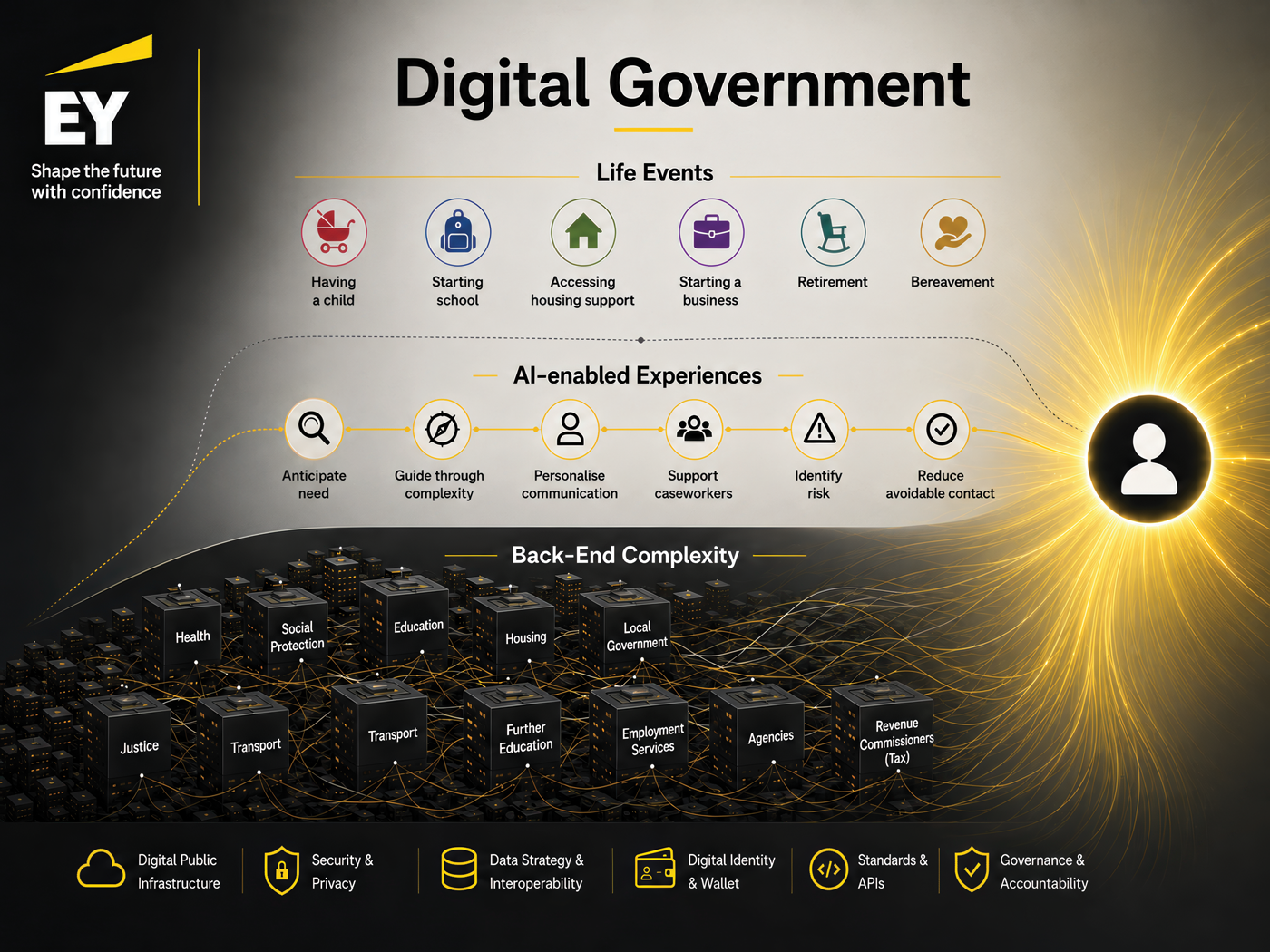
That ambition is easy to support but challenging to implement. Public servants work hard every day to support people through complex services built over decades. What is less obvious is that an individual experiencing a life event, such as having a child, accessing housing support, retiring, starting a business or dealing with bereavement, may only experience it once or twice. They do not arrive with a map of government; they arrive with a need, a question, a deadline, or sometimes a worry. A public sector composed of separate departments and agencies can feel daunting. To simplify that journey, the State must behave as one coherent system.
As my colleague Colin McGovern, EY Government Experience Lead, observes: “A citizen-centred, Life Events approach forces a simple but uncomfortable question: who owns the citizen journey when it crosses organisational boundaries?”
Delivering a seamless citizen experience requires a multi-layered technology solution, but the solution will not come from technology alone. It requires choices about governance, data, service ownership, funding and accountability.
Depth is another consideration. Taking starting school as an illustrative example, parents can be required to navigate varying enrolment policies, catchment rules and transport options. A Life Events approach can make that journey clearer, but a digital layer alone will not address the complexity that sits beneath.
This is where digital reform becomes uncomfortable. A digital service is only valuable if what sits behind it is joined up. Otherwise, the citizen enters a more attractive doorway into the same fragmented system. Too shallow, and Life Events risk becoming presentation-layer integration. Too deep, and they run into complex questions of policy, funding, accountability and the status quo.
AI raises the stakes. Used well, it can help government anticipate need, guide citizens through complex journeys, support caseworkers, identify risk, personalise communications and reduce avoidable contact. Used badly, it can automate confusion, scale inconsistency and erode trust.
Life Events present the opportunity to simplify services, while identifying areas of complexity that require further policy work and transformation. There is also a longevity question. Once a team has implemented an integrated journey, who owns it on day two? Without a named service owner, performance data, change backlog, funding routes and accountability, even well-designed services can drift back towards fragmentation.
Data is the foundation on which both Life Events and AI depend. Joined-up services require an integration layer that can orchestrate events and information across agencies, enabling each to play its part. Public trust will suffer if data sharing feels opaque, unexplained or uncontrolled. The next wave of digital government must treat data integration and transparency as core design features, not afterthoughts.
The Government Digital Wallet is a useful proof point: reusable digital infrastructure that can reduce repetition, support trusted identity and make services feel more integrated.
Based on EY’s experience, delivery depends on practical disciplines as much as ambition: sponsorship, programme management, scope and backlog control, benefits tracking, multidisciplinary teams and governance that resolves issues at pace. In addition to hands-on technology expertise, EY brings the ability to connect strategy, technology, service design and change around measurable outcomes.
International experience is instructive. The EU direction of travel is towards interoperability, once-only data sharing and digital identity. The UK’s Government Digital Service showed the value of standards and common platforms, but also highlighted persistent barriers: fragmented data, legacy technology, uneven skills and services that remain difficult to join up. Estonia points to another frontier: proactive government, where services can be triggered by Life Events rather than initiated by the citizen.
For Ireland, digital maturity will not be measured by online-service volumes, but by whether those services are simple, intuitive, integrated and trusted. AI should be judged the same way: not by the number of pilots launched, but by whether it improves decisions, services and outcomes. The opportunity now is to turn clearly stated ambition into sustained delivery, with the governance, ownership and discipline needed to make digital government more simple, trusted and useful for people.