A dull celebration of 100 years of Fianna Fáil
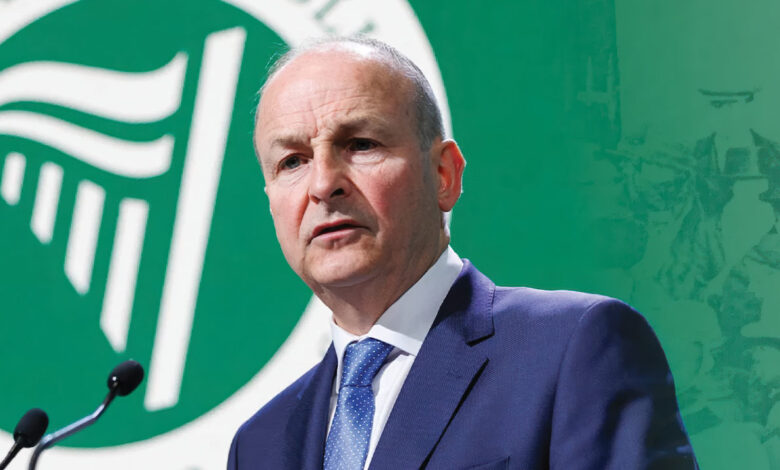
A day of relative jubilation at Fianna Fáil’s centenary ard fheis ended on a dull note when party leader and Taoiseach Micheál Martin TD delivered an underwhelming speech to party members, Joshua Murray writes.
The Fianna Fáil ard fheis, which took place at the Royal Convention Centre in Dublin in May 2026, was preceded by a week in which former party leader and Taoiseach Bertie Ahern was embroiled in a racism scandal.
A recording of Ahern on the doorsteps with a voter during the Dublin Central byelection featured him saying: “The ones I worry about are the Africans. I agree with you on the Africans. We can’t be taking in people from the Congo and all these places. I think there’s too many from those places.”
Ahern subsequently apologised for the remarks and defended his record, telling The Indo Daily podcast he rejects racism in all his forms, and claimed that he had defended “the Muslims” during his 11-year spell as Taoiseach.
Ahern’s absence at the ard fheis was notable, although his successor, Brian Cowen, was present, marking his first appearance at a Fianna Fáil ard fheis since his illness. Cowen was warmly received by delegates when his presence was announced prior to Martin’s speech.
As usual for Fianna Fáil, there was alcohol in vast supply at the convention centre, a notable cultural difference compared to ard fheiseanna and conferences of other parties.
The day was also mired by a small but vocal protest by pro-Palestine protesters which saw a security guard working at the ard fheis covered in paint. It was not clear what group organised the protest, but one protester speaking to eolas Magazine said that the group wished to put pressure on Fianna Fáil to pass the Occupied Territories Bill.
Before Micheál Martin took the stage, Fianna Fáil delegates in the main hall were treated to a trip down memory lane, with a lengthy presentation playing archive footage of key moments in the party’s history, as well as a sing-song to ‘Legion of the Rearguard’ and ‘Arise and Follow Charlie’. Delegates also vocally cheered at the images of Éamon de Valera, Charles Haughey, and Bertie Ahern.
When the Taoiseach took the stage, however, the carnival atmosphere dissipated. Martin is widely viewed as a figure distant from the party’s radical republican roots, but whose relative personal popularity and been helpful in winning power back from its nadir in 2011.
In his speech, Martin set out to take what he described as “a different approach”, stating: “I’m not going to go through a long list of actions from the last year or try to win a few extra headlines with promises for the next Budget. I’m not going to waste time attacking other parties.”
Instead, the Taoiseach sought to set out the main challenges facing Ireland, which he asserted are:
- securing our economic future;
- reducing cost of living pressures on people;
- delivering housing and services which people can access and afford;
- empowering people with the skills and support to thrive in the face of rapid change; and
- building a shared future on this island and standing up for our values abroad.
Martin went through these seriatim in different levels of detail, to sporadic applause but notably no standing ovation at any stage.
He then concluded his speech by saying: “Moving Ireland forward. That is our work. That is our commitment.” This was followed by a bizarre techno remix of an old Fianna Fáil election song and unenthusiastic applause, with a backbench TD reported as saying: “Lots of grassroots were looking for a bit more passion.”
When it was founded at the La Scala Theatre in Dublin 100 years ago, Fianna Fáil was set up with two principal aims: the revival of the Irish language and ending partition. As of 2026, partition abounds and Fianna Fáil is arguably more opposed to planning for Irish unity than even Fine Gael, and the Irish language is spoken daily by 71,968 of the roughly five million people in the State, according to Census 2022.
Dissatisfaction at Martin’s leadership appears to be growing, with many members still angry at the Jim Gavin presidential nomination and mounting speculation that he could be ousted after the presidency of the European Council.
Whatever the future holds for Micheál Martin, Fianna Fáil has certainly left its mark on Irish politics over the last century and has shaped the Ireland of 2026, with all its advances and all its flaws.