Moving Together: A carrot and stick approach
A carrot and stick approach on fiscal measures has emerged as one of the most significant components of the Government’s new transport demand management strategy, Moving Together: A Collaborative Approach to Systems Change in Transport 2026-2030.
At the heart of the Government’s approach is the belief that transport demand cannot be managed through infrastructure investment alone. While expanding public transport capacity and improving active travel infrastructure remain important objectives, the strategy acknowledges that continued growth in travel demand risks outpacing available capacity.
Against this backdrop, fiscal measures are increasingly viewed as a means of influencing behaviour, encouraging more sustainable travel choices, and ensuring that the costs associated with transport are distributed more effectively.
The strategy is underpinned by the principles of ‘user pays’ and ‘polluter pays’. The rationale is that transport users do not always bear the full costs associated with their travel choices, particularly where congestion, emissions, air pollution, and wider societal impacts are concerned.
By contrast, modes such as walking and cycling generate broader societal benefits, particularly in relation to public health and environmental outcomes. Fiscal policy is therefore increasingly viewed as a mechanism through which these differing impacts can be reflected more accurately.
Road user charging
One of the most significant themes emerging from the strategy is the growing focus on road user charging.
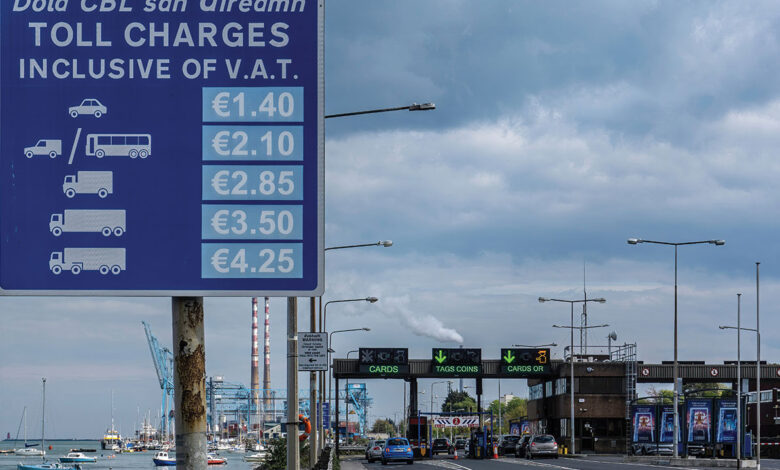
While Ireland’s transport taxation system has traditionally relied on mechanisms such as fuel excise duties, motor tax, vehicle registration tax, and tolling, the aimed transition towards electric vehicles is expected to fundamentally alter this model. As fuel consumption declines, the revenue base that has historically funded transport infrastructure will come under increasing pressure.
In response, the strategy points towards a future examination of distance-based road user charging. Rather than taxing vehicle ownership, such an approach would place greater emphasis on how much, when, and where vehicles are used.
Although no firm commitment is made, the strategy reflects an emerging consensus that alternative charging mechanisms will be required if transport revenues are to remain sustainable in an increasingly electrified transport system.
The proposal builds on recommendations previously advanced by the Commission on Taxation and Welfare and the Better Road User Charging Evaluation project, both of which identified road user charging as a potential long-term solution to declining fuel tax revenues.
Congestion
Alongside road user charging, the strategy identifies congestion charging as a potential policy option.
International experience demonstrates that congestion charges can reduce traffic volumes, improve journey reliability, and encourage greater use of public transport. While the strategy stops short of recommending implementation, it acknowledges that such measures are likely to form part of future policy discussions, particularly in urban areas experiencing significant congestion pressures.
Parking policy is also highlighted as an important demand management tool.
The availability of free or heavily subsidised parking has long been recognised as a factor influencing travel behaviour. As a result, the strategy explores the potential role of a workplace parking levy, a measure designed to reduce reliance on private car commuting while generating funding for sustainable transport initiatives.
Such proposals are likely to prove politically sensitive. However, the strategy argues that parking policy has often been overlooked despite its capacity to shape transport choices on a daily basis.
Behavioural change
While much attention is likely to focus on new charges and levies, the strategy also places considerable emphasis on positive incentives.
Existing supports for cycling and e-bikes are viewed as important mechanisms for encouraging modal shift and are expected to remain an important part of the policy mix. Similarly, the Government intends to examine how schemes such as TaxSaver can be adapted to reflect changing commuting patterns.
The growth of hybrid and remote working has altered traditional assumptions around daily travel. Many existing incentives were designed around five-day commuting patterns, raising questions about whether current supports remain aligned with contemporary working arrangements.
Employers are also expected to play a greater role in transport demand management. The strategy suggests that fiscal measures could be used to encourage organisations to reduce car dependency among employees and support the development of workplace travel plans.
Insurance and travel behaviour
A notable feature of the strategy is its willingness to consider measures beyond traditional taxation. Vehicle insurance is identified as an area where behavioural incentives could be strengthened.
Proposals include allowing drivers to retain no-claims bonuses even when they cease owning a private vehicle and exploring insurance models that reward lower annual mileage.
Analysis
Historically, transport debates have been focussed on infrastructure provision and network expansion. The new strategy suggests that greater attention must now be paid to how existing infrastructure is used and how travel behaviour can be influenced through economic incentives.
The challenge for government will be balancing effectiveness with public acceptance. Measures such as road user charging, congestion charging, and workplace parking levies have the potential to deliver meaningful behavioural change, but they also carry political and distributional implications, especially given cost-of-living challenges.
Recognising this, the strategy places considerable emphasis on the concept of a just transition, and any future reforms will require careful assessment of their impact on households, businesses, and rural communities, particularly where alternatives to private car travel remain limited.