Ports are facilitating Ireland’s offshore energy future

Assistant Secretary for Maritime Transport at the Department of Transport, Eamonn Kelly, outlines how Ireland’s ports are more than just trade gateways, and are also critical enablers of the State’s offshore renewable energy ambitions.
Contextualising that approximately 90 per cent of all trade entering and leaving Ireland passes through the State’s ports, Kelly argues that the infrastructure underpinning Ireland’s maritime economy will also be central in delivering the State’s energy transition.
While ports have traditionally been viewed as gateways for imports and exports, Kelly stresses that they are increasingly being recognised as strategic national assets capable of supporting wider policy objectives.
“While the primary function of our ports is to facilitate maritime transport, they can do an awful lot more than that. They are not just gateways to the world of trade; they can enable other activities.”
That broader role is becoming particularly important as Ireland seeks to develop offshore renewable energy at scale.
Kelly says the development of offshore wind cannot happen without the necessary port infrastructure. “Ports are probably first up. We need ports to be in existence and able to facilitate offshore renewable energy before we can actually build the offshore renewable energy projects.”
Offshore opportunity
Kelly states that offshore wind development is a natural extension of Ireland’s geographical advantages. “We are an island nation. We do not have significant fuel resources and we are very heavily dependent on importing fuel from abroad,” he says.
Pointing to Ireland’s extensive maritime area and strong wind resources, he adds: “We have a lot of sea, we have a lot of wind. It is a logical choice that we should be looking to leverage these sustainable natural resources for the benefit of our country.”
Under the Climate Action Plan, the Government is targeting 5GW of installed offshore wind capacity by 2030, rising to 20GW by 2040 and 37GW by 2050.
While acknowledging the scale of the challenge, Kelly says that significant progress already underway. “There are five planning applications for offshore wind farms currently before An Coimisiún Pleanála which will equate to about 3.8GW of renewable generation capacity,” he says.
‘No single-port solution’
Central to government policy is the recognition that no single port can deliver Ireland’s offshore wind ambitions.
“The Government has recognised that we need a multi-port strategy. No one port is going to solve the problem in terms of building offshore renewable energy,” Kelly states.
Kelly adds that the build-out of offshore wind infrastructure is likely to drive investment in Irish ports for decades. “We will probably need offshore renewable energy infrastructure being built in Irish ports for the next 25 to 30 years,” he says.
However, he cautions that significant upgrades are required before many ports can support offshore wind activity. “Because the offshore wind turbines elements are so heavy, the ports we have are not physically strong enough to facilitate their assembly. The quays needs to be strengthened to take the weight of the giant wind turbine elements, and the berths need to be deepened to allow the massive ORE construction vessels to operate,” he adds.
“The Government has recognised that we need a multi-port strategy. No one port is going to solve the problem in terms of building offshore renewable energy.”
Eamonn Kelly, Assistant Secretary for Maritime Transport, Department of Transport
Funding and delivery
On investment and coordination, Kelly outlines that Ireland’s inclusion in the EU’s Trans-European Transport Network (TEN-T) has enabled ports to secure European funding, including support through the Connecting Europe Facility.
Highlighting the experience of the Port of Cork, Kelly says European support has provided confidence to investors and demonstrated the viability of major infrastructure projects.
On the challenges facing ports and offshore wind developers, he says: “Offshore wind farms need ports, but ports need a pipeline of offshore wind farms to give financial certainty to investors in ports. For ports to build and grow, they need certainty that offshore wind projects are coming.”
That interdependence, he says, has reinforced the need for collaboration across government. “It really is an all-of-government challenge. We are all working together towards an all-of-government solution.” In this regard, the Department of Transport contributes Ireland’s multi-departmental Offshore Wind Delivery Taskforce through its dedicated offshore renewable energy workstream, working with commercial ports, European institutions, and other government departments to ensure infrastructure is ready to support future development.
Progress
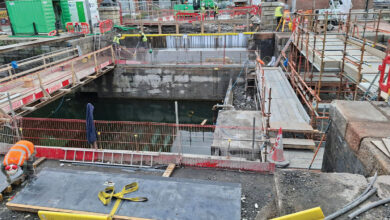
The Port of Cork has emerged as Ireland’s most advanced offshore renewable energy port, with major infrastructure works nearing completion. “It is the first offshore wind deployment port in the State,” Kelly says.
Rosslare Europort, the Port of Waterford, and Shannon Foynes Port are also advancing plans to support the sector, while Belfast Harbour remains an important potential partner.
Concluding, Kelly argues that facilitating Ireland’s offshore wind ambitions will depend on sustained cooperation between the government, ports, investors, and developers.
“While we have great vision, this is not something that one individual actor, one department, or one minister can deal with,” he says.
However, he adds: “We have concrete results already with the near completion of Port of Cork’s ORE facility at Ringaskiddy. We will continue to work to ensure that Ireland is ready and able to secure its energy future.”