
Transitioning to climate neutral cities

Writing in eolas Magazine, Aura-Luciana Istrate, assistant professor in sustainable urbanism and urban planning, School of Architecture, Planning, and Environmental Policy, University College Dublin, discusses the key role urban centres are to play in climate action.

By 2050, nearly 70 per cent of the global population is expected to live in urban areas. However, as primary engines of economic activity, cities remain major emitters of greenhouse gases and the residents suffer the consequences of climate impacts. Recognising this, international policies, such as the EU’s vision for a climate neutral continent, have placed urban centres at the forefront of climate action.
However, translating high level net zero pledges into tangible, ground-level outcomes remains significantly challenging. Current urban climate strategies often stumble due to fragmented governance, reliance on isolated technical fixes, and an inability to bridge the gap between policy goals and resident acceptance.
This article synthesises key insights from a peer-reviewed paper, Collaborative research for transitioning to Climate-Neutral Cities published in the Planning Theory journal (Istrate et al., 2023), where my co-authors and I developed a framework for integrated planning of climate-neutral cities. The work is derived from the
C-NEWTRAL project, an EU-funded Marie Skłodowska Curie Doctoral Network. This piece outlines how our findings can be translated into practice.
Shortcomings of top-down and fragmented planning
Globally, planning approaches on climate-neutrality remain uneven. The European Union puts forward the European Green Deal as a “new growth” strategy, however there are risks of greenwashing in urban developments.
The EU has also advanced ambitious top-down targets through the 100 Climate-Neutral and Smart Cities Mission, while equally emphasising citizen engagement and participatory governance. However, many cities still struggle with fragmented actions, inadequate implementation plans, and poor data utilisation.
In other regions around the world, the situation is not brighter. The United States operates through a patchwork of local policies where city-level net zero ambitions are often constrained by state-level restrictions or lack of binding national frameworks.
China provides strong top-down directives focused on low-carbon industries, but research and execution frequently remain limited in scope or siloed. India and the Middle East face structural issues ranging from limited municipal funding and technical focus (e.g., India) to centralised, non-participative governance structures (e.g., Iran).
For years, climate action in cities has been framed predominantly as a technical or engineering problem. Predictive natural sciences, algorithm-based research, and expansive infrastructure projects have their value and have so far been prioritised; however, the local governance dynamics and community values have been overlooked.
Top-down tech solutions often yield marginal results or unintended consequences, rarely resolving deeper systemic issues on their own. Similarly, ‘green’ investments can trigger green gentrification or socio-economic displacement if implemented without local input. Conversely, community-led, bottom-up projects often align with local needs, but they frequently lack the funding, statutory weight, and institutional alignment required to achieve wider urban impact.
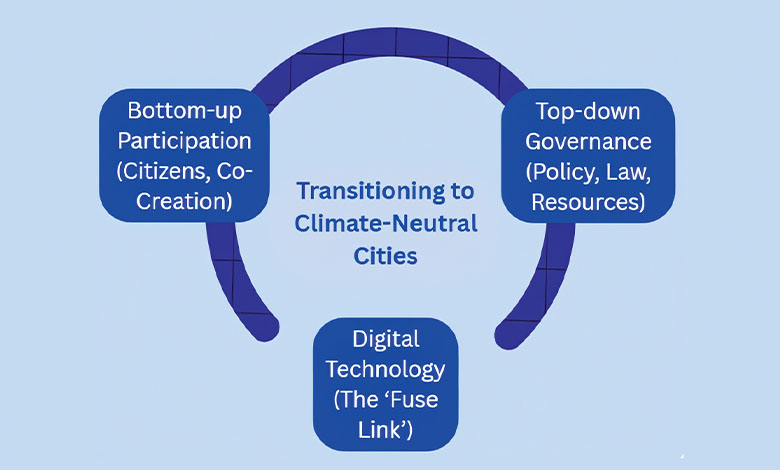
Three-pillar approach
To overcome the above barriers, we proposed a preliminary framework built on three intersecting methodological pillars designed to break down disciplinary and operational silos:
- The bottom-up participatory pillar: Focuses on embedding citizen values, social equity, and climate justice into local planning. Deliberative, ongoing community engagement ensures that climate interventions are met with social acceptance and match local living conditions rather than imposing top-down blueprints.
- The top-down governance pillar: Focuses on equipping municipal authorities with responsive governance tools. By translating international climate targets into statutory local policies, municipal governments can align conflicting financial interests, reduce organisational risk, and manage long-term transitions effectively.
- The digital technology link: It positions modern digital tools, such as digital twins of cities, geographic information systems (GIS), and predictive artificial intelligence, not as end goals, but as the ‘fuse link’ connecting governance decisions with citizen participation. For example, tech tools enable citizens to visualise data and co-design neighbourhood solutions, while providing planners with real-time feedback to model intervention scenarios.
Five core urban dimensions
In the referenced article, we proposed mapping the three methodological pillars presented above across five core urban dimensions of the climate-neutral city:
- Urban nature: Regreening disused urban space, protecting biodiversity, managing stormwater, and expanding public green spaces via nature-based solutions.
- Urban mobility: Shifting away from private car dependency toward multimodal transport, active travel networks, and equitable electric mobility options.
- Built form: Accelerating deep retrofits of existing housing stock, expanding nearly zero energy buildings (NZEBs), and balancing sustainability with housing affordability and viability.
- Energy infrastructure: Decarbonising energy grids, building resilient industrial supply systems, and establishing community-led renewable energy communities (REC).
- Circularity: Implementing closed-loop systems for municipal waste management, water conservation, and resource reuse.
“Achieving climate neutrality requires moving away from disconnected interventions, toward integrated planning.”
Towards climate neutral transitions
Single-sector interventions frequently fail because they ignore spatial relationships such as building high-density housing without matching public transport infrastructure (contemporary urban development in Dublin illustrates prime examples of this). By cross-checking the five urban dimensions with the three methodological pillars, our proposed framework in Istrate et al. 2023 provides actionable research and planning avenues, exemplified below:
- Urban nature and circularity: Deploying digital participatory tools could allow local residents to identify vacant, disused sites for neighbourhood regreening. Such a process could create publicly accepted green infrastructure while mitigating the risk of speculative green gentrification.
- Housing buildings and energy infrastructure: Utilising digital decision-support platforms helps planners weigh development costs against energy efficiency targets. This would enable municipal leadership to protect vulnerable populations from energy poverty while accelerating the rollout of positive energy districts (PEDs).
- Urban mobility and urban nature: Combining spatial simulations with citizen and stakeholder input would allow cities to design active travel routes along blue-green corridors, increasing synergy of these urban systems and reducing conflicts, aiming to improve urban biodiversity while reducing traffic emissions.
Implications for policy and practice
Achieving climate neutrality requires moving away from disconnected interventions, toward integrated planning. Technology alone cannot solve the climate crisis, but when used to democratise data and inform transparent governance, it becomes a powerful catalyst for urban transformation.
The message for policymakers, planners, and community advocates is that transitioning to climate-neutral cities requires balancing technological capacity, political leadership, and meaningful public participation within an integrated spatial vision.