Leading Ireland’s regulatory landscape

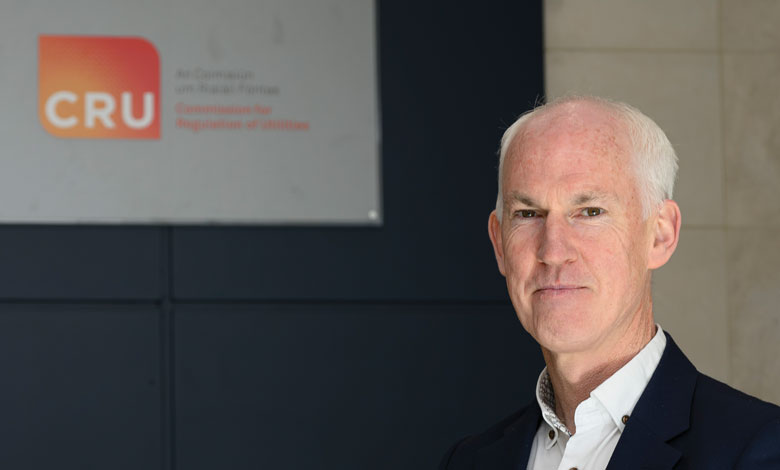
The newly-appointed chair of the Commission for Regulation of Utilities (CRU), Fergal Mulligan, sits down with Joshua Murray and discusses his key priority areas: his immediate priorities as chair, Price Review Six (PR6) and the fallout of the Iran War energy crisis, while also outlining the CRU’s role in energy safety.
In March 2026, Fergal Mulligan, one of the three commissioners leading the Commission for Regulation of Utilities (CRU) became the organisation’s chairperson.
Succeeding fellow commissioner Jim Gannon, whose three-year term ended prior to Mulligan’s appointment, the new chair assumes his role at a time of great flux for the Irish energy sector, with the energy transition driving new infrastructure projects and changing the energy landscape of the State.
In addition, the global energy crisis following the US-Israeli bombing of Iran has driven up the prices of oil and gas, and present a threat to the long-term supply of these fuels.
To meet expanding regulatory and operational demands, Mulligan says that he aims to grow the number of staff at the CRU over his term as chair, with the organisation set to grow from 197 staff members to 263. This follows significant growth witnessed in the immediate years prior.
“A big part of what we need to do as a leadership team is to grow the organisation and meet future demand,” Mulligan says.
“The fact we are growing as an organisation reflects the reality of the market. Our remit has expanded and we have the energy transition as well as ever-growing energy demand. It is about having a well-oiled machine of an organisation which meets the demands on the CRU from all our stakeholders, including government departments, system operators, consumers, as well as meeting our everyday tasks.”
The newly appointed chairperson says that he is aiming for Ireland to become a centre of excellence in regulation of the energy markets. “I think Ireland is very well placed to do that. It is a very well-respected country when it comes to regulation and governance. We participate a lot within European policy and within European groups, so Ireland really punches above its weight when it comes to advising on policy at a European and national level.”
“Price Review Six (PR6) was published in December 2025 and it is all about reporting, holding the system operators to account, and ensuring delivery which is on time and at or below budget.”
On the evolving nature of the CRU’s remit, Mulligan says: “We are at the forefront of the development of renewables. The expansion of renewable energy systems across the island has been transformative and the scale of investment has been significant but that brings complexity to the grid.”
Expanding on the needs of the grid, Mulligan states that a priority for him is “having a grid which is safe, secure, and meets the needs of the renewable energy transition, while ensuring reliability”. Citing the infamous example of the April 2025 Iberian grid collapse, Mulligan says: “No country wants to see anything like that happening, so having our system secure and reliable is critical and it will require a huge level of investment in the coming years.”
Complementing meeting the evolving demand on the electricity system, along with the expansion of the CRU’s remit, is enabling the Government’s infrastructure priorities. Mulligan says: “The critical thing is delivery. A key part of our CRU strategy through the rest of this decade is to ensure that the speed of delivery of infrastructure is met.
“Price Review Six (PR6) was published in December 2025 and it is all about reporting, holding the system operators to account, and ensuring delivery which is on time and at or below budget.”
Infrastructure development goes beyond the State, with the north-south Single Electricity Market (SEM) having traded over €7 billion worth of electricity in 2024/25 and continually expanding due to growing demand. “One of the key roles of the SEM is to ensure there is sufficient capacity in the market and maintaining security of supply.
“We have done that effectively, and it has allowed us to bring on temporary emergency generation which is a key strategic need for any potential security of supply challenges.
“The Single Electricity Market Committee ensures that co-operation on a north-south basis. It is a unique body and it meets monthly in-person in addition to regular ad-hoc meetings online.”
Price Review Six (PR6)
Price Review Six (PR6) is a significant regulatory review that covers the period from 1 January 2026, to 31 December 2030. It aims to set the framework for the allowed revenues of system operators EirGrid and ESB Networks, and paves the way for an historic investment of up to €18.9 billion in Ireland’s energy infrastructure.
Mulligan states that PR6 will make the electricity network “resilient, safe, and secure”, adding: “From a security of supply point of view, it will meet demand for all customers, both domestic and non-domestic. A huge upgrade is required of all substations and the basic infrastructure of wires up and down the country.
“Ultimately, we need more transmission network motorways built and we need to have the wires which ensures that renewables can be brought on to the system when needed. This will ensure that we reduce dispatch down and maximise the use of our renewable infrastructure when the wind blows and the sun shines.”
While the investment outlined in PR6 will increase network charges for retailers, the goal for the regulatory period is a more adaptable network which meets the State’s climate requirements and reduced reliance on volatile fuel markets.
“Currently, we are exposed to external factors such as the Russian invasion of Ukraine and the crisis in the Middle East. So the value we gain is that we are less exposed to that volatility and more certain about where our network capacity is coming from, and that will be a greener future with less fossil fuels.”
Mulligan explains the other positive consequences which will arise from the investment over the rest of the regulatory period. “It will create a lot of investment on our island. Onshore and offshore wind, as well as solar, are creating a lot of indigenous jobs. What we are trying to achieve here is more investment which will lead to more certainty of what will be charged of customers over the next two decades.
“The critical thing is delivery. A key part of our CRU strategy through the rest of this decade is to ensure that the speed of delivery of infrastructure is met.”
“It is a promise to have greener electricity at increased volume. With that will come pricing that we can predict with more certainty and revenue can be reinvested back into our economy and help with job creation and infrastructure investment in our own country, rather than investment being sent off to other countries from which we must buy oil and gas.
“The CRU will also play a central, strategic role in both offshore and onshore wind in Ireland, acting as the primary economic and safety regulator to facilitate Ireland’s 80 per cent renewable electricity (RES-E) target by 2030.
“We will be setting the regulatory framework for connecting offshore wind farms, including deciding on grid connection charges and defining Asset Transfer Values (ATV) as EirGrid becomes the Offshore Asset Owner.”
Middle East energy crisis
On 20 February 2026, one-week prior to the US-Israeli bombing of Iran and the assassination of the Iranian Supreme Leader, Ali Khamenei, the price of brent crude oil stood at roughly $71 per barrel, while European liquefied natural gas (LNG) was priced at €32/MWh.
Following the attack, Iran retaliated by closing the Strait of Hormuz, a significant chokepoint for the transit of oil and LNG exports from many Middle East states, resulting in a significant rise in the price of oil and gas and plunging global energy markets into turmoil. Around 20 per cent of the global supplies of both oil and LNG pass through the Strait of Hormuz.
As of 7 April 2026, the price of brent crude is $110 per barrel (a 60 per cent increase) and the price of European LNG is €52/MWh (a 62.5 per cent increase).
With a global energy crisis taking place almost immediately upon becoming CRU chair, Mulligan has spent his initial time leading the organisation meeting all of the significant electricity and gas retailers in Ireland, as well as working closely with government.
“Following two meetings with the National Energy Affordability Taskforce, hosted by DCEE, work is ongoing on a detailed document setting out a number of actions in response to the crisis that the Department, and we as the regulator, are going to carry out over the coming months.
“The actions proposed by DCEE will be focused on affordability and consumer protection. We are acutely aware that there are many customers currently experiencing affordability challenges, and we have seen with our arrears reporting over recent quarters that there is a high risk of affordability challenges remaining into the 2026 winter period with the risk that high global prices persist.”
While policy decisions, such as the energy credits established following the Russian invasion of Ukraine and subsequent energy crisis, are a matter for the Minster for Climate, Energy and the Environment, Mulligan states that the CRU will provide expertise on policy measures that government can take and will “continue to advise on what the most appropriate measures to take that might have the most positive impact”.
“Where possible measures should be targeted where they will have the most impact, and assist the most vulnerable in society.”
The unpredictable nature of US President Donald Trump’s war in Iran makes scenario forecasting challenging. Mulligan states that the key from an Irish regulatory perspective for navigating the energy crisis is comprehensive modelling, stakeholder engagement, co-operation and collaboration to reach solutions and implement them effectively and in a timely manner.
“We will work with our partners in government to put in place plans which we hope will not be needed, and if we do end up needing them they can be implemented quickly. Agility, flexibility, and comprehensive preparation are the essence of the moment.”
While prices have risen significantly, Mulligan is confident that there will be no challenges around gas supply. “Most of our gas comes from Europe. While there is a challenge with market prices due to the situation in the Middle East, we are facing a pricing challenge and thankfully not a supply challenge.
“In the long term, there is a government challenge to ensure security of supply, and the strategic floating LNG terminal being proposed off the coast of County Clare is key to that. We will have a role to play as a regulator in advising on relevant regulatory matters, however the energy crisis does underline the need for a strategic gas reserve.”
Safety regulation
While these priorities will be the flagship projects guiding the work of the CRU for 2026 and beyond, safety regulation is sometimes forgotten by the public and some external stakeholders, however the CRU sees it as vitally important part of its remit.
Mulligan is also keen to outline the CRU’s role over the next three years. The CRU will have important new functions coming in around nondomestic gas works, and the need to integrate those installers effectively. “We work with Safe Energy Ireland, a body that operates the RGI and Safe Electric Schemes on our behalf. It oversees the registration of electricians and gas installers for domestic gas works.
“A big priority is digitalising the certification processes by electricians and gas installers to make them more efficient and seamless, while ensuring that only properly qualified electricians and gas installers are operating in the market.

“Alongside that, we will continue to carry out inspections and act on illegal works and hold the industry to account where necessary. We are making sure that CRU itself is resourced and structured to meet growing demand in this area, but also to meet demand across the key priorities in terms of our role to protect consumers.”
|
About: Fergal Mulligan Fergal Mulligan was appointed as chair of the CRU in March 2026, having already been a CRU Commissioner since 2024. An accountant by training, Mulligan’s career spans accountancy, telecoms regulation, and national infrastructure delivery. After a decade in accountancy, he spent over 20 years in telecoms, including 11 years at ComReg. As Programme Director at the Department of Communications, he oversaw the Government’s strategy to deliver high speed broadband to all premises across the State and the creation of National Broadband Ireland in 2019. Since then high-speed fibre broadband has been rolled out to every home and business beyond the commercial footprint, making Ireland one of the first countries in Europe to achieve 100 per cent high speed broadband coverage. Mulligan balances his professional role with being the chairman of his local GAA club, coaching gaelic football, hill-walking, and hobby sheep farming. |