
The implementation of the 20-Year Strategy for the Irish Language

Many Irish language developments have been delivered under the 20-Year Strategy for the Irish Language, published in December 2010, but it is unlikely that it will achieve its primary aims of increasing the number of people speaking Irish daily to 250,000, or increasing the nuforbairtímber of people in the Gaeltacht speaking Irish daily by 25 per cent.
This piece was originally written in Irish. Please click here to access the Irish language version..
Census 2022 says that there are 71,698 people speaking Irish daily, a decrease from the 77,185 recorded in Census 2011. The number of people speaking Irish in Gaeltacht areas fell from 68.5 per cent in Census 2011, to 66 per cent in 2022. Additionally, Census 2022 demonstrates that 65,156 people living in the Gaeltacht can speak Irish, down from 66,238 in Census 2011.
An aim to increase the number of people with a knowledge of Irish to 2 million is set out in the strategy. Census 2022 says there are 1.87 million people with a knowledge of Irish, up from the 1.77 million people recorded in Census 2011.
The strategy’s vision is to deliver a bilingual society and to protect the linguistic identity of Gaeltacht communities. This is a commitment seat out in the Statement on the Irish Language 2006 which informed the 20-Year Strategy for the Irish Language.
Education is identified as “one of the critical engines” to achieve the Strategy aims. The Policy on Gaeltacht Education 2017-2022 was implemented under the strategy. The policy was aimed at “maintaining and securing the vitality of Gaeltacht areas as the home of Irish-speaking communities”.
Aims to ensure that Irish would be an obligatory subject from primary education up to the Leaving Certificate, and that a high standard of Irish language would be provided to students are set out in the strategy.
The development of a language planning system was central to the strategy’s aim to protect the vitality of the Gaeltacht areas. This was provided in the Gaeltacht Act 2012.
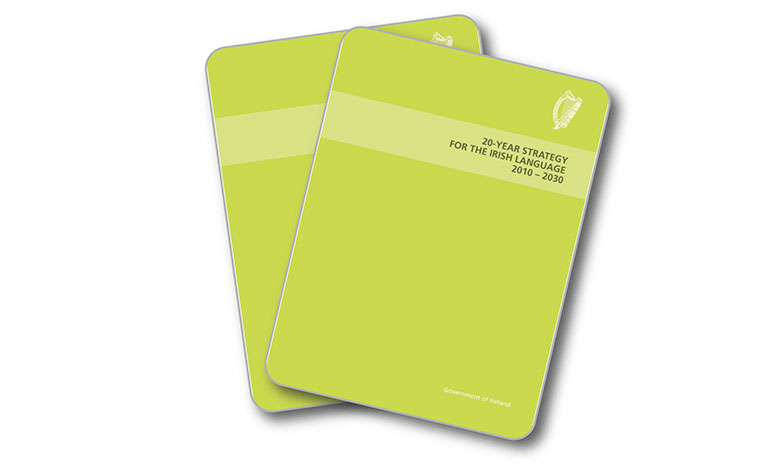
The strategy’s vision is to deliver a bilingual society and to protect the linguistic identity of Gaeltacht communities.
Since its enactment, the Gaeltacht has been divided into 26 areas named Language Planning Areas (LPAs). Additionally, 16 Gaeltacht Service Towns were identified, these are towns situated in LPAs or beside that play a role in the provision of services to them. Under the Act, each LPA has to prepare a language plan to be recognised as a Gaeltacht area.
An action plan was published in June 2022 for the period 2018-2022 to support the strategy. Due to the Covid-19 pandemic, the plan was extended until 2023. Under the plan, in support of transmission of Irish, maximum capital funding provided to early years initiatives under the Community and Language Supports programme increased from 80 per cent to 95 per cent.
In line with an aim in the action plan, the Official Languages (Amendment) Act 2021 was enacted in December 2021. One of the main aims of the act is that 20 per cent of recruitments to the public sector would be competent in Irish before the end of 2030.
Regarding media and technology, a commitment is made to provide broadcasting services through Irish to a high standard is set out in the Strategy. In December 2022, the Digital Plan for Irish 2023-2027 was published. The plan aims to bring the Irish language into the digital era.
Under the strategy, a new Irish-Irish dictionary was published and work has begun on an Irish-English dictionary project. As well as that, the Royal Irish Academy is preparing Foclóir Stairiúil na Gaeilge which is to be prepared before 2027.
Regarding economic life, the action plan states that Údarás na Gaeltachta is providing employmet, Foras na Gaeilge is supporting the publishing sector, and Glór na Gael is supporting economic projects.
An aim to continue supporting Údarás na Gaeltacha to retain the 8,500 jobs it provides in Gaeltacht companies is laid out in the plan. The 2025 annual report of Údarás na Gaeltachta says that 9,716 people are employed in its client companies.
Analysis
Despite these developments, it is unlikely that the main aims of the strategy regarding the number of people speaking Irish daily, or the number of people speaking Irish daily in the Gaeltacht will be achieved.
Additionally, 185 objectives were laid out in the action plan and a report on progress made under the plan in 2022 illustrates that 43 were done, 138 were in progress, and four were delayed.The Department is yet to publish a report on progress under the plan for 2023 and a new action plan has not yet been published.
Speaking to Tuairisc in Janury 2024, former academic coordinator of Acadamh na hOllscolaíochta Gaeilge said: “It is clear at this point that the goal set out in the strategy, that there would be 250,000 daily Irish speakers in the country by 2030, will not be achieved.
“But I think the real disappointment is not only that we will not achieve that goal, but that the number of daily Irish speakers across the country is gradually falling rather than increasing.”