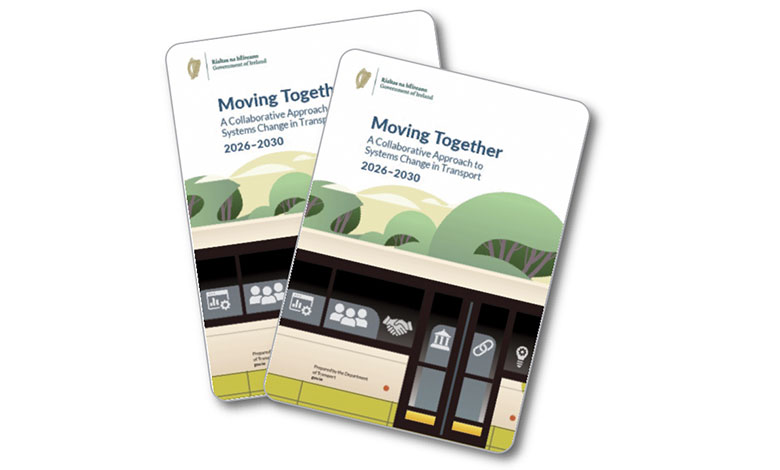
The State aims to contribute to the decarbonisation of transport and improve journeys across all transport modes through Moving Together: A Collaborative Approach to Systems Change in Transport and the Sustainable Mobility Policy (SMP) Action Plan, published by the Department of Transport in March 2026.
Moving Together aims to minimise the social and environmental costs of transport and car dependency including congestion, air, and noise pollution. This is intended to support peoples’ health, safety, and wellbeing.
It is designed to increase the existing transport system’s efficiency by reducing demand for less sustainable journeys by people and freight. The plan aims to encourage compact, mixed use, and transport-led development. This is to make city, town, and village centres “attractive, walkable, accessible destinations”.
The plan aims to support economic and financial sustainability in the transition to net zero. Additionally, it is intended to contribute to the national target of halving transport emissions by 2030 compared to 2018 through network optimisation and reduced kilometres travelled.
Moving Together identifies the need to improve the availability and reliable frequency of public transport, ongoing investment in rail, and to continue supporting electrification and improving EV charging infrastructure. It notes that people in rural areas are more dependent on cars than those in urban areas.
The plan is to provide guidance to local authorities on the development of their bespoke plans. It is underpinned by four key principles: just transition; accessibility and inclusion; rural recognition; and economic and financial sustainability.
The plan is informed by the recommendations of the OECD’s 2022 report, Redesigning Ireland’s Transport System for Net Zero, which found that Ireland’s transport system is “car dependent by design”. Recommendations include road space reallocation, mainstreaming of on-demand shared services, and greater communication efforts “to address car-centric mindsets”.
Multiple existing policies and programmes are identified as key in facilitating the objectives of Moving Together. This includes the National Planning Framework, the National Development Plan, regional spatial and economic strategies, local authority climate action plans, urban renewal and development plans, and car parking measures.
The plan contains 32 recommendations to deliver on these objectives. This includes identification of a pathway to develop a taxation approach to transport based on a ‘user and polluter pays’ principle. It recommends that local authorities develop demand management strategies to take account of the delivery of sustainable mobility alternatives.
The plan recommends that sustainable freight distribution strategies be prepared for five cities. It also recommends measures be taken to encourage remote working and EV uptake.
Furthermore, sustainable mobility supports for primary and secondary school children are to be increased, the civil service motor travel rates are to be leveraged to effect change, and public transport options are to be encouraged by organisations across society.
SMP
The SMP Action Plan, which is to be delivered in tandem with Moving Together between 2026 and 2030, aims to support the delivery of major transport projects including MetroLink, BusConnects, DART+, and Cork Commuter Rail.
It includes actions to improve sustainable mobility options and regional connectivity through the completion of the Connecting Ireland Rural Mobility Plan, the provision of more town bus services, and increased active travel infrastructure connecting towns and villages.
The plan also aims to continue to deliver the Safe Routes to School Programme, development of park and ride facilities, increased taxi provision, and investment in improving transport accessibility.
Climate Action Plan 2023 set aims for a 50 per cent increase in daily active travel journeys, a 130 per cent increase in daily public transport journeys, and a 20 per cent reduction in total vehicle kilometres travelled.
The SMP Action Plan will monitor performance relative to these key performance indicators. It contains the following 10 goals:
- improve mobility safety;
- decarbonise public transport;
- expand availability of sustainable mobility in metropolitan areas;
- expand availability of sustainable mobility in regional and rural areas;
- encourage people to choose sustainable mobility over the private car;
- take a whole-of-journey approach to mobility, promoting inclusive access for all;
- design infrastructure according to universal design principles and hierarchy of road users model;
- promote sustainable mobility through research and citizen engagement;
- better integrate land use and transport planning at all levels; and
- promote smart and integrated mobility through innovative technologies and development of appropriate regulation
Landscape
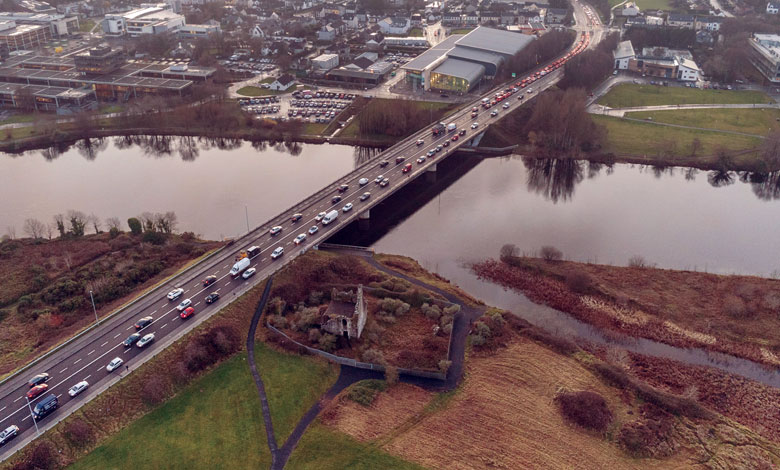
Congestion is estimated to have cost the Greater Dublin Area €336 million in 2022, according to Economic Cost of Congestion in the Greater Dublin Area 2022-2040, published by the Department in December 2023. It estimates that this will rise to around €1.5 billion by 2040.
Reliance on private transport has increased in recent decades due to “historical misalignment between population growth, economic activity, land-use patterns, and infrastructure capacity”.
Space was systematically reallocated to cars in previous decades due to a rapid increase in vehicle numbers. The National Household Travel Survey 2024 finds that 71 per cent of journeys in the State are made by car. There are “physical, environmental, and societal trade-offs in supporting an ever-increasing car-dependent system”, the plan says.
Minister for Transport Darragh O’Brien TD says: “The Government recognises that sustainable options are not always available, especially in more rural or remote areas.
“Finding solutions that work for all is important, and this new strategy seeks to do this in a balanced way, by ‘moving together’ on key issues and future proofing our system for generations to come.”