AI for public good
Martin Bailey, head of the European Commission’s AI for Societal Good unit, outlines the Commission’s work in using artificial intelligence technology to improve lives.
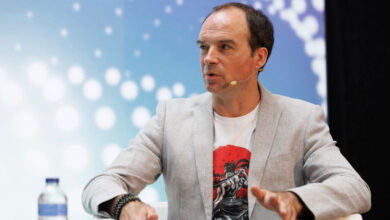
Martin Bailey begins by saying: “AI really is a revolution, and it is going to impact everything, not just the tech sector as we see it traditionally.”
He believes that AI presents a huge opportunity for the European Union and its member states, but they must act to realise the benefits and avoid being left behind.
“The mistake we do not want to make again, and yet again, and yet again, by sticking to our very traditional ways is to watch all the developments happening in the US and China, which is the biggest investor in biotechnology now in the world. And then in 20 years’ time, we are buying all their stuff and we are regulating it.”
Bailey is hopeful but says that he wants to see more work being done by governments and stakeholders across Europe: “I think my message is that we really need to have the guts to do this. There is still time, but I think that it really requires a major change in mindset if we are going to make anything of this revolution.”
Bailey explains that the European Commission is doing extensive work with its AI for Public Good initiatives.
These include the creation of models for detecting breast and prostate cancer in developing countries, as well as energy grid optimisation projects designed to manage the balance between renewable energies and fossil fuels.
Bailey says his unit are currently working on urban preparedness to reduce the impact of natural disasters in Europe, such as floods or wildfires, which are becoming increasingly prevalent.
“It really requires a major change in mindset if we are going to make anything of this revolution.”
He states that this involves “using AI to model the scenarios and model, not just the outcomes, but the resource planning outcomes and what actions we can take in advance”.
Ukraine reconstruction project
One of the major projects that the European Commission is currently working on is the development of a digital twin of Ukraine to be used in the reconstruction of the country.
Bailey explains: “We use digital replicas of parts of cities and buildings, and we model the scenarios to assess damage.
“We can estimate the cost of reconstruction and track this through the cycle to give more value for money and transparency for citizens and donors through the reconstruction project.”
The project came about at the request of the Ukrainian Government: “We started this because the Ukrainians came to us because they are very concerned, that when it gets rebuilt, they do not want the big construction companies coming in and making a fortune rebuilding very poor quality and not building the infrastructure.”
He continues: “It is very important to make Ukraine attractive for the people who want to come back from wherever they have come from, the front line, Europe, or reliving in their cities which have been destroyed.”
Digital twin technologies are also being used in the development of smart cities to address challenges that affect people living and working in cities.
To help with this project, an EU toolbox for digital twins is being created in the areas of energy optimisation, environmental health and footprint, as well as urban mobility and planning.
Bailey says they are investing £32 million into the toolbox and “by the end of next year, we will have AI models in all of these areas to address these challenges for cities”.
Ireland and AI
Bailey notes that Ireland has become a major adopter of AI technology in Europe and highlights the work the State is doing in the field.
He mentions that Ireland is one of the 14 member states of the European Digital Infrastructure Consortium (EDIC), where the EU “invites member states and cities to join and to develop, share, and deploy the technology across Europe”. He adds that several Irish cities are also keen to join the EDIC including Dublin, Galway, and Waterford.
Bailey commends Dublin’s Digital Transformation Strategy, which he says is “very detailed and embraces a lot of the solutions we are developing and deploying, both in the policy and the practical level in Europe”.
He adds that the State should focus on developing homegrown technology rather than hosting foreign companies: “I think it is very important to support and encourage innovation in AI from the bottom up and not just have the hosting effect.”
Concluding, Bailey says that Ireland’s upcoming presidency of the Council of the EU between July and December 2026 will allow the State to have a major impact on the future of AI in Europe if stakeholders get involved: “It is very important that you engage in this process, it is very unique, and it is an opportunity for Ireland to really make an impact, to put its imprint on the processes and the policymaking.”