MARA’s place in the maritime planning system

Ireland’s maritime area is becoming increasingly important to national planning, environmental protection, and economic development, writes Laura Brien, Chief Executive Officer of the Maritime Area Regulatory Authority (MARA).
A coastal development can affect navigation, marine habitats and species, offshore infrastructure, or other maritime users. Equally, an offshore or nearshore project can involve extensive areas of sea and significant connections to land-based infrastructure, and have consequences for coastal communities, ports, roads, electricity infrastructure, and other land-based interests. Effective planning therefore depends on understanding those connections.
This is an increasing challenge for Ireland as the scale and complexity of maritime projects increases. Offshore renewable energy, ports, cables, marine infrastructure, aquaculture, recreation, and conservation all compete for space within an environment that is both economically valuable and environmentally sensitive.
The question, therefore, is not simply how we develop the maritime area, but how we decide where development should take place, who should regulate it, and how the different interests can be brought together.
The establishment of MARA under the Maritime Area Planning (MAP) Act 2021 represented a fundamental reform of how these competing uses are regulated. The MAP Act positions MARA at the centre of a significant change in how Ireland manages its maritime space.
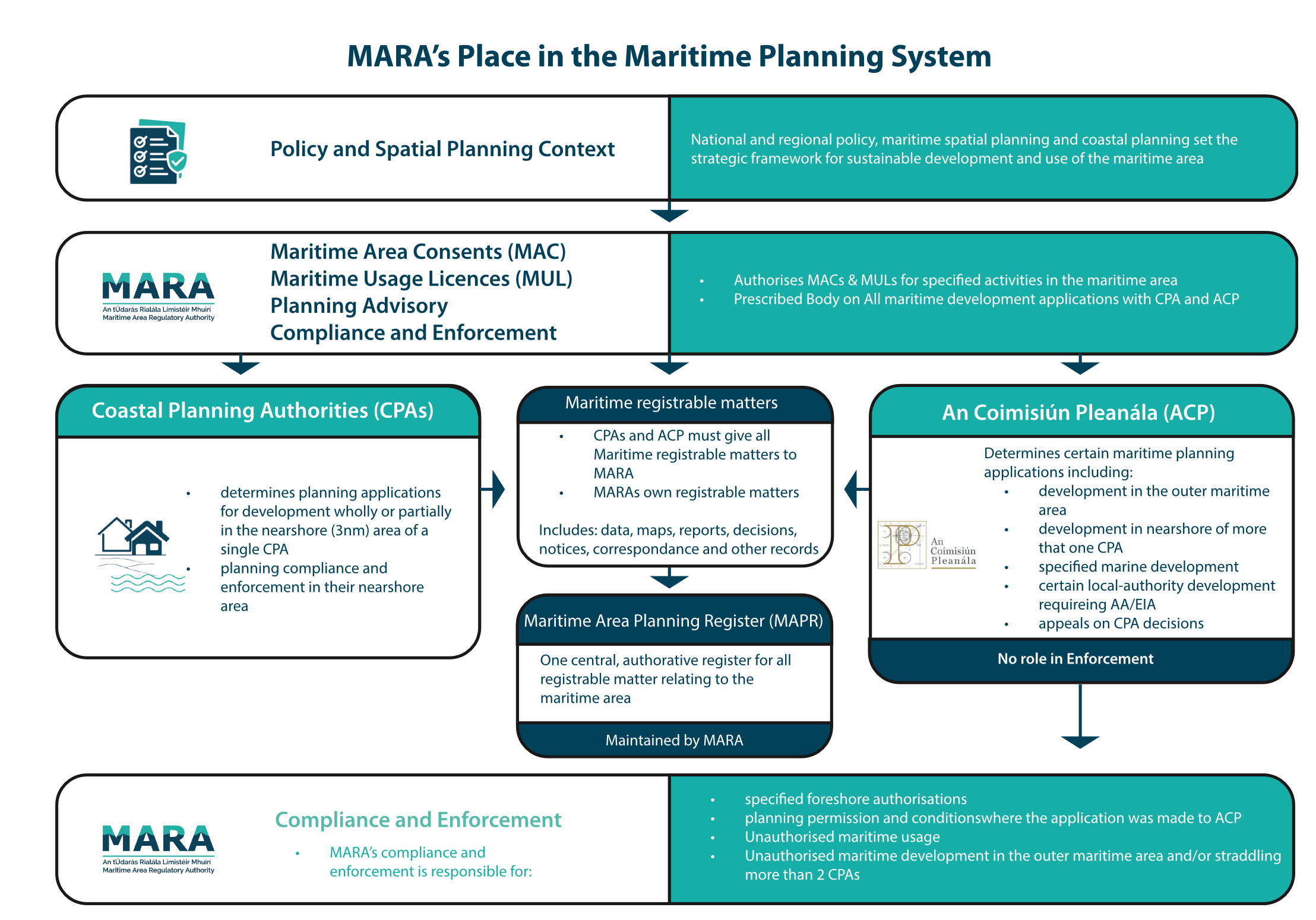
MARA does not operate in isolation. Its role forms part of a wider system involving the coastal planning authorities (CPAs) and An Coimisiún Pleanála (ACP), with each organisation having its own responsibilities. That separation of functions is central to understanding where MARA fits into the overall process. 94 per cent of applications to MARA to September 2026 intersect with CPAs within the nearshore area.
The introduction of the maritime area consent (MAC) system represents a fundamental change in the way maritime development is approached. MARA is responsible for determining whether an applicant should be granted a MAC to occupy a defined area of the maritime space for a specific maritime usage.
In general, a MAC from MARA creates a defined gateway into the planning system and, at the same time, preserves the role of the relevant planning authority in assessing the development proposal. Once the MAC is obtained the MAC holder may then proceed to apply for planning permission. Changes to legislation, however, may facilitate concurrent MAC and planning applications for statutory undertakers.
The MAC process does not include environmental assessment which is undertaken through the planning application process. The planning process is where the public and prescribed-body consultation, appropriate assessment, and environmental impact assessment or screening for same takes place.
That division of responsibility makes sense to me. The different stages are designed to answer different questions. MARA considers the maritime occupation and regulatory aspects, while the planning process considers the development proposal in its wider context, including environmental and planning considerations.
MARA’s role continues beyond the initial decision to allow an activity to occupy a particular area. It also has responsibilities for maritime usage licences (MULs) and for compliance and enforcement in relation to maritime consents and licences. Under the Planning and Development Acts, MARA is the planning enforcement authority for relevant ACP consents.
That continuing regulatory responsibility matters. As Ireland makes greater use of its maritime resources, there will be an increasing need to ensure that activities take place within the conditions under which they have been authorised and that different users of maritime space can operate alongside one another.
There is another aspect of MARA’s role which I believe is particularly important to the planning system: its position as a prescribed body. MARA engages with local planning authorities and ACP in our role as a prescribed and notifiable body under the Planning and Development Acts, for both maritime development applications and land use plans, ensuring effective coordination, clarity of roles, and ensuring that Ireland’s land and marine planning systems work seamlessly together.
This provides a direct route for specialist maritime knowledge to feed into planning decisions. It also recognises something that is becoming increasingly difficult to ignore: the boundary between land and sea is not a hard boundary when it comes to development.
But separating responsibilities does not mean separating the authorities.
If anything, the new system makes cooperation more important. A maritime development may pass through several regulatory stages and involve several different authorities. For the system to work effectively, there needs to be clarity about who is responsible for what, when decisions are made and how information moves from one stage to another.
MARA, ACP, the CPAs, and the Office of the Planning Regulator have come together to produce a guide to understanding these relationships, showing our common stakeholders how the new maritime consenting system is not intended to create another layer operating separately from planning. Rather, MARA forms part of a chain of regulatory and planning decisions.
A further stage to the process will be the development of a new maritime area planning register by MARA as prescribed under the Planning and Development Act 2024. The register will provide a central, publicly accessible record of maritime planning information and decisions, bringing together marine-related data from MARA, ACP, and CPAs.
The register will improve transparency and support more effective coordination between authorities along with providing a clear picture of planned and authorised development and activities in Ireland’s maritime area.
As Ireland looks towards a future in which the maritime area will play an increasingly important role in energy, infrastructure, and economic development, that distinction will become even more important.
The challenge will be finding the balance between development and protection, between new uses and established users, and between national objectives and local interests. MARA cannot resolve all of those issues by itself, nor should it. Its role is to form part of a system capable of dealing with them properly.