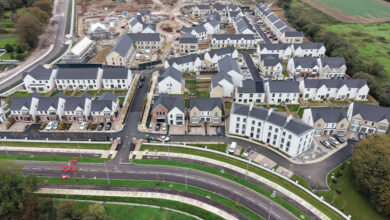
Implementing the Planning and Development Act

Claragh Mulhern, Chief Planner at the Department of Housing, Local Government and Heritage, discusses how developments in planning legislation and policy can unlock housing and infrastructure while delivering on the State’s climate goals.
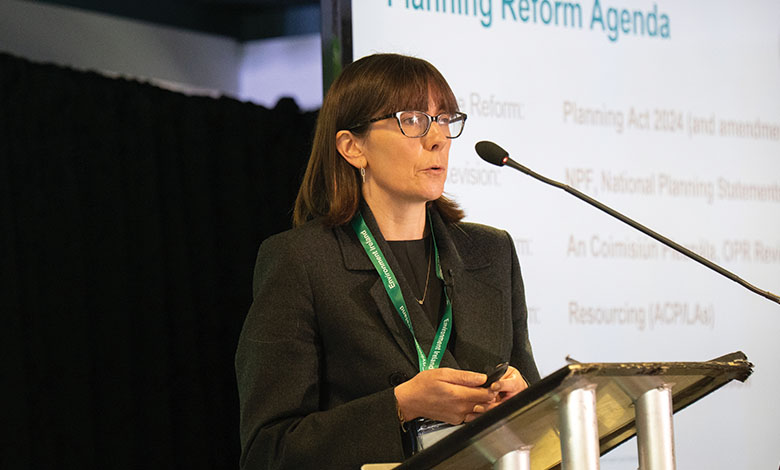
Setting out the legislative context, Claragh Mulhern states that the Planning and Development Act 2024 was signed into law in October 2024. This was the first update to planning legislation in over 20 years.
“Our key objectives in that process were to improve clarity, consistency, and certainty in the system,” she says.
Mulhern adds that the legislation is aimed at enabling “timely decisions” and is intended to “balance the common good with the rights of others”.
Under the Act, each local authority is to create a 10-year development plan which is to be subject to a five-year review. Previously, local authorities developed six-year development plans.
Mulhern explains that this is to ensure the plans are more strategic and provide clarity on the approach to a local area’s development. She adds that zoning will be done through these plans exclusively moving forward. The Chief Planner explains that development plans will contain six thematic strategies of which climate and the environment will be one.
Mulhern says the new legislation has climate action embedded into it as it dovetails with the Climate Action and Low Carbon Development Act and Climate Action Plans.
Mulhern states that the Act is being implemented on a phased basis. Continuing, she says: “The forward planning elements to do with development plans are already in play. The next phase for us is the development consent parts of the act, and we are looking to commence those provisions over the next short while.”
Mulhern notes that the National Planning Framework (NPF), published in 2018, was revised in 2025. She says: “It plays a very important role in terms of the planning hierarchy. The regional strategies and development plans must be consistent with the objectives of the NPF, which is a cross-government strategy.
“It is also aligned with the National Development Plan (NDP). That is very important in terms of linking the capital investment plan to the spatial strategy. It is quite an innovation in that respect.”
Key drivers
Mulhern outlines key drivers behind the 2025 revision of the NPF including the climate transition. She says: “Since 2018, a lot had changed in the climate area. We needed to make sure that we brought the national strategy up to date. That was probably the part of the document that changed the most.
“One particular issue we have addressed is the sectoral emissions targets and the link to the Climate Action Plan [CAP], with renewable energy capacity allocations set out in the NPF for the first time.”
Mulhern outlines that changing and diverse demographics were another key driver of change, saying: “From a population projection perceptive, Ireland is facing significant challenges. From a planning perspective, how we accommodate that growth is a crucial consideration.
“Ireland, in terms of its demographic cycles, is highly cyclical, but with an overall growth trajectory. In a European context it is somewhat of an outlier. Population growth is partly driven by Ireland’s attractiveness in economic terms.
“That presents challenges for policymaking and planning and it is a key consideration at a national level as to how we accommodate that.”
Additional drivers for the NPF revision included the need to reflect on the progress made in delivering greater regional balance, digitalisation, and the prioritisation of investment to ensure infrastructure provision aligns with areas identified for future growth.
The NPF links CAP targets with the development of renewable electricity. Mulhern indicates that regional assemblies are currently translating CAP targets to regional allocation figures to be included in their strategies. This in turn will inform local authorities’ development plans.
She says: “That is really important because it sets an overall framework for decision-making on individual proposals for commercial-scale wind and solar development.”
Mulhern states that delivering compact patterns of future growth remains central to the revised NPF as it was in the original document. She says the Government’s objective is “to consolidate our urban settlements and counter decades of urban sprawl”.
Population growth has also seen housing need and demand increase which is reflected in the revised NPF. Mulhern says: “We are now looking at planning for the delivery of approximately 50,000 housing units per annum to 2040, compared with 33,000 units per annum back in 2018. That is a significant challenge that we need to address in the planning system.
“If you are trying to accommodate growth of that scale, not just from a housing perspective, but also including all of the other facilities communities need to grow, the approach must be embedded in a way that is sustainable and capitalises on opportunities in public transport investment.”
She states that this must be underpinned by infrastructure provision, which planning will be key to unlocking. Mulhern says: “We need to make sure we are investing, coordinating, and prioritising the infrastructure, and that is done in a way aligned with planned growth areas into the future.”