Brexit: A tale of two islands
The term ‘British independence day’ is paradoxical for the almost three billion people living in former British colonies, but this was exactly how the British right labelled 23 June 2016: the date it became clear the United Kingdom would leave the EU. Now that 10 years have passed, eolas Magazine analyses how this monumental decision has led to a complicated evolution in Anglo-Irish relations.
Brexit is a story of chaos. Since the 2016 referendum, Britain has had seven Prime Ministers, suffered clear economic shortfalls, lost significant relevance on the world stage, created a hard trade border within its own country, and even failed on the one significant policy area it was meant to be beneficial: immigration.
For Ireland, the story has been one of resolve, a boosted place in the world, and economic resilience; all while the potential for Irish unification is arguably closer than at any time since partition.
When it became clear at roughly 4am on 24 June 2016 that the British people had voted to leave the European Union, the immediate aftermath saw the resignation of David Cameron as Prime Minister. Subsequently, nearly all prominent Brexiteers chickened out of the opportunity to lead the British Conservative Party, and Nigel Farage resigned as leader of UKIP, his former far-right party.
Before his timely resignation and evasion from responsibility, Farage proudly boasted: “Let June the 23rd go down as our independence day.”
Britain descended into chaos, throwing the hapless Theresa May into Downing Street, while the potential for crisis in Ireland became paramount to the concerns of then Taoiseach Enda Kenny.
An eolas Magazine editorial from August 2016 reads: “The UK vote to leave the European Union will impact Ireland more than any other member state and poses an existential threat to the future of Northern Ireland within the UK. Looking across all policy areas, the impact of Brexit on this island is much more than just the border.”
“They’re all the same thing by the way: the backstop, the protocol, the Windsor Framework…”
Former Taoiseach Leo Varadkar
Initially, the fears were justified as May announced shortly into her premiership that the UK was to leave the EU’s Single Market and Customs Union, which would mean restrictions on the flows of trade and people between the UK and the rest of the EU.
While a narrow 52 per cent of voters throughout the UK voted to leave, in the North of Ireland a considerable majority voted to remain, with 56 per cent voting remain and 44 per cent voting leave.
Nevertheless, the decision made by the people of England and Wales would have profound consequences for this island, as the introduction of a hard border remained a possibility, never openly supported by the British Government or even Northern Ireland unionists, but a potential outcome of miscalculation by either the UK or EU, and likely a secret objective of many unionists in the North.
Fortunately for Ireland, keeping the open border in Ireland was one of the three priorities for Europe, and the EU appointed its political heavyweights in the form of Michel Barnier and ardent Anglophobe Guy Verhofstadt, ready for the resistance against this diplomatic war being waged by Britain.
A decade on, the consequences are difficult to ignore. Britain has passed through seven Prime Ministers since the referendum: Cameron, May, Johnson, Truss, Sunak, Starmer and, since July 2026, Andy Burnham, with Burnham becoming the seventh Prime Minister since the Brexit vote.
For Ireland, meanwhile, the central objective identified in those early days of protecting the open border on the island, has endured. What began in 2016 as a threat to the political and economic status quo has instead contributed to a profound reorientation of the North’s trading relationship, while leaving the constitutional question more politically salient than it had been for generations.
‘The Brexit Taoiseach’
Shortly after this, power-sharing in the North collapsed and Enda Kenny resigned as Taoiseach after six years in the job. One of Kenny’s final acts was securing what became known as the ‘Kenny text’ – a diplomatic agreement between the UK, Ireland, and the rest of the EU – ensuring the North would automatically become an EU member state in the event of Irish reunification.
While there was historical precedent for this through the unification of Germany in 1990, RTÉ reported in 2017 that the UK Government had steadfastly resisted Kenny’s efforts. If Ireland is one day united, it may well prove to be one of his greatest legacies as Taoiseach.
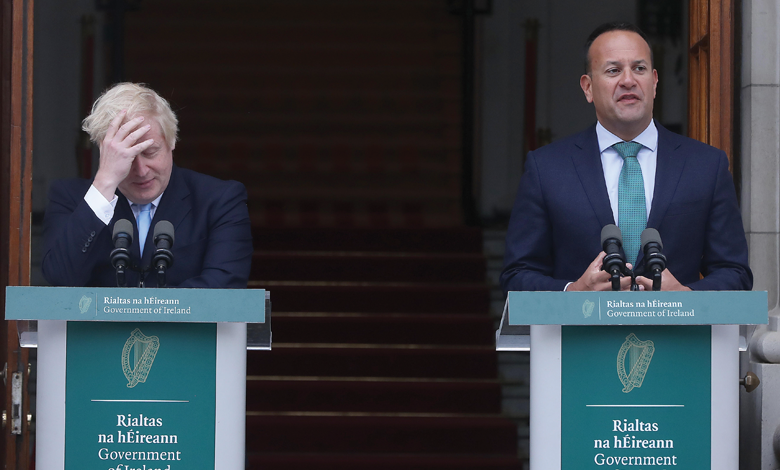
Replacing Kenny was Leo Varadkar, who served as Taoiseach from 2017 to 2020, before returning to the role between 2022 and 2024. Varadkar stated in July 2026 that securing a Brexit deal was his priority, and that this meant ensuring there was no hard border on the island of Ireland.
Varadkar secured some powerful allies, with the united support of the rest of the EU and, in a rare moment of bipartisanship, the United States Congress.
In 2018, the US House of Representatives expressed concern that “the United Kingdom’s negotiations to exit the European Union have created much uncertainty and concern on all sides as to how this would affect Northern Ireland and the Good Friday Agreement”.
Britain had, in the process, endangered its relationship with its most important ally, while uniting much of the Western political establishment behind Ireland’s position. This manifested itself in a much more serious way in 2019, when Speaker Nancy Pelosi warned that there was “no chance” of a US-UK trade deal passing Congress if a hard border were established on the island of Ireland.
‘The oven ready deal’
Following a politically miscalculated snap election in 2017, which stripped Theresa May of her parliamentary majority and forced her into a confidence-and-supply agreement with the DUP, the British position became much weaker.
British politics became embroiled in heated debate about whether Brexit was indeed the correct decision, and the ‘People’s Vote’ campaign, backed by Tony Blair, much of the Labour Party, the Liberal Democrats, and elements of the Conservative Party, gathered momentum. Through 2018 and 2019, May attempted to pass a deal which effectively kept the UK in the Customs Union, but failed three times.
In July 2019, following disastrous European elections for both the Conservative and Labour parties, the Tories rounded on May and elected Alexander Boris de Pfeffel Johnson as the new leader and UK Prime Minister.
Johnson had enjoyed a colourful political career which had been marked, up until 2016, by being pro-EU. BBC Newsnight reported in 2016 that Johnson, then a columnist for The Telegraph, had written both a ‘pro-remain’ and a ‘pro-leave’ draft, with his decision to support leave reportedly based on the calculation that Britain would vote to remain, but that his support for Brexit would secure his position among the Conservative Party’s substantial Eurosceptic wing.
“The protocol which has partitioned our country [the UK].”
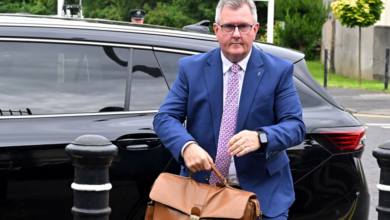
TUV leader Jim Allister MP
Johnson then set about a trail of destruction, illegally proroguing the British Parliament and, in light of its confidence-and-supply deal, and charming the DUP in the North that an Irish Sea border – which would have been avoided under Theresa May’s backstop proposal – would happen “over my dead body”.
Johnson later unveiled a deal which called for an end to Britain’s membership of the EU Single Market and Customs Union, while seeking to avoid a hard border in Ireland by placing customs procedures and checks on goods travelling between Great Britain and Northern Ireland.
After this deal initially failed to pass Parliament, and with the DUP withdrawing its support for the Tories, Johnson saw his chance. A landslide victory in the 2019 general election meant his Brexit deal would pass, with the concerns of Northern Ireland unionists over the Irish Sea border reduced to a footnote in British commentary on the deal.
Irish Sea border
As a sideshow to Brexit, early 2020 also saw the return of power-sharing in the North. However, growing opposition to the Irish Sea border by unionists ultimately saw the Stormont institutions collapse again in 2022, with the DUP withdrawing from the Executive specifically in protest against the Protocol and the trade barriers it created between Great Britain and Northern Ireland.
Varadkar recently reflected that he was told by a “very senior unionist MP” that “the one thing that a unionist can guarantee is that they will be betrayed by a Conservative British Prime Minister”.
Unionism had been lied to, and the by now-disgraced Johnson’s promise over the sea border now failed the straight-face test. It did, however, pass the legal test.
Jim Allister, now the MP for North Antrim and leader of the far-right TUV party, attempted to strike down the sea border through the courts, arguing that the arrangements violated the Acts of Union. Allister also consistently and, unironically, complained that his country had been “partitioned”.
However, the UK Supreme Court ruled in 2023: “The modification of article VI of the Acts of Union does not amount to a repeal of that article. The Acts of Union and article VI remain on the statute book but are modified to the extent and for the period during which the Protocol applies.”
The subsequent Windsor Framework was reached between the UK and EU in 2024, with the now-disgraced sex offender Jeffrey Donaldson having led the negotiations for northern unionists. Donaldson proceeded to pretend that through this new agreement, the sea border was gone even though checks remain in place. He was able to convince the DUP membership of this, which meant Stormont returned and continues to sit.
Broad reflections
The overwhelming reflection must be that Brexit has been an utterly pointless exercise, and that this has been a lost decade for Britain. One of the key themes in Britain was the need to ‘take back control of our borders’.
Rather than falling, immigration reached unprecedented levels in the years following Brexit. Long-term immigration peaked at 1.47 million in the year to March 2023, before falling to 813,000 in the year to December 2025.
The composition changed significantly following the end of free movement, with non-EU nationals accounting for 77 per cent of long-term immigration in 2025.
As for economic prosperity, the evidence is increasingly stark. The Economic Impact of Brexit, published by the National Bureau of Economic Research in November 2025, estimates that, by the end of 2025, Brexit had reduced UK GDP by 6-8 per cent, investment by 12-13 per cent, employment by 3-4 per cent, and productivity by 3-4 per cent, compared with a scenario in which Britain had not left the EU. The authors find that the economic impact accumulated steadily over the decade rather than arriving as a single shock.
Public opinion in Britain now shows a significant majority supporting re-entry into the EU. However, whether Britain would even be welcomed back into the EU, and on what terms, is another matter entirely.
As for Ireland, the State has weathered the storm and secured the upper hand in the monumental negotiations which followed the Brexit referendum. Ireland’s goods exports reached €223.7 billion in 2024, while its goods trade surplus reached a record €89 billion.
For the North, the years since Brexit have also been marked by a significant trade realignment, with north-south goods trade more than doubling. Goods trade north and south increased from approximately €4.9 billion in 2019 to €10.6 billion in 2024, an increase of around 116 per cent. The State’s exports to the North more than doubled over the period, while imports from Northern Ireland also increased substantially. This represents a striking shift in the economic relationship between Northern Ireland and the Republic in the years since Brexit.
Meanwhile, the prospect of a hard border returning on this island is as unlikely as it has ever been post-Good Friday Agreement. The political and economic architecture established since Brexit has instead entrenched arrangements designed to avoid a hard border, while Northern Ireland’s distinctive trading position has strengthened its economic links both north-south and east-west.