From the honours list to the sex offenders list
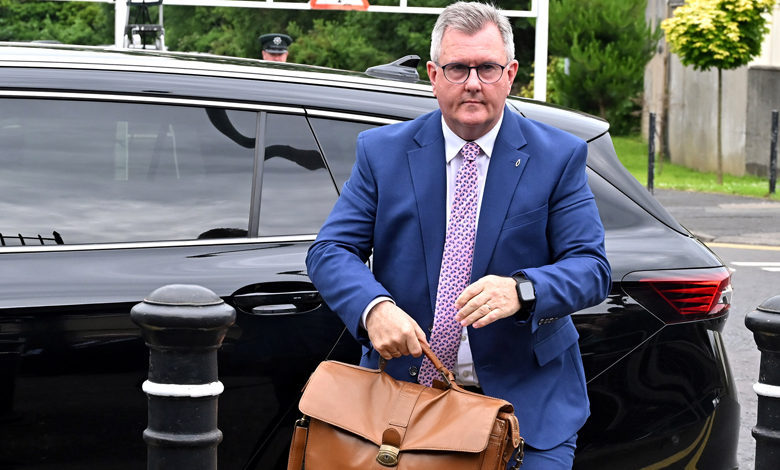
In June 2026, people across Ireland watched in stunned horror as Jeffrey Donaldson, the former leader of the DUP and one of the most influential figures in modern unionism, was convicted of sexually abusing two girls over more than two decades.
The verdict marked the dramatic downfall of a politician who had spent four decades at the centre of Northern Ireland politics and whose leadership was instrumental in restoring power sharing at Stormont in 2024. The case has profound implications not only for the DUP, but for the political settlement Donaldson helped to shape.
“Take Mr Donaldson down,” Judge Paul Ramsay said on 22 June 2026 after a jury at Newry Crown Court unanimously convicted Donaldson of 18 sexual offences, including one count of rape, committed against two girls between 1985 and 2008. Donaldson has been remanded in custody at Maghaberry Prison ahead of sentencing, with the court indicating he should expect a lengthy prison term.
His wife, Eleanor Donaldson, was proven to have aided and abetted five offences. However, because she underwent a trial of the facts due to mental ill-health, she received neither criminal convictions nor a custodial sentence.
Donaldson’s arrest in March 2024 came just days after he had returned from Washington DC following the restoration of devolved government at Stormont, where he was widely praised for securing DUP support for the Windsor Framework.
While this took place, two women had already made complaints to the PSNI and the DUP leader was under investigation. By the end of the month, he had been arrested and charged, bringing an abrupt end to one of the most significant careers in the North’s politics.
Crisis in the DUP
For more than two years, Donaldson’s criminal case hung over the DUP. Legal restrictions prevented extensive public comment while proceedings were ongoing, but his arrest cast a long shadow over the party’s electoral fortunes and leadership. Party figures later acknowledged that the case featured prominently on the doorstep during the 2024 general election campaign in which the DUP suffered significant losses.
When Donaldson was convicted, DUP leader Gavin Robinson issued an unequivocal statement condemning his predecessor.
“No one, regardless of status or position, can ever be above the law and Jeffrey Donaldson is no exception. Abuse, preying on the innocent, and taking advantage of the vulnerability of children in particular is evil.”
He added that the victims had shown that “perpetrators cannot outrun justice” and expressed the party’s sympathy for those affected.

While Robinson’s response reflected the gravity of the verdict, subsequent reporting has raised broader questions about the DUP’s internal culture. Investigations by BBC Spotlight, the Belfast Telegraph, and The Irish News suggested that concerns about aspects of Donaldson’s behaviour had circulated within political and security circles for years. Although separate from the offences for which he was convicted, these revelations have intensified scrutiny of how Donaldson rose to become party leader despite repeated concerns about his conduct.
At the centre of those questions is whether warning signs were missed or ignored. Ultimately, however, it was the testimony of two women, who endured years of legal proceedings and robust challenges to their evidence, that secured Donaldson’s conviction.
The DUP has since announced an independent inquiry into how Donaldson was able to rise through the party while engaging in behaviour that has now left unionism’s largest party facing the greatest crisis in its history.
Future of the Windsor Framework
Donaldson’s conviction has ramifications far beyond the DUP. The political arrangements that restored power sharing in February 2024 were secured under his leadership, with Donaldson negotiating the package that became known as the Windsor Framework settlement and persuading a divided party to return to government. His dramatic fall from grace inevitably casts a shadow over one of the defining political agreements of recent years.
The verdict also provided an opportunity for Donaldson’s political opponents to revisit longstanding arguments about the framework. Jim Allister, leader of the far-right Traditional Unionist Voice (TUV) party, has alleged that the UK Government may have used knowledge of Donaldson’s private life to pressure him into accepting the deal, an allegation the Northern Ireland Office (NIO) dismissed as “deeply distasteful” and “absolute nonsense”. No evidence has emerged to support claims of blackmail.
Subsequent reporting has established that, although the formal complaints leading to Donaldson’s prosecution were made to the PSNI in March 2024, police had earlier informal contact relating to one complainant and were gathering information before his arrest. While this timeline has fuelled political speculation, it does not substantiate claims that Donaldson’s negotiations with the UK Government were influenced by the criminal investigation.
Nevertheless, perception matters in politics. Opponents of the Windsor Framework have already begun referring to it as the ‘Donaldson deal’, seeking to undermine its credibility by associating it with the disgraced former DUP leader. Whether that argument gains wider traction remains uncertain, but initial polls have shown a sharp decline in support for the DUP in the North, with the Ulster Unionist Party now polling as the biggest party in unionism, and the TUV hot on the heels of the DUP.
Donaldson’s conviction represents far more than the downfall of an individual politician. It has plunged the DUP into its deepest crisis, prompted difficult questions about leadership and accountability within unionism, and reopened political debates many believed had been settled with the restoration of devolution. While justice has finally been delivered for two victims after decades of abuse, the political consequences of the case are likely to be felt for years to come.