
Enabling infrastructure delivery?
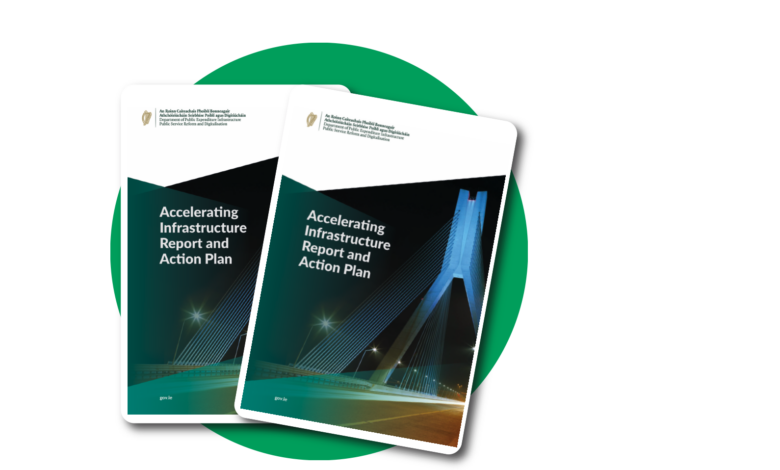
The Government is off track on goals to publish national planning statements for critical infrastructure by Q1 2027 and to deliver a review of the Office of the Planning Regulator contained in the Accelerating Infrastructure Report and Action Plan (AIRAP).
Published by the Department of Public Expenditure, Infrastructure, Public Service Reform and Digitalisation (DPER) in December 2025, AIRAP set aims to streamline planning and regulatory frameworks for critical infrastructure.
The action plan sets an aim to achieve this through national planning statements, regulatory simplification, legislative rationalisation, and agency process reform. Reforms also include “proactive engagement on EU legislation”, enabling developer-led delivery, and strengthening the Planning Regulator’s role in promoting consistency and sight of pipeline.
One of the most significant actions set by the plan was the publication of national planning statements (NPSs) for critical infrastructure between Q1 2026 and Q1 2027. The Department of Housing, Local Government and Heritage (DHLGH) is delivering this action.
NPSs are to replace the 28 ministerial guidelines provided for by the Planning and Development Act 2000. During a September 2026 Dáil Éireann debate, Minister of State at DHLGH Christopher O’Sullivan TD, said: “There are approximately 28 national planning statements that we are preparing at the moment.”
Under the Act, planning authorities and An Bord Pleanála (now An Coimisiún Pleanála) must have regard to the guidelines in the performance of their functions. The NPSs are intended to align with the policy objectives of the National Planning Framework.
DHLGH published an amended draft NPS for planning design standards for apartments in September 2026. In June 2026, draft NPSs for short-term letting (STL) and sustainable rural and Gaeltacht housing were approved. A finalised version of the STL NPS is expected in autumn 2026, while a finalised NPS for sustainable rural and Gaeltacht housing is expected before the end of 2026.
In April 2026, Minister for Housing James Browne TD indicated that NPSs relating to onshore wind energy development are being prepared. During a September 2026 Dáil debate, Minister of State O’Sullivan indicated that an NPS for solar energy is to be developed. With only three of 28 draft NPSs published 10 months into 2026, it is incredibly unlikely that this goal will be delivered upon.
Planning Regulator review
AIRAP sets an action to review the role and functions of the Office of the Planning Regulator (OPR) and “drive performance in the planning system, including consistency in decision-making”. This was to be achieved between Q2 and Q3 2026. The Government’s housing plan, Delivering Homes, Building Communities also recommended the OPR undergo review.
In March 2026, DHLGH announced that the review had commenced. This review is to determine the future role of the OPR, assess how best to align plan review, examination, and training functions in the planning system, and identify the optimal use of resources to achieve planning objectives.
Upon announcement, DHLGH set a completion date of Q2 2026 for the review. As of October 2026, the review has not yet been published. During a July 2026 Seanad Éireann debate, Senator Victor Boyhan said that the review has been completed and is “sitting on someone’s desk”. In reply, O’Sullivan said the review “is ongoing at the moment and will be finalised very shortly”.
National planning excellence framework
DHLGH is developing a national planning excellence framework (NPEF) “to examine the potential for improvement and innovation within the planning system”. Creation of the NPEF is also included in Delivering Homes, Building Communities. The Strategic Performance and Innovation Unit (SPIU), established within the planning division of DHLGH in 2025, is to develop the NPEF.
In June 2026, DHLGH published a discussion paper on the NPEF. It identifies development of the framework as “the next critical step in the planning reform journey”. Stakeholder feedback in response to the discussion paper was accepted by the SPIU up to 3 July 2026. In the discussion paper, DHLGH said a final draft of the framework was to be prepared by Q3 2026, with a view to final publication before the end of 2026.
Regulatory simplification
AIRAP asserts that there is “significant complexity in critical infrastructure delivery” due to a range of bodies conducting process for permissions, consents, and licences. This is deemed to delay critical infrastructure delivery. In February 2026, the Infrastructure Regulatory Simplification Unit was established within DPER, in line with an action in AIRAP.
The unit is to conduct a risk-based review of the current regulatory landscape to identify and remove bottlenecks in consenting, permitting, and licensing. It is also to support more effective delivery of the National Development Plan.
Furthermore, the unit is to simplify and improve consenting, permitting, and licensing systems across energy, transport, and water infrastructure to support housing delivery.
DPER tells eolas Magazine: “AIRAP continues to demonstrate strong momentum, with delivery remaining on track across all 30 actions and major reform measures progressing from policy development to implementation.”
The Department says the Critical Infrastructure Act 2026 has been introduced, and that the Government has designated the first nine critical infrastructure projects for delivery. Furthermore, the Planning and Development (Amendment) Act 2026 has been signed into law, and the Government has approved the drafting of the Strategic Environmental Assessment Bill 2026.
DPER says: “As of end-Q2 [2026], 95 per cent of all commitments were complete. Commitments due for completion in Q3 are currently being assessed, with Departmental owners due to report by mid-October [2026].
“It is expected from current updates the majority of these commitments will be marked complete. As work progresses into Q4 and beyond, the focus will remain on sustaining delivery, embedding reforms, and realising further benefits across the infrastructure system.”