Planning Scotland’s net zero transition
The Scottish Government’s Chief Planner, Fiona Simpson, outlines how the country’s National Planning Framework (NPF) is part of a long-term spatial strategy to drive its transition to net zero while also delivering infrastructure and driving economic development.

Fiona Simpson contextualises that the Scottish planning system’s purpose is defined by the 2019 Planning Act which states: “The purpose of planning is to manage the development and use of land in the long-term public interest.”
On this, Simpson says: “The emphasis on the long term is really important because that is where planning can really go much further than a lot of policies that might be subject to quicker review cycles.”
National Planning Framework
Introduced in 2023, the National Planning Framework 4 (NPF4) is Scotland’s fourth national spatial strategy. It sets out the country’s spatial principles, regional priorities, and for the first time, the national planning policies.
Simpson hails the requirement for the NPF to be approved by the Scottish Parliament, saying: “It is really positive to have that level of buy-in at a national scale to quite a radical planning document.”
The framework is supported by a delivery programme, detailing how action on the 33 national planning policies is to be taken forward. The 33 national planning policies are split into three separate sections; sustainable places, liveable places, and productive places.
The first section focuses on environmental goals in areas such as climate mitigation and adaptation, biodiversity, waste, and peatlands, which Simpson describes as a “very important issue in Scotland at the moment”.
The central policy of this section states: “When considering all development proposals significant weight will be given to the global climate and nature crises.”
Simpson says the second section focuses on “liveable places and is very people focused”. Its policies cover a range of topics including housing, 20-minute neighbourhoods, and flood risk.
The third section of the NPF focuses on economic development with policies devoted to tourism, community wealth-building, and rural development, although Simpson adds that there is a “sustainable emphasis built through those policies as well”.
The plan also includes 18 national developments, projects occurring across the country that place strong emphasis on the Scottish Government’s environmental goals.
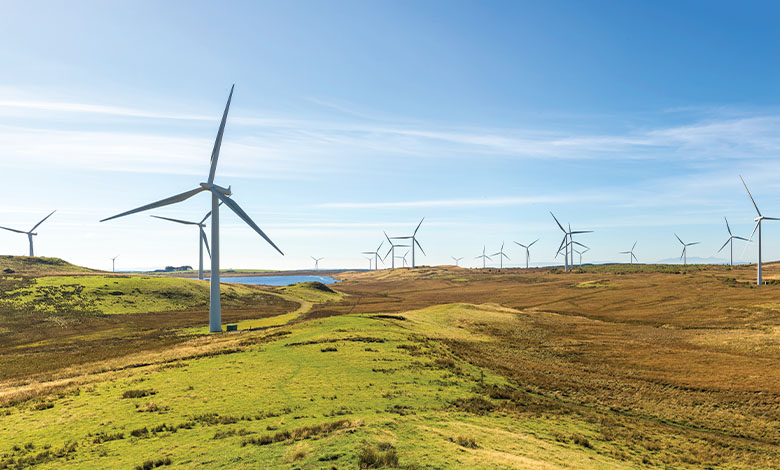
These include improving public transport across urban areas, expanding Aberdeen Harbour, and supporting renewable energy developments across the country, including in the Outer Hebrides, Shetland, and Orkney island groups.
Noting the large scale and scope of the framework, Simpson says: “When we brought forward the NPF, we were keen to make sure people understood the scale of the ambition and the speed of change that is required.”
Spatial strategy
Simpson describes the NPF’s policies as “a means of implementing what is a high-level and long-term spatial strategy”.
Describing this approach, Simpson says: “We took a strategic look at Scotland and rose above the administrative boundaries to think spatially where are the areas of common interest, challenge, and opportunity.”
Simpson details how each part of Scotland will have different areas of focus but there is a common goal of increasing sustainability and transitioning to net zero.
The chief planner says there is a big opportunity in the Highlands for the development of renewable energy, but that significant infrastructure is needed to support the transition.
Simpson says there are also significant opportunities in the blue economy in the islands and the north and west coast during the transition, noting that the links with marine planning are a key part of the strategy.
In the central area of the country, where Glasgow and Edinburgh are located, there is a focus on “urban greening and how we transform our cities and towns and smaller settlements into much more sustainable models of living”, says Simpson.
Challenges
Simpson says that due to the scale and scope of the NPF, there have been several challenges in implementing it.
“Although the aspiration was to have a single set of national planning policies that works throughout Scotland and makes the system more predictable, there is varying interpretation of national policy locally,” she says.
Simpson adds: “Often that is for very good reason, because the context is very different in different parts of the country.”
Another challenge faced by the Scottish Government is the perception by the development sector that the NPF has been a barrier to development. However, Simpson says this is not borne out by statistics, stating that around 92 per cent of all planning applications are approved and that has not changed significantly since the NPF was adopted.
Simpson adds: “The NPF often is a bit of a lightning rod for some of the challenges of our time and the planning system, whether it is in Scotland or in Ireland, is contending with all of these issues.”
Implementation
Much of the Scottish Government’s work on implementing the NPF has focused on providing guidance to local planning authorities.
The chief planner says her team have already produced guidance on a range of topics that affect planners, including climate change and greenhouse gas emissions, biodiversity, flood risk, and new technologies, such as battery energy storage systems, and hydrogen.
Simpson says: “It is not about government telling you who should do what. It is more about working together and exchanging good practice and learning from one another.”
The Scottish Government also created the National Planning Hub which provides help to planning authorities to access expertise and supports them with funding to broaden their service capacity.
Since its introduction in March 2026, this project has provided over £1 million of support in surge capacity to 50 projects across 20 planning authorities.
One example of this support, Simpson notes, is in Orkney where a flood risk survey assessment was supported by the hub, to help planners to better understand future development potential.
Concluding, Simpson highlights the important role effective planning policy can have on the local environment as well as on citizens’ lives: “Planning can and must drive change and that requires strong decisions and sometimes difficult choices.
“We have a responsibility to do the right thing for the environment, and a place-based approach can lock in much wider benefits.”