
Why HAP and the private rented sector must work

In 2021, Ireland signed the Lisbon Declaration, promising to work towards ending homelessness by 2030. The key question now is whether the Government remains committed to that declaration, writes Ber Grogan, Executive Director, Simon Communities of Ireland.
Ireland will not meet its commitment to end homelessness by 2030 through aspiration alone. It will be achieved, or not, through the everyday mechanics of our housing system. One of the most critical factors, for the moment, is whether people can actually access homes in the private rented sector through the Housing Assistance Payment (HAP).
Locked Out of the Market
For many years now, Simon Communities of Ireland (SCI) has been documenting the growing gap between housing policy intent and housing market reality. Our Locked Out of the Market series, published quarterly, offers a clear and troubling picture: people relying on HAP are increasingly excluded from the private rented sector, and that exclusion is directly feeding into homelessness.
HAP is an imperfect but necessary tool in tackling homelessness. Until such time where we have affordable, accessible, and appropriate housing for everyone who needs it, we will continue to require the private rental sector to play its part.
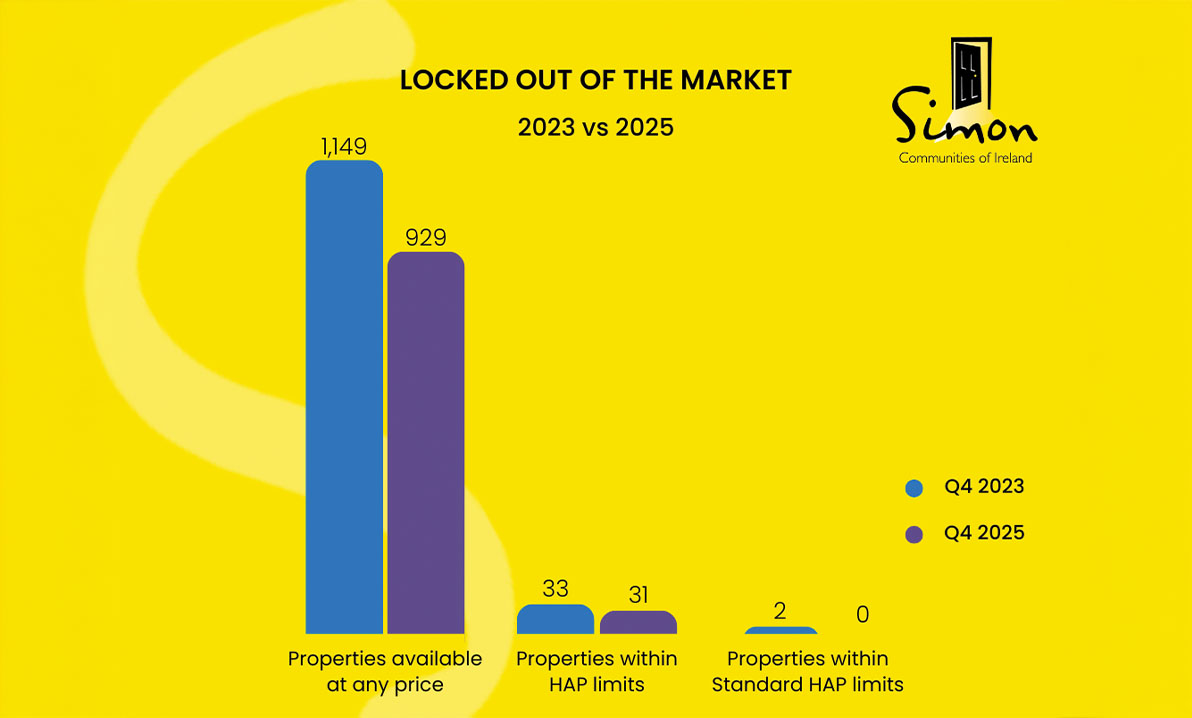
In 2023, our report showed that private rented homes within HAP limits were already extraordinarily difficult to find. Properties advertised as available within the relevant thresholds were rare, and in many areas effectively non-existent.
Even when rent limits nominally aligned with advertised prices, landlords routinely excluded tenants in receipt of HAP before any meaningful engagement could take place, despite this exclusion being illegal under our equality legislation.
In 2024, the situation deteriorated further. The quarterly snapshots documented a tightening market, driven by reduced supply, increased competition, and smaller landlords exiting the sector. The higher discretionary HAP limits were increasingly needed, but they still lagged far behind real market rents, particularly in high-pressure urban areas.
By the end of 2025, the pattern was unmistakable. Our most recent Locked Out of the Market report, for the end of Q4 2025, showed that the private rented sector was no longer simply difficult to access for HAP households, it had become structurally exclusionary. Households dependent on HAP were not “competing poorly” in the market; they were not competing at all.
Lived experience
At Simon Communities across Ireland, we see the human consequences of this failure every day. People with approvals in place, ready to move on, spend months searching unsuccessfully for properties that meet HAP criteria. One person in Cork told us that they were struggling to find places for HAP, that the cap does not match the rents and that a lot of landlords are not taking HAP anymore.
The Simon Communities of Ireland’s role is to ensure that these realities are reflected in policy decisions. Alongside delivering services, we engage intensively in representative and advocacy work. We make detailed submissions to public consultations, meet with policymakers, and use evidence like that from our Locked Out of the Market series, to demonstrate how current systems are falling short.
Ending homelessness
Despite some progress in social housing delivery and cost-rental development, we are not yet at a point where those routes can meet demand. Until supply is sufficient and all levers at the State’s disposal are used, the private rented sector remains an essential exit pathway from homelessness and a critical prevention tool.
The evidence points consistently to the same conclusion: HAP must be aligned with the actual functioning of the private rented sector if it is to play a credible role in ending and preventing homelessness. That means rent limits that reflect real market conditions, stronger measures to address discrimination, and greater security for tenants.
It also requires an honest conversation about the role of the private rented sector itself. Too often, it is framed as either a short-term stopgap or a problem to be solved away. In reality, it is currently doing some of the heavy lifting when it comes to housing low-income households. If that is to continue, even as we scale up public supply, it must be shaped and regulated in the public interest.
The Lisbon Declaration rightly places emphasis on prevention and rapid exits from homelessness. Neither is possible if people cannot access housing in the here and now. The Locked Out of the Market series shows that the gap between policy ambition and lived experience has widened over the past decade. Recognising that is not pessimism; it is a necessary starting point for reform.
There are grounds for confidence but only if we choose to act decisively. We know what changes would make HAP more effective. We know that security, affordability, and access reduce homelessness. And we know that evidence-led policy, informed by frontline experience, delivers better outcomes.
What is required now is urgency and alignment. Homelessness will not end by 2030 unless housing supports like HAP actually open doors. A regulated, affordable and accessible private rented sector, imperfect as it is, remains central to that task. Until we fix how HAP operates within it, too many people will remain locked out and homelessness will remain unresolved, not for lack of solutions, but for lack of implementation.
At Simon Communities of Ireland, we will continue to listen, document, challenge and advocate. Ending homelessness by 2030 is possible, but only if we all work together.
W: www.simon.ie