
Facilitating housing investment

In a significant reform, the Government’s new housing strategy, Delivering Homes, Building Communities 2025-2030, is placing emphasis on the need to create “the conditions to enable inward investment to fund new housing developments”, placing more emphasis on the role of private capital to solve the State’s housing crisis.
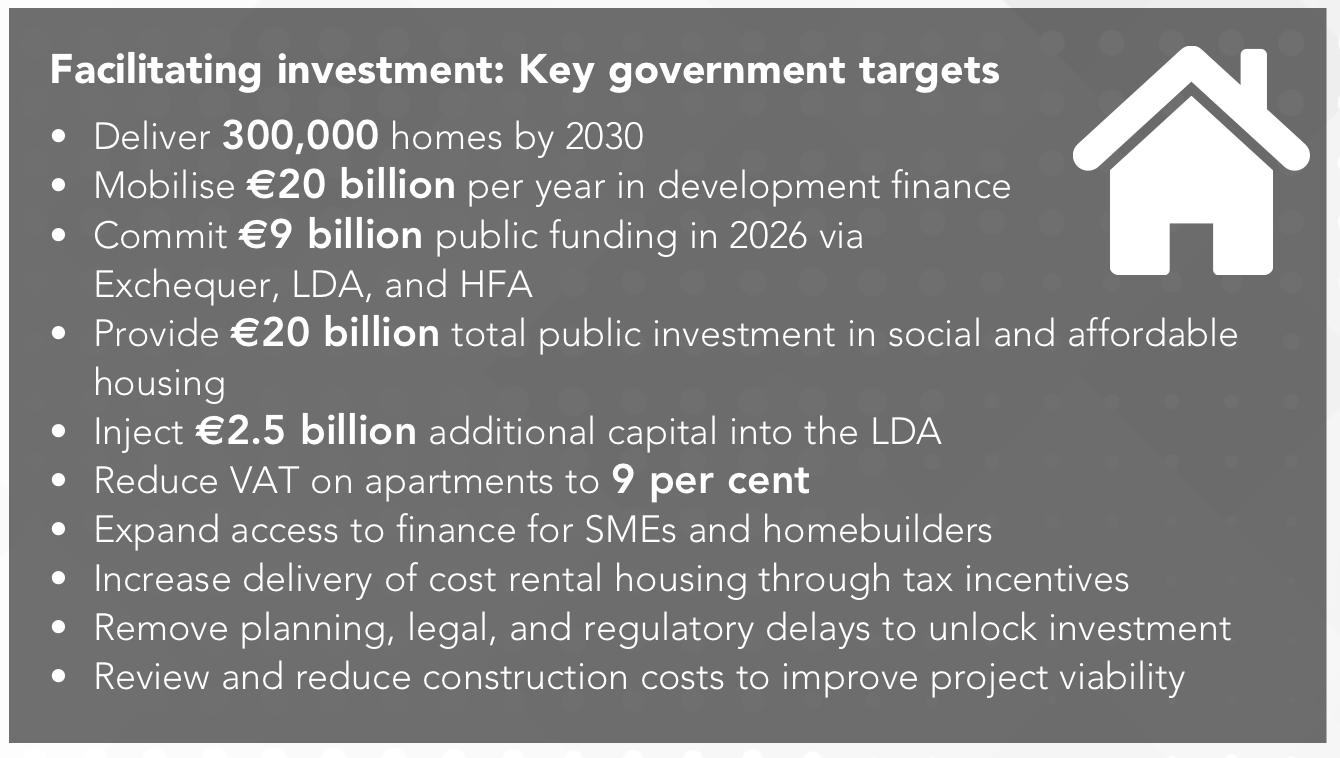
The Government argues that private sector investment holds the key to addressing the housing supply gap in urban areas, with the construction of apartments planned to play a key role in ensuring that 300,000 new homes are delivered by 2030.
This emphasis reflects a broader shift in housing policy from a system primarily focused on regulation and public provision to one that actively seeks to shape market conditions in order to stimulate large-scale delivery.
Central to this approach is the Government’s conviction that, in current market conditions, many developments, particularly apartments, are not financially viable with high construction costs, expensive land, and uncertainty around returns having combined to play a role in supressing supply, even in areas where demand is strong.
Aiming to address this, the strategy outlines a series of interventions designed to improve viability and attract both domestic and international capital. A key component is the State’s continued role as a direct investor.
Through mechanisms such as the National Development Plan, The Land Development Agency, and the Housing Finance Agency, the Government has committed substantial public funding aiming to de-risk development and provide a baseline level of activity. This is intended not only to deliver homes directly, but also to signal stability and confidence to private investors.
Private finance
The new housing strategy is increasingly oriented towards “crowding in” private finance. This involves reducing barriers to entry, improving certainty, and ensuring that the regulatory environment supports development.
One of the most significant measures proposed is the adjustment of tax policy to improve returns on residential projects. The reduction of VAT on apartments, alongside targeted corporation tax incentives for cost rental housing, is intended to directly lower development costs and enhance profitability.
These measures represent a clear attempt to recalibrate the financial equation for developers, particularly in higher-density urban schemes where margins have been under sustained pressure.
Alongside fiscal changes, the Government is also proposing reforms to apartment design standards. While framed as a means of improving viability, this aspect of the policy is likely to prove contentious. The argument advanced is that existing standards have contributed to elevated construction costs and reduced feasibility, and that, by introducing more flexibility, there can be a greater volume of apartment construction.
Another central pillar of the strategy is the reform of the rental framework. The plan acknowledges that investor confidence has been undermined by regulatory uncertainty, particularly in relation to rent controls and tenant protections. In response, it proposes a revised system designed to provide greater predictability over returns, while maintaining a degree of protection for renters.
Access to finance is also identified as a key constraint, particularly for small and medium-sized builders. The strategy includes measures to expand lending capacity and improve access to equity, recognising that a more diverse development sector is necessary to increase output. State-backed financing mechanisms are expected to play an important role in bridging funding gaps and supporting projects that might otherwise not proceed.
The Government has also committed to a review of construction costs, acknowledging that Ireland remains a high-cost environment for residential development. While the plan does not provide immediate solutions, it signals an intention to identify and address structural cost drivers over time.
The strategy also seeks to address non-financial barriers to delivery. Delays in the planning system, legal challenges, and regulatory complexity are all cited as factors that can undermine project viability.
Analysis
Taken together, the measures on financing Delivering Homes, Building Communities 2025-2030 represent a comprehensive attempt to reposition the State’s housing system as an attractive destination for private capital.
The Government’s case is essentially that without a significant increase in private investment, the scale of housing delivery required will not be achieved. This marks a more fiscally conservative approach than Housing for All which is highly market-dependent.
The success of this strategy will depend on its ability to balance competing objectives and how to manage the economic climate of the State given ongoing global volatility which has resulted in a rise in inflation and potential energy supply challenges to come.
In a joint foreword, Taoiseach Micheál Martin TD and Tánaiste Simon Harris TD say: “We will enable the private sector to deliver homes at much greater scale by providing more zoned and serviced land for housing right across the country; reducing planning, legal, and regulatory delays and uncertainties; radically increasing investment in public infrastructure; and providing greater certainty to both tenants and investors.”