
AHBs’ role in local authority housing delivery plans

Approved housing bodies (AHBs) are ready to play their part in the rollout of local authorities’ forthcoming housing delivery plans from 2027 to 2030, writes Donal McManus, CEO of the Irish Council for Social Housing (ICSH).
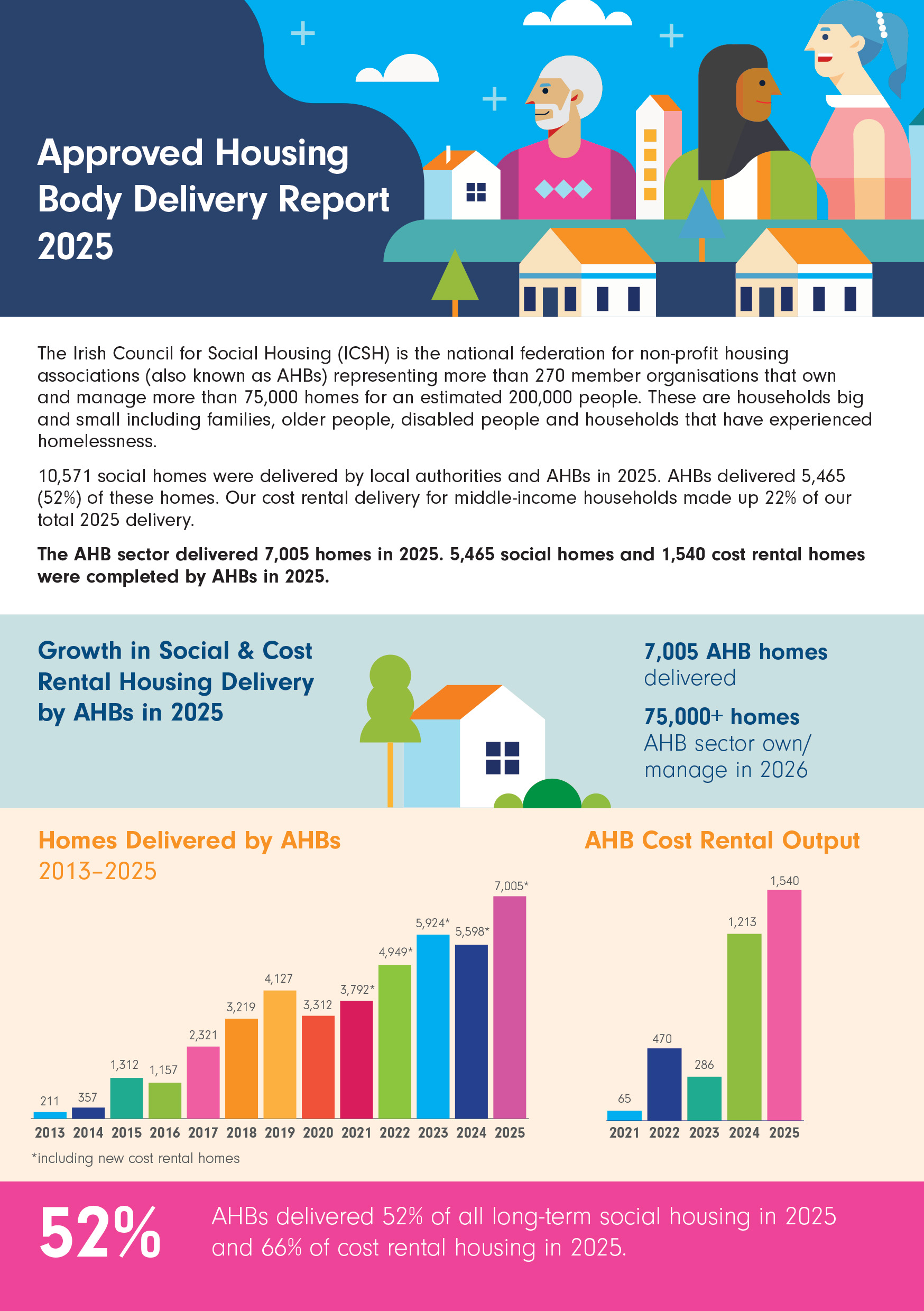
The AHB sector has grown significantly over the last 20 years to now owning and managing over 75,000 homes in 2026.
Social housing was primarily delivered by AHBs for families, older people, people with disabilities, former homeless households, and other target areas of specific housing need. However, since 2021 a small number of larger developing AHBs have been very active in providing the new cost rental tenure which has delivered much needed affordable cost rental homes in mix-tenure developments.
AHBs’ housing delivery has evolved to three-quarters of delivery being social rented housing and the remaining cost rental homes. This has been supported by government capital funding schemes which have underpinned and enabled AHBs to have increased annual delivery since 2014 from a few hundred homes per year to many thousands of new homes a decade later. The change has been significant.
In supporting this increased delivery, the AHB sector has worked with a huge range of delivery partners from the Department of Housing, Local Government and Heritage, local authorities, The Housing Agency, the Housing Finance Agency, the HSE, Dublin Regional Homeless Executive, private finance institutions, the private development sector, and the LDA.
Therefore, it is key that AHBs as willing delivery partners in future delivery and are engaged with as early as possible to ensure they and their plans are included as part of the targets for delivery in the local authority housing delivery plans.
Delivering homes
As far back as 2001, AHBs were tasked with playing their part in providing social rented homes to assist in meeting government delivery housing targets through various National Development Plans and later subsequent national housing plans such as the Social Housing Strategy, Rebuilding Ireland, and, more, recently Housing for All.
AHBs previously contributed around one-fifth of all new social housing in the 1990s and 2000s which has now risen to between 40 per cent and 50 per cent of all new social housing in recent years in different local authority areas.
Overall, during the last 30 years, AHBs have emerged from having a complementary role in social housing delivery to a more central one as well as diversifying the type of housing needs being met. In fact, the housing crisis would have been much worse for parts of the population if AHBs had not delivered over 30,000 social and cost rental homes since 2020.
In addition, with the introduction of cost rental housing in 2021 for those on moderate incomes, AHBs have been to the forefront and delivered over half of new cost rental homes with rents up to 30 per cent less than market rents.
AHBs, with their more singular focus in providing and managing housing, were able to retain much of their organisational capacity during the housing market collapse after 2008 at the time of the reduction or removal of capital funding and the AHB capital funding scheme.
Subsequently the sector was able to respond more quickly to the improvement in the housing market from 2014 with improved capital funding together with the CALF programme and opportunities that arose from using vacant homes and partnerships in the private sector.
Housing Europe, the European representative federation for EU social housing, has recently indicated the Irish AHB sector has grown the fastest out of other social housing sectors within the EU.

Record delivery in 2025
The latest ICSH AHB Sector activity report for 2025 shows the highest ever annual level of homes provided by the AHB sector with 7,005 social and cost rental homes delivered by AHBs. This was done through a range of programmes including CALF, CREL, and CAS.
Over half of total social housing and 66 per cent of total cost rental housing in 2025 was delivered by AHBs. Importantly, over the last five years, there has been a strong housing development pipeline that has emerged annually and this needs to be maintained.
Therefore, it is crucial that there is support to continue this strong progress such as access to funding, sites, and conditions of funding schemes that facilitate continued progress.
The proposals in the new national housing plan, Delivering Homes, Building Communities, and the development of the recommendations of the AHB Strategic Forum report will be key to further supporting and enhancing the capacity of the sector to meet social and affordable housing needs in local authority areas.
Housing options
Within future housing delivery plans, it will be key there are a range of types of delivery to meet housing need from one to two person homes for smaller households, to homes for larger families including homeless people where need is identified.
In recent years there have been increasing housing needs identified through housing needs assessments for key target groups such as the homeless households including those in emergency accommodation, people with disabilities, and older people.
These can be overlooked but are often groups that encounter the most housing exclusion as housing options to meet their needs are much more limited. There are a range of AHBs in the sector that have specific expertise and experience in delivering in this area and have the capacity to support local authorities. The AHB funding schemes should be organised to deliver for these groups.
Overall, while new policy initiatives emerge at national level, the AHB sector is still a willing partner to work with local authorities to assist them to meet their housing need.
Donal McManus is the CEO of the ICSH and Chair of Housing Europe ECOFIN and Internal Market Working Group.
W: www.icsh.ie