
Ireland a digital government leader

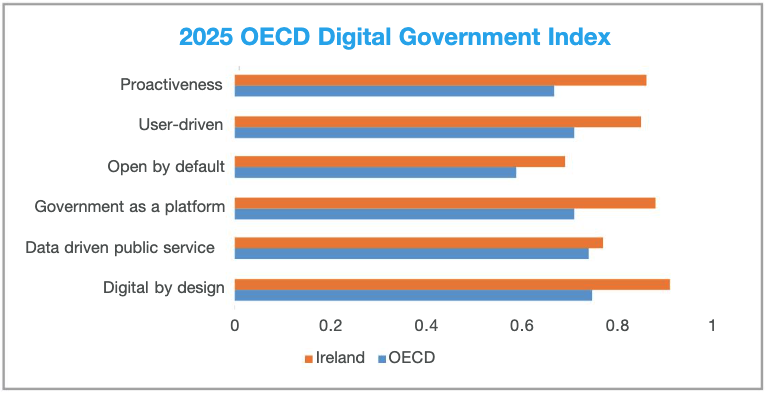
Ireland ranked seventh in the OECD’s 2025 Digital Government Index (DGI), scoring 0.83 against the OECD average of 0.70 as it increased its score by 0.12 from 2023.
The DGI assesses digital government policies and their implementation “through a whole-of-government and human-centred approach”, the OECD states. It assesses it across six dimensions comprising digital by design, data-driven public sector, government as a platform, open by default, user-driven, and proactiveness.
The OECD says Ireland’s results on digital by design, data-driven public sector, government as a platform, user-driven, and proactiveness show the State “has advanced in integrating digital technologies into government operations, developing shared platforms, and designing proactive and user-centred services”.
However, it also says the State’s performance on open by default suggests that it “could further strengthen efforts in promoting openness and transparency of government data processes”.
Separately, on the Open, Useful and Reusable data (OURdata) Index, Ireland scored 0.64, a 0.05 decrease from 2023 but still above the OECD average of 0.53. The OURdata Index assesses how effectively governments develop and implement open data strategies, engage stakeholders in data sharing and re-use, and ensure key datasets are publicly available.
The State scored 0.72 in data accessibility compared to the OECD average of 0.67. It scored 0.61 in data availability compared to the OECD average of 0.53. The OECD states: “These results reflect Ireland’s efforts in ensuring accessible open data and actively supporting its re-use.”
On government support for data re-use, the State scored 0.59 compared to the OECD average of 0.40. The OECD states: “This remains its comparatively lowest pillar. This suggests that Ireland could further strengthen mechanisms for monitoring the impact of open government data and promoting its re-use within and beyond government.”
The OECD asserts that the State has “established a comprehensive digital government governance structure”, and that a “comprehensive approach to building digital government skills” is in place. It also says user data and feedback are systematically integrated into service design and delivery.
Identifying opportunities for improvement, the OECD says the State’s framework for AI transparency could be further developed. The OECD says: “In particular, transparency instruments such as disclosure standards or guidelines for AI tools used in public decision-making are not yet in place. Developing such mechanisms could strengthen public accountability and trust.”
While the OECD notes “strong performance across several dimensions of digital public infrastructure”, it says this is “not yet fully matched by its data sharing and interoperability framework”.
“A formal interoperability system and associated requirements for data exchange between public institutions are not yet fully in place,” the OECD says. “Developing these capabilities could support more seamless service delivery across government.”