Nigel Farage and Ireland: A messy relationship
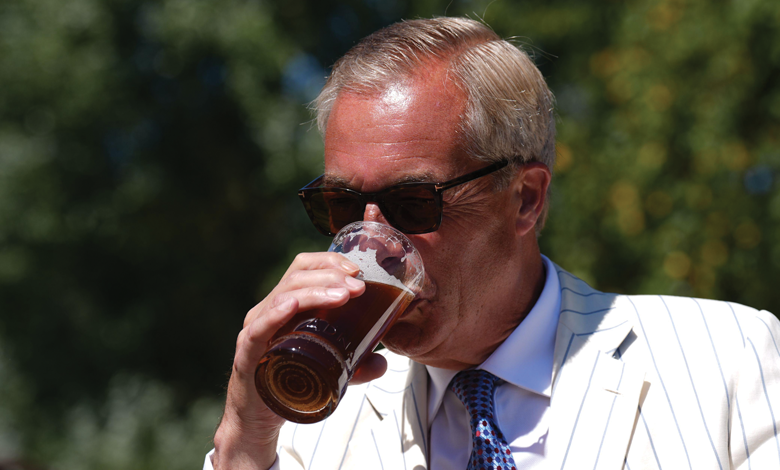
Between his Irish great-grandmother, friendly relations with the Sinn Féin president, campaigning against the Lisbon Treaty, saying “one day there will be a united Ireland”, and using the phrases ‘up the ra’ and ‘tiocfaidh ár lá’, Nigel Farage has shown himself to have a more complex relationship with Ireland than one would expect from an English nationalist.
In August 2026, Nigel Farage returned to Westminster after seeing off a byelection challenge from the formidable Count Binface. He had been under investigation by the UK’s Parliamentary Standards Commissioner over a £5 million gift from Thailand-based cryptocurrency billionaire Christopher Harborne, which Farage allegedly failed to declare. Upon his return to parliament, the investigation immediately re-opened.
In spite of this and the bounce in popularity in Britain for new Prime Minister Andy Burnham, Reform remains strong in the polls and the prospect of Farage moving into 10 Downing Street in 2029 creates a serious interest in Ireland in the man who could govern its closest neighbour after the next general election.
Farage’s relationship with Ireland is personal as well as political. His great-grandmother was Irish, while his first wife, Gráinne Hayes, was Irish, having met Farage in hospital in the 1980s while he was recovering from a car crash. This was one of Farage’s three close encounters with death, alongside surviving an airplane crash and a cancer diagnosis. Farage and Hayes later married and had two children before divorcing.
At the time, Farage was working as a commodities broker in the City of London while also active in the Conservative Party. He joined the UK Independence Party (UKIP) in 1993 after becoming disillusioned with the Conservatives over European integration such as the Exchange Rate Mechanism and the Maastricht Treaty.
UKIP remained a fringe party until its breakthrough in the 2004 European elections, when it finished third. It came second in 2009 before topping the poll in 2014.
Although UKIP failed to break through at Westminster, it pressured the Conservative government and played a central role in the 2016 Brexit referendum. Farage subsequently formed the Brexit Party in 2019, which was renamed Reform UK in 2021.
After stepping back from frontline politics in 2021, Farage remained prominent through a show on GB News and an appearance on I’m a Celebrity. He returned to politics in 2024, winning a Westminster seat at his eighth attempt.
Since then, dissatisfaction with the political establishment has boosted Reform’s prospects, with Farage remaining a serious contender to become prime minister at the next general election.
‘One day there will be a united Ireland’
In a fascinating and apparently drunken interview with The Irish Times in 2023, Farage revealed a lot about his relationship with this island, including his relationship with Sinn Féin president Mary Lou McDonald, who was an MEP between 2004 and 2009. He says of the Sinn Féin president: “We always got on well when she was in Europe.”
During the 2008 and 2009 Lisbon Treaty referendums, Farage travelled to Ireland to encourage a ‘no’ vote, sharing platforms with McDonald. He later recalled using EU money to produce an anti-Lisbon leaflet which was delivered to almost every household in Ireland.
After the second referendum passed in 2009, Farage said: “I guess history may well look back upon this day as being the day when the very short, brief period of Irish independence actually ended.”
However, Farage’s relationship with Ireland is not one-dimensional. He told The Irish Times that Britain has “this historical affinity with Ireland that can’t be lost” and that he has “huge love and respect for the Republic”.
He also spoke sympathetically about the 1916 Rising, acknowledging that the British government had “f***ed it up” and questioning whether executing its leaders had unnecessarily fuelled Irish nationalism. Farage said he possessed records and medals relating to an Irish soldier in the British Army, adding another curious dimension to his relationship with the island.
Of former Taoiseach Leo Varadkar, Farage claimed that he and the former Fine Gael leader “had some fun once or twice” and that Varadkar “even asked me for a selfie”.
The former MEP subsequently and astonishingly revealed that he believes a united Ireland is inevitable: “One day there will be a united Ireland, but it’s not on the horizon immediately just for practical reasons.”
This belief is perhaps at the core of Farage’s murky relationship with unionists in the North. A source once revealed to eolas Magazine that Farage takes pleasure in teasing Northern Ireland unionists in the House of Commons by referring to them as ‘Paddy’, a joke which is reportedly and unsurprisingly not appreciated by the North’s unionist MPs.
Before Farage returned to frontline politics in 2024, Reform was in an electoral alliance with Jim Allister’s TUV party in the North. Farage, however, personally endorsed the DUP’s Ian Paisley and Sammy Wilson, despite Reform continuing to back Allister under its electoral arrangement with the TUV.
Paisley subsequently lost North Antrim to Allister, ending 54 years of Paisley family representation in the constituency. Allister later failed to take the Reform whip in the House of Commons.
‘Up the ra Nigel?’
Daft and ill-thought miscalculations are at the heart of Farage’s approach to politics. When he was ‘retired’ from politics, the Reform leader decided to follow many celebrities and read out messages in return for cash payments on the Cameo website.
Farage subsequently spent the Covid years reading out requests including wishing someone a happy birthday by saluting and saying “up the ra”, and unwittingly recording a message apparently intended to invoke Gerry Adams, complete with a reference to a fictitious ‘tiocfaidh ár lá’ bar “in Brighton”.
Farage was infamously called out on the “up the ra” video RTÉ presenter Claire Byrne in a 2021 television interview. Farage was calling for Ireland to leave the European Union: “Why don’t you ask yourselves in Dublin the question – why did you fight the British? Why did Irish nationalists fight the British for 500 [sic] years?” Farage said.
Interjecting to play the infamous video, Byrne then said: “Up the ra, Nigel? I mean I know you said sorry, I know that you get 87 quid, that’s entirely within your rights to do that.”
Analysis
Farage presents as a schoolboy messer who often lacks serious political conviction. It is difficult to believe, given his Irish ancestry, Irish marriage, close dealings with members of Sinn Féin and long political engagement with Ireland, that he did not understand the significance of ‘up the ra’.
The more convincing explanation is that, in his mind, the allure of money, combined with the controversial nature of the remarks, simply outweighs the risk of looking foolish.
Therefore, while Farage’s popularity is being driven largely by a tidal wave of right-wing nationalism and anti-immigration rhetoric, it is, as John Major once described it, “not the politics of conviction but convenience” that motivates this undoubtedly charismatic politician.
If he does indeed reside in Downing Street after the next general election, it is entirely possible that Farage could become the British leader who ends the partition of Ireland. However, it is just as possible that such an unserious administration, with such a rash decision-maker at the helm, could be hostile towards Ireland.