‘A thundering disgrace’: The resignation which saved the presidency
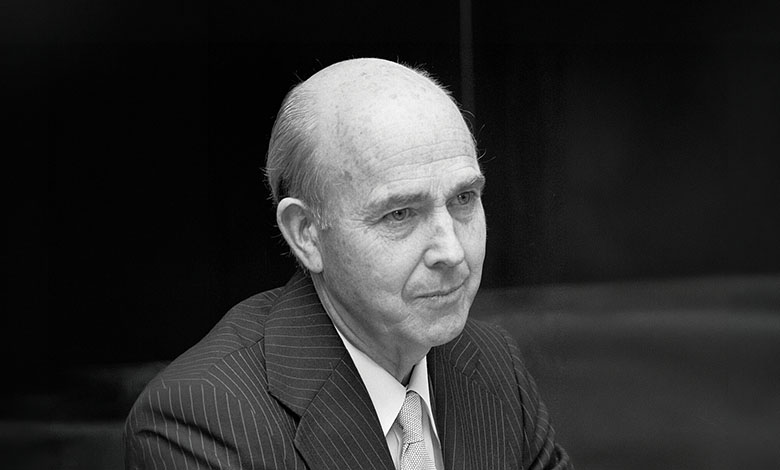
October 2026 marks 50 years since the resignation of Cearbhall Ó Dálaigh as President of Ireland. Joshua Murray looks back at the constitutional crisis which culminated in Ó Dálaigh’s resignation, and how his decision to resign arguably saved the presidency as an institution.
Cearbhall Ó Dálaigh resigned as President of Ireland on 22 October 1976, following a political crisis involving the Government’s emergency legislation regarding the Provisional IRA, Defence Minister Paddy Donegan, and Taoiseach Liam Cosgrave.
The crisis followed the IRA’s assassination of Christopher Ewart-Biggs, the British ambassador to Ireland, in July 1976. In response, the Fine Gael-Labour coalition introduced the Emergency Powers Bill, which provided for the detention of people suspected of involvement in paramilitary violence for up to seven days without charge.
Ó Dálaigh’s background was of a former Chief Justice rather than a political one. In this context, he referred the Bill to the Supreme Court under Article 26 of Bunreacht na hÉireann to test its constitutionality. The Court subsequently found the legislation constitutional.
The decision angered some members of the Government. On 18 October 1976, at an Army function in Mullingar, Donegan controversially and publicly criticised Ó Dálaigh’s decision and infamously described the President as a “thundering disgrace”. He also said that the Army must stand behind the State. Donegan offered his resignation to Cosgrave later that day, but the Taoiseach refused to accept it.
Donegan subsequently expressed regret and sought to apologise to Ó Dálaigh. The President declined to meet him. The following day, Cosgrave defended Donegan in the Dáil, acknowledging that he had made a serious and disrespectful comment about the President, but retained him in government. Ó Dálaigh resigned three days later.
Personal disagreement
Donegan’s relationship with Cosgrave was another factor. The two were close political associates, and Donegan was regarded as strongly committed to the Government’s security policy.
According to later accounts, Donegan had also been affected by a serious car accident shortly before the Mullingar function and subsequently said he had been concussed. A former Defence Forces source says that during his time in office, Donegan was known for heavy drinking. Donegan nevertheless maintained that alcohol was not responsible for his remarks.
According to former minister Paddy Cooney, who was present, Donegan’s remarks were directed at the President’s decision rather than Ó Dálaigh personally. Cooney nevertheless recognised immediately that the comments were politically and constitutionally serious and informed Cosgrave.
What was the constitutional crisis?
The constitutional issue centred on Article 26 of the Constitution, which gives the President a specific role in scrutinising Bills passed by the Oireachtas. Where the President considers that a Bill, or a specified provision of it, may be unconstitutional, he or she may refer the question of its constitutionality to the Supreme Court after consulting the Council of State.
The President is not bound by the Council of State’s advice. In 1976, Ó Dálaigh proceeded with the referral despite the Council having advised against it. The Supreme Court subsequently upheld the legislation.
The significance of the episode was therefore not that Ó Dálaigh had attempted to prevent the Government from introducing its security measures. Article 26 did not give him a political veto over legislation. Rather, it gave him a constitutional mechanism through which the Supreme Court could determine whether legislation complied with the Constitution. Once the Court had upheld the Bill, the President was constitutionally required to sign it.
The wider constitutional tension concerned the independence of the presidency. The President is head of state and is required to exercise certain constitutional functions independently, even though executive government is carried out by the Government. The Taoiseach also has constitutional responsibilities towards the President, including keeping the President generally informed on matters of domestic and international policy.
According to contemporary and subsequent accounts, the dispute had deeper roots than Donegan’s outburst in Mullingar. Ó Dálaigh had already become frustrated by what he regarded as Cosgrave’s failure to keep him properly informed about government affairs. According to his private papers, he believed the Taoiseach was failing to meet a constitutional obligation by not keeping the President generally informed about domestic and international policy.
According to accounts of the 1976 State papers, Cosgrave was also deeply irritated by Ó Dálaigh’s decision to refer the Emergency Powers Bill to the Supreme Court. The Council of State had advised against the referral, and the Taoiseach regarded the decision as unnecessary amid the Fine Gael-Labour coalition’s strong stance against the IRA’s campaign.
Saving the institution
In his resignation statement, Ó Dálaigh said that resignation was the only course available to him to assert publicly his personal integrity and independence as President.
The episode caused a major political crisis and damaged the standing of the coalition government. For the presidency, however, Ó Dálaigh’s decision to resign arguably saved the institution, and also put the initial steps in place for the role to evolve in the manner it has since.
While Patrick Hillery, who was subsequently chosen as Ó Dálaigh’s successor and was inaugurated in December 1976, was a fairly quiet president, Mary Robinson, Mary McAleese, Michael D Higgins, and Catherine Connolly have overseen the transition of the presidency into an office with soft power. They have frequently used the office’s constitutional and soft powers to refer legislation to the Supreme Court, build relations in the North, and express views contrary to government policy citing their mandates.
As a result, Irish presidents have consistently enjoyed significantly higher approval rating and larger mandates than any political party in office, suggesting that the office enjoys a high level of public confidence and serves society well.