Elevate: Advancing the inclusive workplace

Business in the Community Ireland (BITCI) is a leader in sustainability and social inclusion. Through its work, BITCI supports companies to integrate social and environmental responsibility into their core operations, recognising business as a powerful force for positive societal change, writes Richa Tyagi, sustainability adviser at BITCI.
A central pillar of BITCI’s mission is social inclusion, with a particular focus on tackling inequality, disadvantage, and exclusion in the Irish labour market.
BITCI’s Social Inclusion Programme works with employers to address barriers faced by groups experiencing disadvantage including people experiencing socio-economic inequality, people with disabilities or health conditions, ethnic minority communities, migrants, members of the Traveller Community, lone parents, carers, and others who are underrepresented in quality employment.
This work is grounded in the belief that inclusive workplaces are not only fairer, but stronger, more innovative, and more sustainable.
Elevate: The Inclusive Workplace Pledge
In 2021, existing inequalities in Ireland were exposed and intensified. The social and economic impacts of the Covid pandemic disproportionately affected minority groups and those already experiencing disadvantage.
Evidence at the time showed that:
• low-paid and insecure workers were more vulnerable to job loss and income instability;
• ethnic minority communities experienced greater risks of poor health and disproportionate unemployment or under-employment;
• people with disabilities faced increased barriers to accessing and retaining work; and
• women, particularly lone parents and carers, experienced heightened economic and care-related pressures.
While many organisations voiced support for inclusion, it became clear that passive commitment was not enough. Without clear targets, data, leadership accountability, and changes to systems and practices, inequalities persisted. Business had, and continues to have, a critical role to play in reducing disadvantage through deliberate, inclusive employment practices.
BITCI launched Elevate: The Inclusive Workplace Pledge to move beyond awareness-raising and towards measurable, practical action by business. While many organisations expressed a commitment to equality, diversity, and inclusion, there was a recognised gap between intention and impact. The Elevate Pledge was designed to provide employers with:
• a clear framework for taking action on inclusion;
• evidence-informed guidance and learning;
• accountability through benchmarking and progress reporting; and
• a collective space for leadership, learning and peer influence.
By signing the Elevate Pledge, organisations committed to embedding inclusion across recruitment, progression, culture, and leadership recognising that systemic inequalities require structured and sustained responses.
Five years on
By 2025, the context for inclusion in Ireland had evolved. There were areas of progress alongside persistent and, in some cases, emerging challenges. Some of the positive developments observed include:
• greater awareness of structural inequality and bias in workplaces;
• improved data on workforce diversity in some sectors;
• increased leadership engagement on DE&I issues; and
• stronger focus on inclusive recruitment, flexible work, and wellbeing.
However, challenges remain. Labour market inequalities continue to affect certain groups disproportionately, with gaps in representation, progression, and job quality still evident. Research confirms the following:
• rising discrimination in workplaces;
• marginalised groups still face significant barriers to employment;
• under-employment of skilled and qualified workers in ethnic minority communities persists;
• migrant workers experience systemic exploitation;
• experiences of workplace bullying and harassment are widespread amongst LGBTQIA+ employees;
• disability inclusion in the workplace remains limited; and
• socio-economic inequality continues to affect work opportunities.
Additionally, economic uncertainty, cost-of-living pressures, and changing patterns of work have underscored the risk that progress can stall or reverse without sustained commitment. In this context, intentional, evidence-based action by employers remains essential.
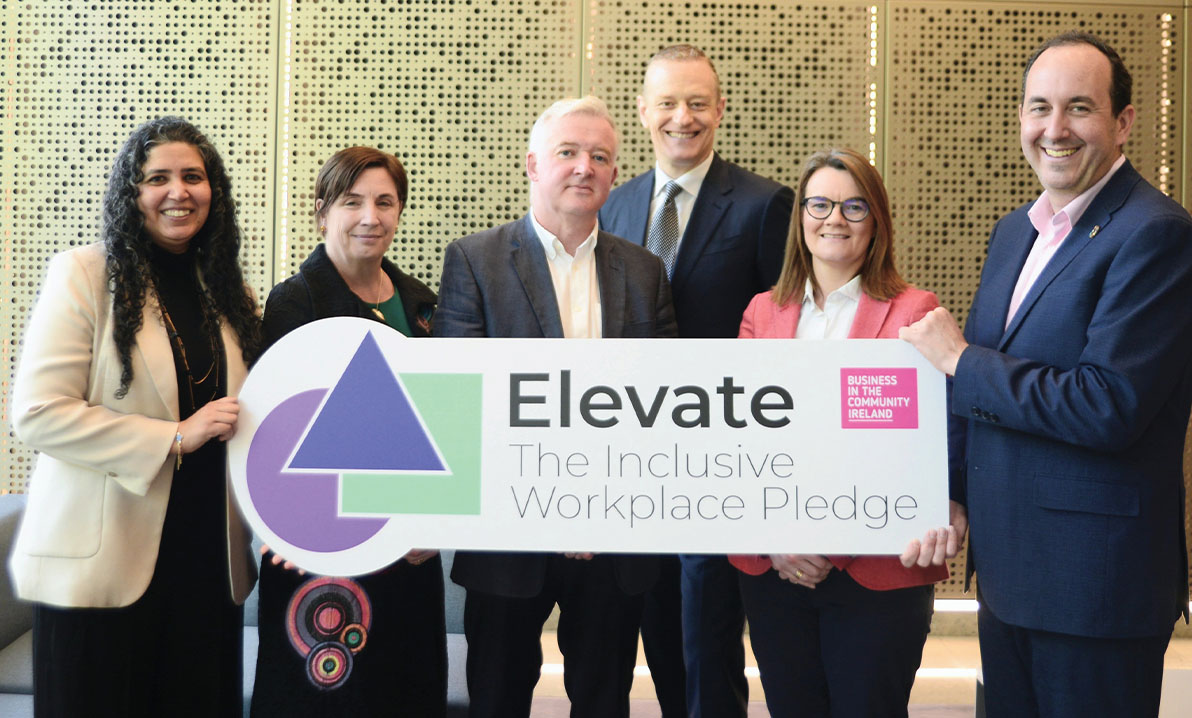
Progress by Elevate Pledge signatories
Over five years, organisations that signed up to the Elevate Pledge have demonstrated progress in embedding inclusive practices. Through engagement with BITCI supports and reporting frameworks, many signatories have:
• developed clearer inclusion strategies aligned with business objectives;
• introduced fairer and more inclusive recruitment and onboarding practices;
• strengthened supports for employees experiencing socio-economic disadvantage;
• improved leadership capability and accountability for inclusion; and
• begun measuring workforce diversity and inclusion outcomes more systematically.
Findings published in Elevate reports indicate that Pledge signatories are increasingly moving from intent to action, with signs of cultural and structural change emerging over time. While progress is not uniform, the evidence suggests organisations that commit to a structured, long-term approach are better positioned to improve inclusion outcomes.
For example, many Elevate signatories have refreshed their hiring and progression criteria to prioritise potential over rigid qualification requirements or expectations of experience that may unintentionally exclude non-traditional applicants.
Initiatives like inclusion passports help people with disabilities or caring responsibilities access reasonable accommodations and overcome hidden barriers.
To make these initiatives work, Elevate signatories are also strengthening leadership through inclusive leadership training for senior leaders and reverse mentoring. Together, these actions help embed a culture of inclusion, improve employee experience, and increase access to opportunity.
Call to action
Inequality remains one of the defining social challenges of our time. Business has both the influence and the responsibility to contribute to solutions. BITCI calls on businesses to:
• move beyond statements of intent and invest in sustained, measurable action;
• use data and employee insight to understand who is being left behind;
• embed inclusion across leadership, systems, and everyday practice;
• learn from peers and evidence through initiatives such as Elevate; and
• commit to long-term cultural and structural change.
Inclusion is not optional; it is a business necessity and a driver of long-term success. It requires deliberate action, transparency, and accountability.
Elevate: The Inclusive Workplace Pledge provides a practical pathway for organisations that want to lead with integrity, impact, and purpose. By acting intentionally, business can help build a more inclusive labour market and a more equitable society for all.
W: www.bitc.ie