Empowering Ireland’s disabled people
It is impossible to talk about genuine social inclusion without considering the more than 21 per cent of our population who have a disability.
The National Disability Authority (NDA) has a role to advise the public sector on ways to improve inclusion while also monitoring progress against various strategies, policies and legislation. In doing so we highlight examples of good practice and identify areas where further focus is required.
The NDA is the independent statutory body with a duty to provide evidence-informed advice and guidance directly to government on disability policy and practice. Established under the NDA Act of 1999, the organisation has seen its role and remit evolve and grow over the last quarter century in response to increased focus on the State’s efforts to foster an inclusive society.
The NDA is also lucky to have within it the only statutory Centre for Excellence in Universal Design (CEUD) in the world. Universal Design is the design and composition of physical and digital environments, products and services, so that they can be accessed, used and understood by all users, regardless of age, size, ability or disability.
National Human Rights Strategy for Disabled People
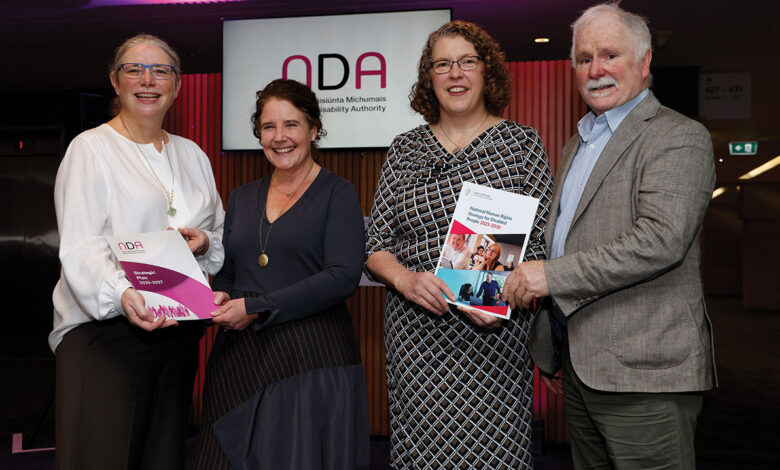
In September 2025, the Government published its National Human Rights Strategy for Disabled People 2025-2030 (NHRSDP). This articulates a whole-of-government commitment to realising the rights of disabled people.
The five pillars under the Strategy recognise the domains of life which we can take for granted, but where many disabled people can encounter barriers to inclusion. Government departments and public bodies have since set out their action plans to address these barriers, and the NDA has a role to monitor progress against these plans, but also to provide data and evidence to inform policy decisions.
It is a strategy for the full life course, looking at education, employment, independent life in the community, health and wellbeing, and transport and mobility.
Education and employment
The Strategy recognises that genuine inclusion begins early in life, where places of childcare, education and learning are universally designed to meet the needs of the full population, and the physical environment, curricula and assessment processes also recognise the varied requirements of those teaching and learning within these settings.
Employment is also recognised as a key enabler of social and economic inclusion. Over the past number of years, the NDA has carried out research with partners such as the ESRI and OECD showing that Ireland has one of the largest employment gaps for disabled people in the EU27 and OECD. The gap between the percentage of disabled people of working age in employment and the percentage of their non-disabled peers is 22 percentage points and has proven a difficult gap to close. People are watching closely to see if the implementation of the new Strategy will be successful in narrowing the gap.
One of the NDA’s annual responsibilities is to report on the proportion of the public sector workforce made up of disabled people. In 2024, 5.4 per cent of employees in this sector declared a disability, exceeding the minimum target for that year which was 4.5 per cent.
Analysis of the 2025 figures will begin shortly, applying a newly increased target of 6 per cent. Success is not just about meeting the target but in creating truly inclusive workplaces where disabled people can have confidence that they will receive the accommodations they need to fully achieve their potential.
Our research has shown that most accommodations cost little or nothing, and can range from allowing flexibility with regard to working patterns, ensuring office spaces are fully accessible, to designing job specs that focus on the truly essential requirements of the role rather than criteria that are often automatically included for example, clean driving license, but which may never be called on or can be easily adapted. Some of our work involves sharing evidence about good practice in this area with other public bodies so that employers can feel confident and empowered in tapping into this talented and under-utilised labour force.
Monitoring: What gets measured gets managed
We have other statutory monitoring responsibilities that ensure we keep a focus on aspects of public services that can foster rather than hinder participation and inclusion. We monitor how public body websites meet the requirements of the EU Web Accessibility Directive, seeing improvements in performance year-on-year as a result.
We also examine how public bodies meet their obligations under the Disability Act 2005 to provide accessible services and information, as well as implementation of the Irish Sign Language Act of 2017. The evidence-base provided through these monitoring activities is key to driving continuous progress across the public sector, and we balance this with provision of practical information and guidance to help public bodies on their journey.
Meaningful engagement
Policy decisions related to disability should always be informed by the voice of those impacted. Disability groups often use the phrase ‘nothing about us, without us’. As a party to the United Nations Convention on the Rights of Persons with Disabilities (UNCRPD), the State is required to closely consult and engage with disabled people through their representative organisations (called Disabled Persons’ Organisations) on all relevant policy matters. An example of this process was evident in the development of the NHRSDP, including wide-ranging consultation and co-design of the finished product. This is still an area that is new to many public bodies, however, and the NDA has developed practical guidance to help them along this journey.
This type of engagement with people with disabilities reminds us of the day-to-day challenges experienced by so many in the disabled community, including inaccessible infrastructure such as buildings, transport, and public spaces in our towns and communities. Public bodies should also give consideration to staff training in disability equality and evolving language relating to disability.
Access to suitable housing is a significant challenge for many disabled people, highlighting the need for a stock of universally designed housing to enable disabled people to live ordinary lives in ordinary places. There is also a well-documented additional cost for many to having a disability, as well as challenges in navigating access to publicly funded services and supports. Without addressing these challenges, disabled people can find themselves continuously marginalised and excluded from the socioeconomic life of the State.
W: www.nda.ie