Home truth: Ireland’s housing crisis needs a new delivery playbook

Ireland has the will and the funding to solve the housing crisis; now it is about building the delivery machinery to match, writes Ronan Devlin, Central Government Portfolio Director at Jacobs.
After nearly a decade in London working on global infrastructure programmes and large-scale regeneration, I have returned to Ireland. Much has changed for the better. The National Development Plan is channelling unprecedented investment, confidence has returned, and there is a renewed appetite for long-term thinking. Ireland is thinking big again.
Yet the gap between ambition and delivery remains painfully clear.
For me, this is both professional and personal. I have worked on infrastructure programmes that reshaped cities: rail corridors that unlocked tens of thousands of homes, Olympic venues converted into thriving neighbourhoods, new towns delivered at pace. I have seen what happens when ambition meets delivery capability and when it does not.
Ireland’s housing crisis is less about resources or intent, and more about how delivery is currently structured. Demographic pressures, returning talent and infrastructure expansion demand a fundamentally different approach. The Government’s target to deliver 300,000 homes by 2030, including 72,000 social homes, is ambitious, but achievable if we adapt the best international lessons.
The current arithmetic is unforgiving. Ireland delivered 36,000 homes in 2025, an improvement on previous years, but still 14,000 short of the 50,000 annual average needed to meet the Government’s 2030 target. Even optimistic forecasts project 40,000 completions by 2026. On current trajectory, Ireland will deliver perhaps 240,000 homes by 2030, leaving 60,000 families without the housing promised. Incrementalism is not working. The gap is not closing fast enough.
Moving beyond incremental change: building new towns at scale
Urban development zones, as proposed in the Planning and Development Act 2024, are sensible in theory: focused development, coordinated infrastructure and streamlined planning. In practice, they can struggle to deliver at the pace now required. Fragmented land ownership, limited compulsion powers and complex institutional coordination mean they often encourage development rather than enable it at scale in a timescale that addresses immediate delivery needs. The result is likely to be incremental growth where transformation is needed.
The UK’s post-war New Towns programme took a different approach. Dedicated development corporations were given land-assembly powers, long-term funding certainty and a mandate to deliver complete communities: housing alongside transport, utilities, schools, green space and jobs. Milton Keynes, Stevenage, and Harlow were not accidents but planned outcomes that now house more than 2.8 million people.
Ireland now has an opportunity to do something similar. The Land Development Agency has made important progress in the delivery of housing since its establishment, particularly in the area of affordable housing. While well-funded and well-intentioned, its remit remains constrained. The LDA has a focus on state-owned land, has limited compulsory acquisition powers, and operates within fragmented planning structures. Critically, it cannot create entirely new settlements with integrated governance. The LDA has access to the new Housing Infrastructure Investment Fund, with €1 billion committed over five years to unlock enabling infrastructure. This is a significant step but funding alone is not sufficient.
Ireland needs a true development corporation: a body with authority over defined geography, the power to assemble land, and capacity to coordinate utilities, transport and housing delivery with clear accountability and pace. Infrastructure remains a binding constraint. Water, wastewater and grid capacity already limit housing growth. These challenges cannot be solved project by project; they require coordinated, place-based delivery.
The UK’s New Towns Taskforce provides a live case study. Planning up to 12 new communities of 10,000 homes each, its focus is removing delivery friction rather rewriting policy. New towns succeed when governance matches ambition.
Build housing around trains, not roads
Transit-oriented development is one of the most powerful delivery accelerators available. Concentrating higher-density housing around quality public transport reduces car dependency, lowers commuting costs, tackles land scarcity and supports climate targets.
I have seen this on East West Rail, connecting Oxford, Milton Keynes and Cambridge. With over 100,000 new homes planned along its length, the railway offers more than transport; it is a growth corridor. Stations become anchors for housing, employment and investment.
Ireland has a similar opportunity, particularly along the Dublin-Belfast corridor, home to roughly a third of the island’s population. Programmes like MetroLink, DART+ and regional rail investment are transformational. Yet transport and housing still operate in parallel: separate departments, funding models and statutory processes. Rail is delivered first, followed by years of debate about what can be built around stations.
While the Dublin-Belfast corridor is an obvious starting point, given its population density and committed transport investment, the same model applies elsewhere. The Cork-Limerick-Shannon axis and Galway-Athlone-Dublin corridor are both suited to building new transit-led communities. The objective is not to prioritise one corridor over others, but to establish a repeatable delivery model that can be scaled nationally.
Done well, transit-oriented development is not just efficient; it is equitable. It places affordable housing near jobs, reduces the penalty of distance for lower-income households and supports mixed-income communities.
Think legacy from day one
There is an immediate opportunity to rethink ‘temporary’ worker accommodation for major infrastructure projects. Large programmes require thousands of workers over many years, making dedicated accommodation unavoidable. The mistake is treating it as disposable.
Olympic villages offer another model. Built for short-term use, they are designed from the outset for permanent residential conversion. Stratford’s regeneration following London 2012 demonstrates how temporary demand can leave a lasting housing legacy.
Ireland should apply the same thinking to MetroLink and other National Development Plan projects. Where worker accommodation is required, it should be located on transit-accessible land and designed for post-construction conversion into affordable housing. This represents a near-term housing dividend hiding in plain sight.
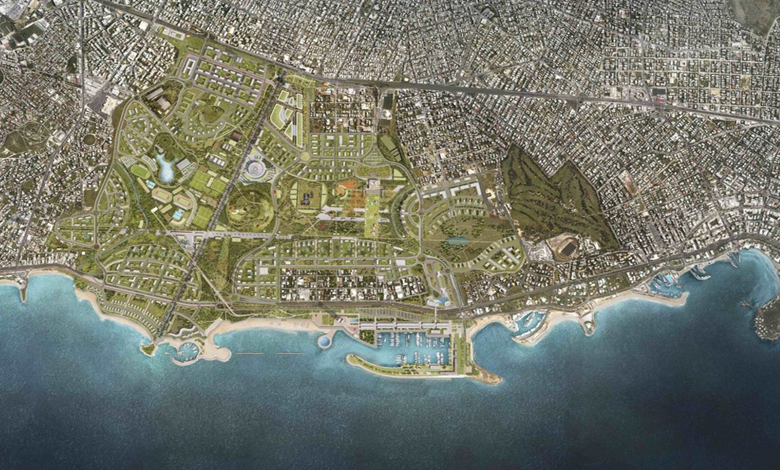
The same legacy mindset applies to large brownfield regeneration. The Ellinikon, Europe’s largest housing project, in Athens, shows how a former airport can be transformed into a mixed-use district delivering housing at scale. Legacy thinking means asking one simple question early: what happens next?
From crisis management to nation-building
Ireland’s housing crisis is real, but so is the opportunity. Investment levels are historic, infrastructure pipelines are established and talent is returning.
International experience is clear: housing at scale requires delivery structures that match ambition. That means new town programmes with real powers, transport-led development planned as a system, and infrastructure designed with long-term legacy in mind.
The question is not whether we can do this. The capability exists. What is required now is the confidence to think bigger and the discipline to deliver.
| Ronan Devlin is a Central Government Portfolio Director covering the island of Ireland with Jacobs. With a background in architecture and project management, he has spent the past decade working at the intersection of public policy, consultancy and major infrastructure delivery. He has advised government clients in the UK and Ireland on housing, transport and place-based regeneration, with a particular focus on governance, delivery models and infrastructure-led growth. |