
Becoming a global AI hub
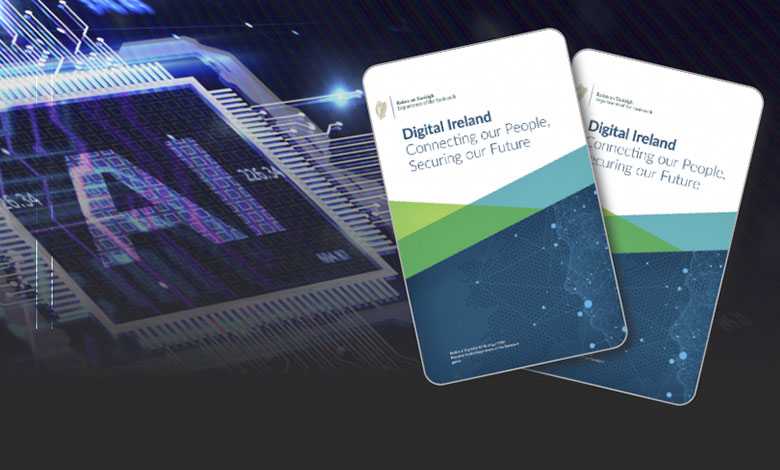
The Government’s National Digital and AI Strategy 2030, Digital Ireland: Connecting our People, Securing our Future, sets out an ambition to position Ireland as a global leader in digital innovation and applied artificial intelligence by the end of the decade.
The strategy, published in February 2026, is built around five pillars: apply, grow, invest, lead, and empower. The strategy outlines a wide-ranging programme of reform across public services, enterprise, infrastructure, regulation, and skills.
The strategy arrives at a time when Ireland’s exposure to digital transformation is both an opportunity and a risk. Government analysis indicates that while Ireland ranks among EU leaders in AI adoption and digital skills, as much as 63 per cent of employment is exposed to AI-related disruption.
Against this backdrop, the strategy aims to balance competitiveness with inclusion, while committing to a detailed set of 20 objectives and 90 deliverables to 2030.
Apply
The ‘apply’ pillar centres on the transformation of public services, with a headline commitment to digitise 100 per cent of key services and achieve 90 per cent online usage by 2030. Central to this is the adoption of a Life Events model, which aims to redesign services around key moments in citizens’ lives rather than departmental structures.
Key actions include the rollout of shared digital infrastructure, the introduction of a Government Digital Wallet, and the implementation of a new Public Service Data Strategy. The ‘capture once, share many’ principle is intended to reduce duplication and streamline interactions, supported by interoperable systems and common data standards.
Alongside this, the Government plans to establish an AI Advisory Unit and a National AI Fellowship Programme to build capacity within the public sector. In addition, all public servants are expected to be supported to undertake AI training from 2026.
However, the strategy also recognises challenges in integrating legacy systems and ensuring inclusion. While digital-first service delivery is prioritised, there is an explicit commitment to maintain non-digital access channels for people either unable or unwilling to engage online.
Grow
Under the ‘grow’ pillar, the strategy focuses on strengthening Ireland’s position as a location of choice for digital and AI investment. A central measure is the development of a sectoral AI Adoption Strategy, aimed at accelerating uptake across the enterprise base.
Current data indicates a divide between large firms and SMEs, with over half of large enterprises using AI compared to a significantly lower proportion of smaller businesses. To address this, Enterprise Ireland is to introduce an AI adoption roadmap, supported by the appointment of AI sector champions and a national awareness campaign.
The establishment of an observatory for business AI readiness (OBAIR) is intended to provide real-time data on AI adoption trends, addressing a gap in policy responsiveness. This will operate alongside existing supports such as the Local Enterprise Offices and European Digital Innovation Hubs, which provide advice, training, and ‘test before invest’ services.
In parallel, the strategy outlines measures to position Ireland as a global hub for applied AI innovation. These include the creation of an AI Research Centre of Scale, expansion of existing research infrastructure, and the establishment of a Quantum Centre of Excellence. A new AI Office of Ireland is to act as the national competent authority for the EU AI Act, while also supporting innovation through an AI regulatory sandbox.
Invest
The ‘invest’ pillar addresses the infrastructure required to underpin digital transformation. A key objective is the delivery of universal gigabit broadband through the National Broadband Plan, alongside enhanced international connectivity via new subsea cable routes.
The strategy also places emphasis on advanced computing infrastructure, including the development of national high-performance computing capabilities and participation in European initiatives such as the EuroHPC ecosystem.
Cybersecurity is treated as a parallel priority, with plans for a new Cyber Security Strategy in 2026, expansion of the National Cyber Security Centre, and the establishment of a Cyber Security Research Centre of Excellence. The integration of AI into critical systems is identified as a key risk area, prompting the development of a National AI Cyber Risk Assessment.
Notably, the strategy acknowledges energy and infrastructure constraints associated with data centres and digital growth, indicating the need for a coordinated approach through the Large Energy User Action Plan.
Lead
The ‘lead’ pillar reflects Ireland’s role in the European digital regulatory landscape. The Government aims to strengthen its position as a digital regulatory hub, with a focus on implementing EU legislation such as the AI Act in a coherent and efficient manner.
Key measures include the establishment of the AI Office of Ireland, enhanced resourcing for regulators, and the development of a more coordinated domestic regulatory framework. The strategy also highlights Ireland’s intention to influence EU digital policy, including through its Presidency of the Council of the EU in 2026, during which it plans to host an International AI and Digital Summit.
A central challenge identified is balancing regulatory enforcement with innovation. The proposed AI regulatory sandbox is intended to provide a controlled environment for testing new technologies, reducing barriers for startups while ensuring compliance.
Empower
The ‘empower’ pillar addresses the social dimension of digital transformation, with a focus on skills, inclusion, and online safety. The Government commits to ensuring that all learners acquire foundational digital and media literacy skills, supported by a new Roadmap for Technology Skills of the Future.
A National Skills Observatory will be established to monitor labour market trends and identify emerging skills gaps, while a one-stop-shop AI skilling platform will provide access to training for individuals and employers.
The strategy also acknowledges the potential for job displacement arising from AI adoption, committing to expanded upskilling and reskilling initiatives. Particular emphasis is placed on supporting groups identified as more exposed to disruption, including younger workers and women.
Online safety is identified as a priority, particularly for children and vulnerable groups. Measures include strengthening the Online Safety Framework, supporting age verification tools, and progressing work on disinformation and media literacy. Ireland also intends to advocate at EU level for decisions on age restrictions for social media use.
Implementation and delivery
Across all pillars, the strategy emphasises a whole-of-government approach to implementation, coordinated by the Department of the Taoiseach. Progress will be monitored through a structured framework of objectives and deliverables, with ongoing stakeholder engagement.
However, the scale of the ambition presents challenges. Many of the proposed reforms, including data sharing across departments, integration of digital infrastructure, and widespread AI adoption, require significant organisational and cultural change within the public sector. While the framework is comprehensive, delivery will ultimately determine whether Ireland can translate its digital ambitions into tangible outcomes by 2030.
Taoiseach Micheál Martin TD says: “We are at a pivotal moment in our digital transformation, with the rapid evolution of digital technologies and the transformative power of AI reshaping how we live, how we work, and how we interact as a society.
“Digital Ireland: Connecting our People, Securing our Future sets out how we will reinforce Ireland’s position as a digital leader and regulatory hub, strengthening our profile as a location for investment and a global hub for Applied AI.”