Leadership in healthcare

Fiona Brady, CEO of the National Treatment Purchase Fund (NTPF), speaks to eolas Magazine about leadership in healthcare, the role of the NTPF, patient-centred innovation, digital transformation, and her vision for the organisation.
In July 2023, Fiona Brady joined the NTPF as its first female CEO, and the first with a clinical background. She brought extensive leadership experience, having served five years as Chief Executive of Our Lady of Lourdes Hospital, Drogheda, and Louth County Hospital. Prior to that, she was Chief Operations Officer and Director of Unscheduled Care and worked with the Emergency Medicine Programme.
Brady began her career in clinical practice, training as a nurse and midwife, with over 20 years’ experience in emergency nursing and management. She is also a trained coach and mentor. Her appointment presented an opportunity to “put a more patient centred focus on NTPF commissioning of scheduled care, by bringing her clinical experience from the coalface of hospital management where the emphasis generally tends to be on unscheduled care and patients on trolleys”, she says.
She continues to promote a patient-centred approach, emphasising that “behind every waiting list number and metric is a patient awaiting access to care”.
Role of the National Treatment Purchase Fund
Since becoming CEO, Brady has stressed that “public patients, public waiting lists and public funding form the foundation of everything the NTPF does”. Too often, this central principle is lost in translation in the wider healthcare and public arena. The organisation is in fact an independent public body that carries out several important functions within the Irish health service”.
“Public patients, public waiting lists and public funding form the foundation of everything the NTPF does.”
The NTPF plays a vital role by gathering, organising, and reporting information on outpatient, inpatient, and day case waiting lists. This ensures hospitals have reliable data to plan services and respond to patient needs. Each month, national waiting list reports are published via the NTPF’s enhanced reporting dashboard, offering transparency for patients, families, and healthcare staff. Brady highlights that “every year, we process over 53 million patient waiting list records and produce more than 25,000 reports to support hospitals, the wider health system, and other partners in improving access to care”.
NTPF data is used to identify long-waiting public patients across all specialties. This information supports the commissioning function of the NTPF and helps guide national healthcare reform efforts. National waiting list protocols ensure patients are managed safely, fairly, and on time, promoting governance, clear patient information, equity of access, standardisation, efficiency, and reduced wait times. The NTPF audits hospitals to confirm compliance with these protocols and adherence to reporting requirements based on the principles of integrity, objectivity, competence, due care, and confidentiality.
Brady is keen to correct the misconception that the NTPF’s administrative validation of public hospital waiting lists is not about removing patients from waiting lists. She explains that “in reality, it involves contacting patients to confirm their readiness and availability for care”. With 87 per cent engagement, validation strengthens hospital-patient communication, updates records, and ensures waiting lists remain accurate.
Following validation, the commissioning process identifies and procures capacity across public and private hospitals to arrange treatments for public patients. “The NTPF’s approach to providing access to care, fully aligns with the ambitions and targets set out under Sláintecare, to meet the needs of this and future generations,” Brady says, while emphasising the importance of collaboration across agencies to improve access.
Another key aspect of the NTPF’s work is setting the maximum prices for long-term residential care in private or voluntary nursing homes under the Nursing Homes Support Scheme (NHSS). “This responsibility is essential, not only for protecting residents but also for ensuring the responsible use of public funds” states Brady.
Patient-centred innovation and digital transformation
Since Brady’s arrival, innovation and digital transformation have been a key focus informed by a patient-centred approach.
In the last two years, digital transformation has become a cornerstone of the NTPF’s strategy, enabling better data use and therefore more patient-centred care. Brady says that “one of the most recent NTPF developments of the Patient Online Automated Response (POLAR) for both validation and commissioning has yielded an overwhelming response with 66 per cent of patients choosing now to engage online”.
To understand and address patients declining NTPF offers of treatment, Brady established a call centre to proactively contact patients and provide information to ensure patients are making informed decisions. This innovation has seen a marked improvement in the number of patients now accepting these offers.
In October 2024, the NTPF published the first National Radiology Diagnostic Waiting List Management Protocol, ensuring that patients seeking access to radiology diagnostic services are administratively managed in line with all other national waiting lists. Brady looks forward to the NTPF publication of radiology diagnostic waiting lists in 2026.
She is proud that these innovations demonstrate how “ultimately the work of the NTPF directly benefits the patient”.
Vision for the future
Since joining the NTPF, Brady has been impressed by her team’s unique skillsets, expertise, and the significant national impact they have made in supporting patients on public hospital waiting lists and those awaiting access to private and voluntary nursing home care.
Looking ahead, the NTPF is committed to continuing to work with the Department of Health, HSE, HIQA, nursing home bodies, and new regional structures to deliver a more collaborative approach to managing waiting lists.
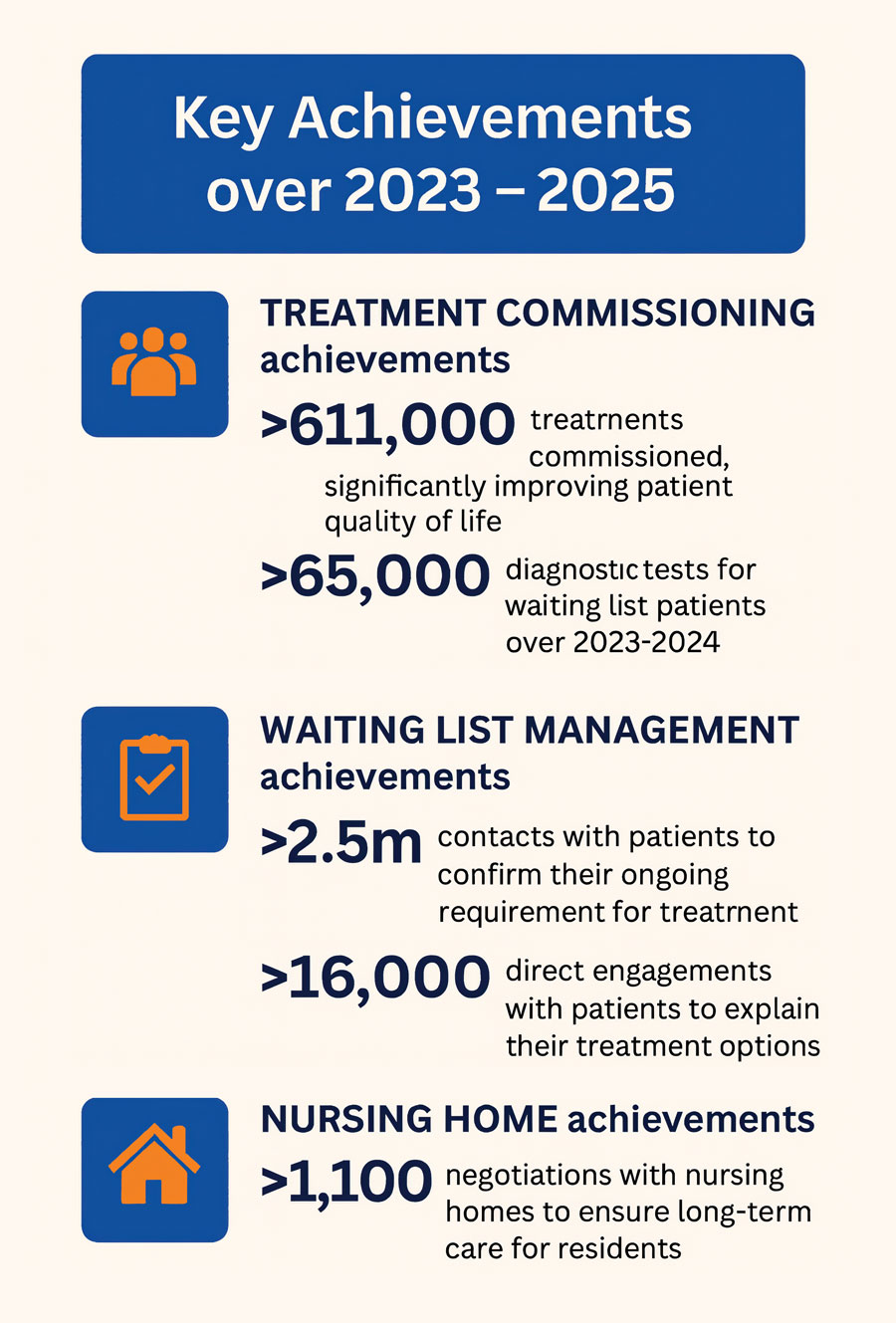
Every initiative reflects the belief that “good health is a shared responsibility,” and Brady acknowledges that “the achievements of 2023-2025 would not have been feasible without the support of the NTPF Board and commitment from the Department of Health and the HSE”.
Brady’s vision for the future is to continue leading the NTPF as a “patient-first, data-driven, innovative organisation that is central to improving access to care, ensuring transparency, and driving healthcare reform in Ireland”.
T: 01 6427101
E: ask@ntpf.ie
W: www.ntpf.ie