The Pobal HP Deprivation Index Using Data to Support Social Inclusion in Ireland
Pobal works on behalf of Government to support communities and local organisations toward achieving social inclusion and community development.
We do this by providing high-quality programme supports and grant management services, working in partnership with Government, partner agencies and those delivering services.
As a social inclusion agency, we recognise that good data is crucial for understanding community needs and improving outcomes for individuals and families. To this end, we have invested in our data and analytics capabilities, a crucial element of which is the Pobal HP Deprivation Index, developed by Dr Trutz Haase and Dr Jonathan Pratschke.
About the Pobal HP Deprivation Index
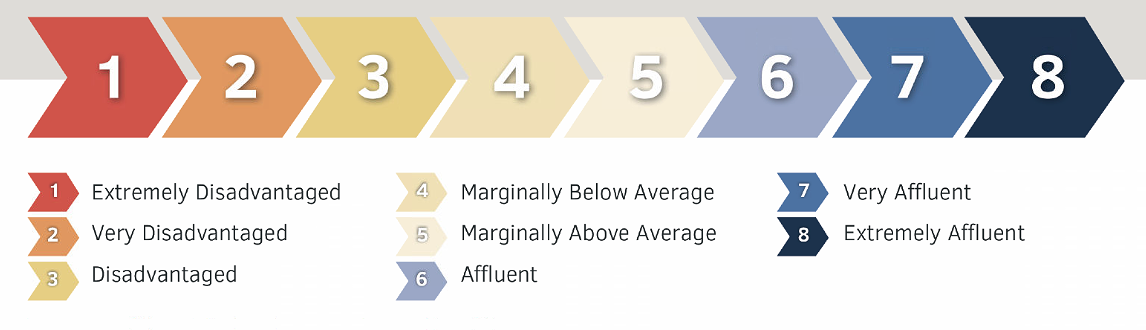
The Pobal HP Deprivation Index is Ireland’s primary social gradient tool, used by numerous Government departments and state agencies, to target resources and services towards communities most in need. The Index has provided a crucial evidence base for tailored interventions, ensuring those communities experiencing the most disadvantage receive supports proportionate to the scale and intensity of their need.
Created using data from each Census, the Index is based on ten measures of an area’s levels of disadvantage. These include educational attainment, employment status and population changes. Almost 19,000 small areas (approximately 100 households) were indexed leading to the development of a detailed map of the relative affluence and disadvantage. In this way, the Index identifies the specific pockets of Ireland which have not kept pace with national level progress and this data can then inform the policy response and resource allocation models. There are currently four waves of data (2006, 2011, 2016 and 2022) so it is possible to see how deprivation scores have changed over time at different geographic units of analysis: small areas, electoral divisions or at county level.
By helping to create an understanding of the challenge of disadvantage and where it is prevalent, the Index has supported transparency and evidence driven allocation of public resources. This objective and impartial data underpins many national and local strategies aimed at addressing social inclusion, early learning and care, education inequality, community development and health inequality.
Pobal publishes the Index and ensures its accessibility to Government departments, state agencies and local implementers. Beyond publication, Pobal makes the data available online, as well as providing practical supports to policymakers, state agencies and researchers across a range of public policy areas to utilise the index.
Key Use Cases Across the Civil and Public Services
- Resource Allocation Models
The Index is integral to allocating funds across Government funded programmes such as:
Social Inclusion and Community Activation Programme (SICAP): SICAP 2024-2028 is co-funded by the Irish Government, through the Department of Rural and Community Development and the Gaeltacht, and the European Social Fund Plus under the Employment, Inclusion, Skills, and Training (EIST) Programme 2021-2027.
Community Services Programme (CSP): The Community Services Programme is funded by the Department of Rural and Community Development and the Gaeltacht. The Community Services Programme supports community-based organisations to provide local social, economic and environmental services that meet identified needs and provide employment locally, contributing to sustainable, inclusive and empowered communities.
Spatial targeting in programme design is critical for ensuring that publicly funded services and supports can reach those who are most in need.
- Educational Targeting
The Department of Education’s DEIS model was one of the first national initiatives which used the Pobal HP Deprivation Index with the model being recently recognized in an OECD evaluation.
The Index has also been to central roll-out of the Equal Start model for Early Learning and Care which gives enhanced resources to childcare centres where there is a concentration of children from disadvantaged backgrounds.
- Health Service Executive (HSE) Service Planning
The HSE’s Health Intelligence Unit uses the Index to support service planning in areas such as primary care, population health, chronic disease supports and addiction services.
Research Using the Pobal HP Deprivation Index
Complementing its use as a resource allocation tool, the Index has also been used to build the evidence base on key areas of social policy.
A recent partnership project undertaken with UCD School of Geography revealed a stark divide in Ireland’s clean energy transition. The analysis demonstrated that households in the most disadvantaged areas are almost five times less likely to use renewable energy than those in more affluent communities, providing critical evidence which can guide energy policy and a just transition.
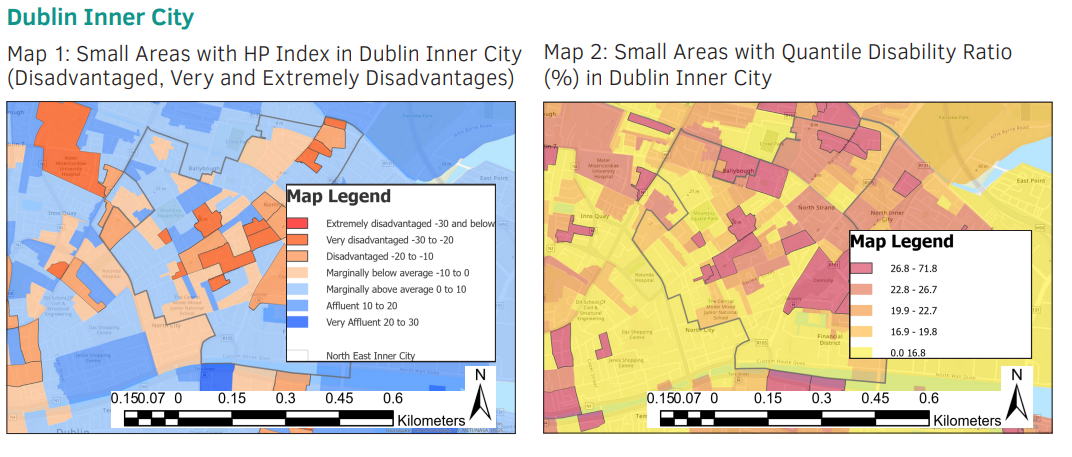
Similarly, several recent projects using the Index have added to the literature on health inequalities and the social determinants of health. A project by Pobal using Census 2022 data found that people living in the most disadvantaged areas in Ireland are much less likely to rate their health positively and, are twice as likely to report having a disability compared to their peers in affluent areas. This heightened health burden has also been documented by the ESRI through the Pobal-ESRI Research Framework. One recent study revealed that the national declines in health status are most pronounced in the most deprived areas, while another project showed that rates of COVID-19 infections were also higher in these areas.
Accessing the Pobal HP Deprivation Index
The 2022 datasets are freely available on Pobal’s Open Data portal and on data.gov.ie
For users wishing to explore the data visually, Pobal Maps (maps.pobal.ie) provides an interactive platform to view Index scores across Small Areas and Electoral Divisions, compare regions and overlay other relevant socio‑economic indicators.
Contact Pobal
Pobal welcomes enquiries from Government departments, agencies, local authorities, academic researchers and community organisations interested in using the Index or seeking analytical guidance.
Please email: pobalmaps@pobal.ie
or visit www.pobal.ie