The Council of State
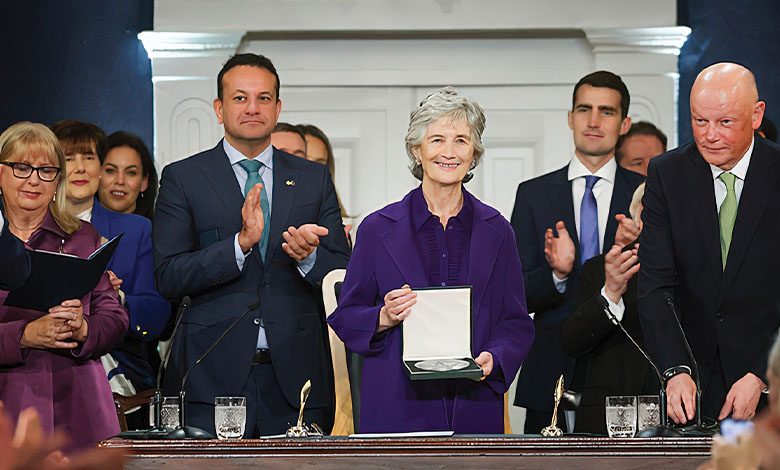
President Catherine Connolly is set to announce her Council of State “early in the new year”, according to a spokesperson for Áras an Uachtaráin. eolas Magazine examines the role, remit, and history of the Council of State.
As described in Bunreacht na hÉireann, the Council of State’s purpose is to “aid and counsel” the President. The President must consult with the council before exercising certain presidential powers. Those powers include:
- convening a meeting of either or both Houses of the Oireachtas;
- communicating with the Oireachtas “by message or address on any matter of national or public importance”;
- addressing a message to the nation “at any time on any such matter”;
- deciding to appoint a committee of privileges to assess if a bill is a money bill;
- deciding if a bill should be expedited through the Oireachtas in emergencies or if the bill is “immediately necessary” to preserve public peace and security;
referring a bill to the Supreme Court for a decision on whether it is repugnant to Bunreacht na hÉireann; and - deciding if bills must be subject to a referendum.
Bunreacht na hÉireann stipulates that the President must convene a meeting of the council and be heard by members present at the meeting before performing any of these powers. The President decides when and where to convene a meeting with the Council of State.
If the Dáil and Seanad disagree on whether or not a particular bill is a money bill, the Seanad may ask the President to refer the question to a committee of privileges. Before deciding on whether the committee should be appointed, the President must consult the Council of State. The President must also consult with the Council of State on appointees to the committee, which comprises an equal number of members of the Dáil and Seanad, and is chaired by a Supreme Court Judge.
Previous presidents have referred bills to the Supreme Court on 16 occasions. This is done when the President believes that a bill may be unconstitutional. The Supreme Court has upheld the constitutionality of referred bills on nine occasions, while seven have been deemed unconstitutional. Although the President must consult with the Council of State, the decision to refer the bill is the President’s alone.

Members
The Council of State comprises three categories of members: ex oficio, former office holders, and appointed members.
Ex officio members include the Taoiseach, Tánaiste, Chief Justice, President of the Court of Appeal, President of the High Court, Ceann Comhairle, Cathaoirleach of the Seanad, and the Attorney General. As of early December 2025, ex oficio members that will sit on President Connolly’s Council of State include:
- Taoiseach Micheál Martin TD;
- Tánaiste Simon Harris TD;
- Chief Justice Donal O’Donnell;
- President of the Court of Appeal Justice Caroline Costello;
- President of the High Court Justice David Barnivile;
- Ceann Comhairle Verona Murphy TD;
- Cathaoirelach of the Seanad Senator Mark Daly; and
- Attorney General Rossa Fanning.
Former office holders include anyone who has previously held office as President, Taoiseach, or Chief Justice that is able and willing to act. The President can also appoint up to seven members to sit on the Council. Bunreacht na hÉireann stipulates that the President can do this “at any time and from time to time”. It also states that the President can terminate the appointment of any member of the council they have appointed.
Connolly has not yet appointed any members to the Council of State but is expected to do so in early 2026. During her campaign, she indicated she would appoint someone to represent disabilities in Ireland.
Appointed members indicate a president’s priorities over their seven-year term. Michael D Higgins, who was in office from 2011 to 2025, appointed the following seven members:
- Cara Augustenborg: Irish-American environmental scientist;
- Sinéad Burke: Writer, academic, and disability activist;
- Sindy Joyce: Irish Traveller human rights activist;
- Maurice Malone: CEO of the Birmingham Irish Association;
- Johnston McMaster: Adjunct Assistant Professor at the Church of Ireland Theological Institute;
- Mary Murphy: Senior lecturer in Irish Politics and Society at Maynooth University; and
- Seán Ó Cuirreáin: Former journalist and former Irish language commissioner.
Although Bunreacht na hÉireann provides the President with the power to terminate the appointment of any member of the council they have appointed, this does not extend to members that are ex oficio or former office holders. The Constitution also states that appointed members may resign from the office. It provides no basis for the resignation of ex oficio members or former office holders.
This became significant towards the end of Mary Robinson’s presidency, which spanned from December 1990 to September 1997. Former Taoiseach Charles Haughey came under scrutiny as a council member in the lead up to the 1997 presidential election following the 1997 McCracken Tribunal. The Tribunal investigated payments to Haughey and Michael Lowry TD by businessman Ben Dunne.
It found that Haughey received numerous payments from Dunne that totalled close to IR£2 million; that he attempted to hide these payments from Revenue; and that much of the evidence he provided to the Tribunal was unacceptable.
Independent presidential candidate Derek Nally called for Haughey to resign from the Council in October 1997 due to the Tribunal’s findings. Haughey did not resign but did not attend another meeting.