
Justice sector digitalisation: What tomorrow looks like

The Courts Service hosted justice sector leaders and experts for a round table discussion on digitalisation of the sector and what tomorrow looks like.
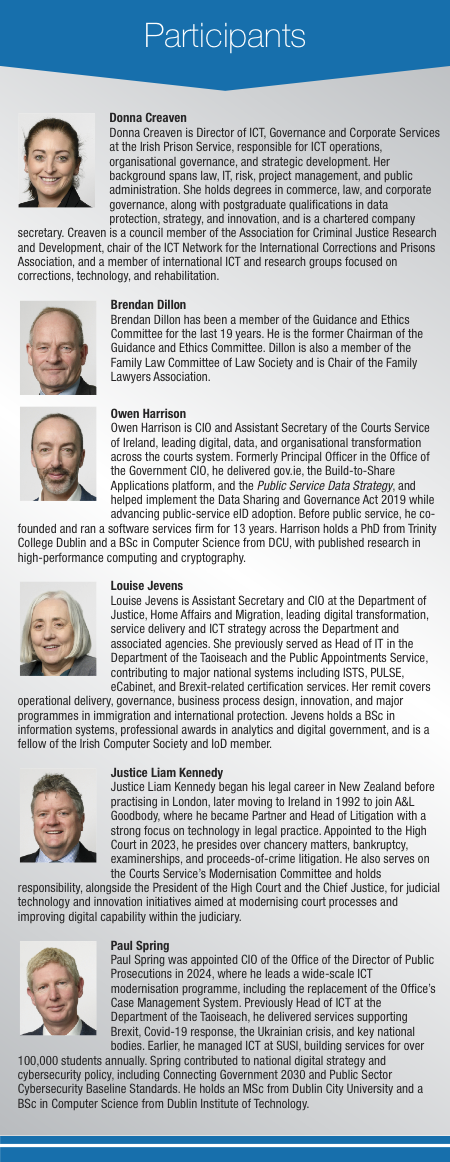
What has been the most significant IT advancement in the last five years within your organisation/to impact your work?
Owen Harrison
Our transition to cloud has been instrumental in enabling us to respond to challenges with agility. It is the bedrock of everything we do. Cloud services have been a game-changer for us across the board allowing us to respond to application needs right through to security threats in a very coherent way. The cloud also underpins our new Unified Case Management System which is one of the biggest strategic decisions we have taken in the past five years.
Donna Creaven
Virtual video conferencing was initially introduced as an emergency measure during Covid but it has fundamentally changed our operations. On average, 380 virtual court appearances, 60-plus legal consultations, and hundreds of family video visits take place each week. This has had a positive impact on transport operations, escort demands, and disruption to prison routines.
Justice Liam Kennedy
Although it is still a work-in-progress, electronic filing is a game-changer. The amount of paper produced in a typical case is increasing all the time but electronic tools will help us deal with such information more efficiently. Video conferencing is also increasingly significant. Its use in live court hearings during Covid helped ensure continued access to justice during lockdown but since then it has continued to prove itself as valuable for call-overs and directions hearings which could otherwise require barristers and solicitors to spend hours in court waiting for a listing that might only take minutes. It is also helpful when dealing with expert witnesses like doctors testifying in personal injury actions and overseas witnesses. Such technological changes should lead to significant efficiencies and savings both for the Courts Service but also for parties appearing before the Irish courts.
Paul Spring
Digital evidence has become significantly more prevalent in the last few years. This has hugely impacted our work. There is an enormous volume of data that must be stored, processed, and transmitted. Some of this evidence is highly technical which presents its own challenges, particularly for some defence solicitors who, in some cases, may not have the capacity to store huge volumes of data.
Brendan Dillon
Coincidentally, right before lockdown measures were imposed during Covid, we had replaced old computers with laptops across the organisation. We have also transitioned to the cloud which has been significant for remote working. We have hugely improved our case management and aligned our case management system. This has streamlined our operations. We are also utilising AI dictation. It is not perfect but it is a huge improvement. This accelerates the workflow and frees up staff to complete other tasks which delivers more efficiencies.
Louise Jevens
Low code platforms and cloud adoption have enabled us to expedite front-end digital delivery of applications and forms. They provide us with functionality to deliver quick wins. This has helped us address challenges in recent years such as the four-fold increase in international protection applications and has enabled efficient processing of those coming to Ireland seeking temporary protection fleeing the war in Ukraine.
What has been the greatest challenge in implementing new IT initiatives?
Paul Spring
We have actually had great buy-in from staff. The organisation is expanding rapidly. Timing has been the challenge for us. Staff are keen to use modern tools and services, and they are eager for us to introduce more. But this must be balanced with training and scaling capacity. It can be difficult to keep up with the demands and expectations of incoming and existing staff. We have a big challenge with our Case Management System which is end of life. This is a long-term project.
Justice Liam Kennedy
The great challenge has been the digital divide; both internally and externally. Externally we have a diverse range of stakeholders who have varying digital capacities and computer literacy levels. Not every organisation has the foundations in place to upscale digital implementation. Internally, we must ensure that incoming judges are trained to utilise new technology.
Louise Jevens
The greatest challenge for us is ensuring that the entire organisation moves together in the digitalisation journey. Moving to an agile methodology puts additional asks on the organisation when it is already dealing with high demands. There is a lot of enthusiasm for tech and digital so digital literacy needs to be supported. In cross agency projects, ensuring priorities are aligned is another challenge. This is crucial to ensure that the sector can deliver value.
Owen Harrison
The ‘people’ part of the people-process-technology triangle has been one of the biggest challenges. To implement a user-centric service design, you need users’ time, but they have limited capacity. Therefore, you need highly skilled IT staff that can extract the value out of users during the limited time they have with them. Identifying, hiring, and retaining such staff has been a constant challenge for us.

“Collaboration means decisions are not made in isolation; instead, solutions are built from the ground up to meet collective needs.”
Owen Harrison
Donna Creaven
Supporting people through change management and fostering trust in new systems have been significant challenges. Sometimes, there will be duplication of processes because there is not enough trust in the new system. Additional challenges include escalating ICT costs, perpetual licenses needed for cloud subscription models, and the cybersecurity threat. Furthermore, we have legacy systems, fragmented data, and underdeveloped data modelling capabilities which create further obstacles when you attempt to implement new systems as you need strong foundations in the first place.
Brendan Dillon
Everything you want to implement comes at a cost but each organisation must consider if not implementing new technology incurs a greater cost. This also ties in with security. The prospect of someone hacking into our client account is the single biggest threat we face. Cyber threats are becoming increasingly sophisticated and each organisation is endeavouring to implement adequate security, but ultimately you do not know how effective it is until it is tested. Ensuring that staff are correctly processing information digitally is a challenge.
Donna Creaven
Many prisons are located in Victorian estates and the buildings are over 100 years old. Rolling out new services requires improved WiFi and upgraded physical structures which in turn require extensive building works and cabling in the first instance, so there is a need for underpinning infrastructure in order to meet our digitalisation needs.
How has IT collaboration across the justice sector benefitted your organisation/work?
Brendan Dillon
The Covid-19 pandemic highlighted the value of justice sector IT collaboration. In the early months of the pandemic, family law proceedings almost halted, but remote consent hearings helped restore access and proved hugely effective. Hybrid hearings continue in some areas, and the new online filing system being piloted has transformed workflow and efficiency. While the full potential of digital systems is not yet realised, we now have a strong proof of concept. The pandemic showed that new models can work, and with continued collaboration, there is considerable scope to streamline processes further and deliver faster, more accessible family law services.
Louise Jevens
The Hub project has significantly improved collaboration across the Courts, prisons, and An Garda Síochána by enabling secure, real-time message and data exchange. This has introduced development challenges but the outcome for users has been overwhelmingly positive with greater speed, reduced error rates, and smoother data transfer between agencies. We now have full visibility of who is due in which venue and when, supporting more efficient case progression and prison management. By sharing information electronically rather than manually, the sector has created clearer workflows, fewer delays, and better service outcomes. Collaboration has made processes faster, more accurate, and more joined up.

“By sharing information electronically rather than manually, the sector has created clearer workflows, fewer delays, and better service outcomes.” Louise Jevens
Justice Liam Kennedy
Cross-sector collaboration enabled the development of a unified legal diary, something which is long overdue. Previously, more than 150 different databases had evolved organically and operated separately, creating gaps, confusion, and risk. With a single digital diary, the chance of errors, such as the wrong prisoner being released, is reduced, and efficiency increases across the system. This progress was built on the foundations of the Unified Case Management System, which has become the engine for transformation. While non-digital routes must remain available, fears of a digital divide have not materialised to the degree once expected. Scaling and strengthening digital services now offers the greatest benefit.
Owen Harrison
Many collaborative gains stem from the Unified Case Management System, which aims to replace over 150 legacy systems with one integrated platform. This shared approach has enabled developments like the legal diary but, more importantly, ensures design is centred around users with judges, prison services, gardaí, legal representatives, and others. Collaboration means decisions are not made in isolation; instead, solutions are built from the ground up to meet collective needs. As this platform expands, the benefits will continue to grow: streamlined information sharing, reduced duplication, and more consistent, reliable data across the justice sector.
Donna Creaven
Courts list integration has greatly benefitted the Prison Service by reducing unnecessary transport and giving us clear, timely access to court data. This means more efficient detailing of staff, officers can be redeployed to more meaningful duties, and fleet and operational risks are reduced. Collaboration has also helped shift our culture away from paper-based operations. The Department of Justice, Home Affairs and Migration’s Innovation Ambassador Programme, in which we participated, supported projects like digital journals and new digital service design approaches. Shared learning, training, and sector-wide problem-solving have changed how we view technology and enabled more user-focused digital development within prisons.

“Our aim is a modern prison environment equipped for secure digital services and improved prisoner access to support.”
Donna Creaven
Paul Spring
Sector collaboration has been exceptionally strong and continues to grow. The Criminal Justice Hub has created valuable working groups, including one led by the Courts Service on Common Data Registries. This group involving the DPP, the Courts Service, An Garda Síochána, the Department, and the Central Statistics Office is tackling longstanding inconsistencies in how offences are classified and coded. A standardised approach would vastly reduce duplication, errors, and inefficiencies across the system. The Courts Service has produced excellent groundwork, and although implementation will be challenging, the foundations for a shared data model are in place. The potential benefits are substantial and widely supported.
What key IT developments are planned for your organisation/do you envisage for your work over the next two to three years?
Donna Creaven
Our organisation is currently facing significant overcrowding, and a major Capital and Capacity Development Programme is underway for the next five years. As we modernise our physical estate, we want to ensure new and refurbished prisons are built to support modern digital services. This includes expanding in-cell technology, improving WiFi and digital access throughout landings, and building on the successful rollout of in-cell telephony. Alongside infrastructure upgrades, strengthening cybersecurity, improving network resilience, and increasing staff awareness of digital risks will be key priorities. Our aim is a modern prison environment equipped for secure digital services and improved prisoner access to support.
Owen Harrison
For the Courts Service, our primary development is the Unified Case Management System. This will enable digital filing for court users and legal practitioners, modernising how information flows through the courts. Beyond efficiency in submissions, we expect significant wider benefits as digital processes reshape how cases progress. A judicial interface is also being introduced, allowing judges to access documents electronically and work with cases more effectively. Feedback so far has been positive. Over the next few years, expanding this system will be central to improving access to information, case preparation, and court administration.

“AI could streamline the administrative sections of judgments, allowing judges to focus on interpretation, reasoning, and outcomes.”
Justice Liam Kennedy
Justice Liam Kennedy
I fully support the Unified Case Management System and see it as a foundation for further development. Looking ahead, artificial intelligence will influence judicial work, and guidance will be issued for legal professionals to ensure safe and appropriate use. AI will not decide cases, but it could support judges by processing factual material, summarising documents, and speeding up the preparation of judgments. Given the current delays in judgment production, particularly in the High Court, AI could streamline the administrative sections of judgments, allowing judges to focus on interpretation, reasoning, and outcomes. Used carefully, it could accelerate justice delivery.
Paul Spring
Our organisation is progressing through a broad modernisation programme. While much of the foundational work has been completed, expansion and scalability remain priorities. Cybersecurity is a major focus, with further advancements needed to match evolving risks. Our largest planned development is rebuilding our Case Management System to improve our own business processes, data sharing, reduce duplication, including a reduction of paper based processes. Currently, information is re-entered across systems, particularly between An Garda Síochána and our own teams. A redesigned platform will streamline information flow, incorporate digital evidence more effectively, and integrate material such as body-worn camera footage directly into case files.

“Collaboration will be essential to design, adopt, and govern this safely across the sector.”
Paul Spring
Louise Jevens
We are progressing two major modernisation programmes, one in immigration services and one in international protection, with core phases already delivered. Key developments include a digital contact centre, self-service applicant portal and modernised back-office systems, simplifying complex proofing processes. Upcoming phases of work are driven by ambitious EU Migration Pact deadlines for first-decisions and appeals. We are replacing legacy systems and building solutions on secure cloud platforms. Looking forward, a Smart Borders project aims to streamline movement at airports through pre-travel notification and digital entry and exit, reducing manual interactions and improving efficiency.
Brendan Dillon
Security remains a continuous focus as we ensure systems are fully utilised and resilient. We are enhancing our case management processes, particularly client onboarding, AML checks, and file opening, making them more seamless and less manual. A major new development is an AI-supported intake system for our family law services. Given the sensitivity of these matters, the goal is to gather key information in advance so early meetings are less stressful and more productive for clients. By improving the initial contact experience and streamlining administrative steps, we hope to deliver a more efficient, supportive service and a stronger client journey.
What future collaboration do you expect across the justice sector in the next few years?
Justice Liam Kennedy
I expect future collaboration to continue along the same path, building on unified systems, reducing inefficiencies, and improving integration across the sector. The Unified Case Management System will remain central, enabling more video hearings and smarter scheduling. Remote listings are ideal for short or procedural matters, while in-person hearings will still be essential where liberty is at stake. The sector will need to balance stakeholder needs, work practices, and hearing formats while expanding digital capability. Ultimately, closer collaboration will improve efficiency for courts, prisons, practitioners, and the public, delivering better outcomes system-wide.
Paul Spring
I agree that the next phase is about progressing what has already begun. System interoperability and data sharing will be major priorities, reducing duplicate entry and improving accuracy. One significant area will be digital evidence, particularly as body-worn cameras become standard. A centralised digital evidence management system could transform how material moves between gardaí, prosecution, defence, and courts, replacing current manual processes and improving chain-of-custody and auditability. This will require cultural, operational, and technical changes, but the efficiency, security, and consistency gains are substantial. Collaboration will be essential to design, adopt, and govern this safely across the sector.
Louise Jevens
There is strong potential for further collaboration through the Criminal Justice Operational Hub and the Criminal Justice Strategic Committee, which drives cross-system reform. Continued use of shared innovation networks will help identify common pain points and support development of digital solutions. A critical future step will be progressing a sector-wide identifier to improve data flow, supported by policy, legislation, and operational frameworks. AI will also feature, but governance, skills, and responsible deployment will be key. As systems become more efficient, we must also plan for downstream effects, acknowledging that gains in one area can increase pressure in another. Collaboration ensures balance.
Brendan Dillon
Engagement between practitioners, courts, and justice agencies has significantly increased, giving confidence that deeper collaboration is now achievable. The legal diary and online filing pilots show real progress, but future work could focus on expanding remote administrative hearings. Many lawyer-only directions and procedural matters could be handled online, reducing court waiting time, lowering costs for clients and easing pressure on physical courtrooms. With 150 systems already being consolidated into one, we have proven that large-scale cooperation is possible. If this momentum continues, further efficiency gains and access to justice improvements should follow with relative ease.

“The pandemic showed that new models can work, and with continued collaboration, there is considerable scope to streamline processes further and deliver faster.”
Brendan Dillon
Donna Creaven
Future collaboration will likely expand video link use and strengthen data sharing under the Criminal Justice Strategy, particularly through cleaner data foundations and a unique identifier. Cross-agency work on analytics and projection models could help long-term resource planning, including prisoner forecasts and policy development. E-warrants present another major opportunity, reducing delays and improving traceability. AI holds potential for security monitoring, interpreting multilingual communication and supporting operational decision-making, but must be used ethically, safely, and with a human-centric lens. Efficiency gains are valuable, but decisions should reflect real-world impact on people and not just technical possibility.
Owen Harrison
Sustained collaboration across the justice ecosystem will be essential. Shared reform reduces cost, duplication, and administrative burden, which are benefits felt not only internally, but by users, taxpayers, and society. AI will be a defining feature of the next phase, with enormous promise and equal risk. Its capability can be remarkable, but it also fails unpredictably, so collective governance, risk assessment, and decision-making will be critical. Working as one sector allows opportunities to be developed safely and consistently, ensuring courts, prisons, gardaí, legal practitioners, and government progress together. Continued cooperation will improve outcomes, efficiency, and accessibility across justice.