Family Resource Centres: Social inclusion in action
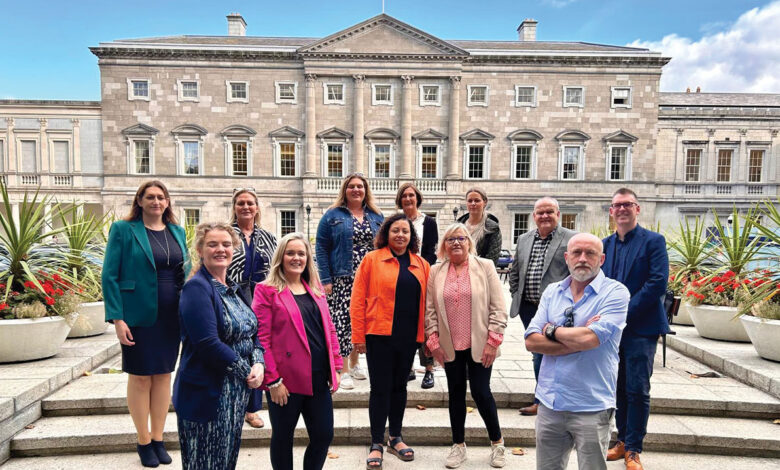
Family Resource Centres are one of Ireland’s most effective but under recognised engines of social inclusion. The Programme for Government commits to expanding and funding FRCs, with 10 new centres announced (now 136 nationwide) and core funding increased to €180,000 per year, writes Fergal Landy, CEO, Family Resource Centre National Forum.
FRCs are a critical and increasingly fundamental part of the mix of community infrastructure needed to build cohesive and inclusive communities. As an agile policy lever. FRCs help deliver the elusive whole-of-government approach sought by policymakers and politicians alike and to address priority areas, such as child poverty or support for people with disabilities.
Whilst policy objectives are assigned for implementation by government departments directly or by various state agencies and local authorities, implementation is unlikely to be well received by communities unless those communities are engaged as active agents in those policy objectives.
This is true not just of community cohesiveness and social inclusion but also many other inter-related policy areas such as child and family wellbeing, poverty eradication with a particular focus on child poverty, community health and wellbeing, lifelong learning through community education, community safety and crime prevention, climate change, biodiversity and a just transition, and participatory democracy.
Family Resource Centres (FRCs) are community-based hubs that help families and individuals access support, build skills, and feel connected locally. They do not just replace public services; they make them reachable, coordinated, and human. They offer community development activities, community education, childcare and parenting support, counselling and therapeutic support, support for older people and so much more.
This CLG structure also helps to integrate the silos that can occur as an unintended consequence of departmental funding streams. Using a belt and braces analogy, if governmental agencies are the braces for policy implementation, communities are a woven belt, and FRCs are the golden thread. Unique within the landscape of Irish community and voluntary organisations, FRCs operate a human rights-based approach to community development and family support across the life-course.
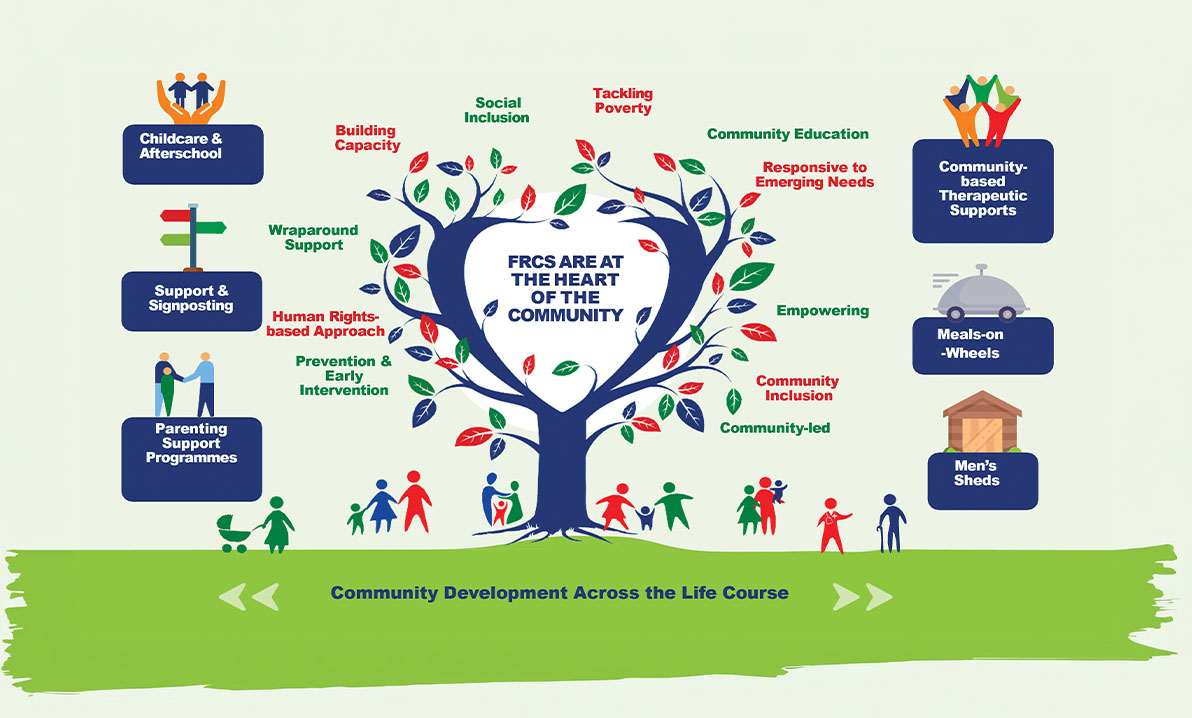
For FRCS, this starts with identifying the strengths of the community and then responding to the needs by acting as a broker between the complex tapestry of informal, semi-formal and formal supports that help to create meaningful social inclusion. Some FRCs are in urban areas where there is a concentration of poverty and inequality, many are the heart of a rural village or town and the surrounding hinterland. Place-based identity, the need to belong and to matter, are not only key to the work of FRCs but are also the evidence-based bedrock of lifelong health and wellbeing.
Integral to FRCs, is that each FRC is an independent company limited by guarantee (CLG) with trustees derived from the local community. These community representatives provide governance and oversight of a strategic plan developed in partnership with the community and implemented by a professional staff team acting alongside the community.
This highly devolved governance model delivers community autonomy, distributed leadership, and individual agency, it is also a mechanism to deliver meaningful social inclusion by creating the opportunity for marginalised groups to directly participate in the governance and oversight of funding allocated for their community.
This CLG structure also helps to integrate the silos that can occur as an unintended consequence of departmental funding streams.
Using the core funding managed and administered on government’s behalf by Tusla, each FRC leverages and pools funding streams to deliver developmental opportunities and wrap around supports to the community in a joined-up manner under one roof.
The increasing governance and compliance required of Irish charities is undoubtedly a challenge for many locally led organisations. Rather than framing them as a burden, to be alleviated through centralisation and specialisation, FRCS offer the opportunity to re-frame governance and compliance requirements as process and outcome in a theory of change based on empowering rather than fixing communities.
FRCs understand that communities are struggling with intergenerational poverty and inequality, frequently without access to housing, fulfilling employment opportunities, leisure amenities, or proper public services in areas like health, including mental health, disability, education and public transport. Specific groups within communities, such as the Traveller and Roma communities, migrants, the LGBT+ community, lone parents, people with disabilities, and older people experience social exclusion.
The community development approach of FRCs is fundamentally about seeking change. Community is where change starts and where it is experienced, whether that is local, national, or indeed global change. FRCs have been working closely with communities on methods for dealing with those who seek to divide their communities with divisive rhetoric.
FRCs bring the community together in a safe and trusted space to have conversations designed to create mutual understanding and solidarity, FRCs are empowering communities to address the structural causes of the challenges they face. This creates a real alternative and antidote to division.
Where FRCs are resourced, the community is much better equipped to respond and to deescalate such situations because the relationships of trust within the community have already been established.
This is why it is vital that the community development work of FRCs is resourced, so that we can build cohesive communities with meaningful social inclusion. There is a real opportunity now to grow this potential as part of a long-term strategy to address decades of poverty and inequality and to counteract divisive forces. If social inclusion is the policy objective, then government must continue to expand the capacity and network of FRCs and critically provide all FRCs with the adequate, sustainable funding needed to deliver meaningful social inclusion.
E: ceo@familyresource.ie
W: www.familyresource.ie