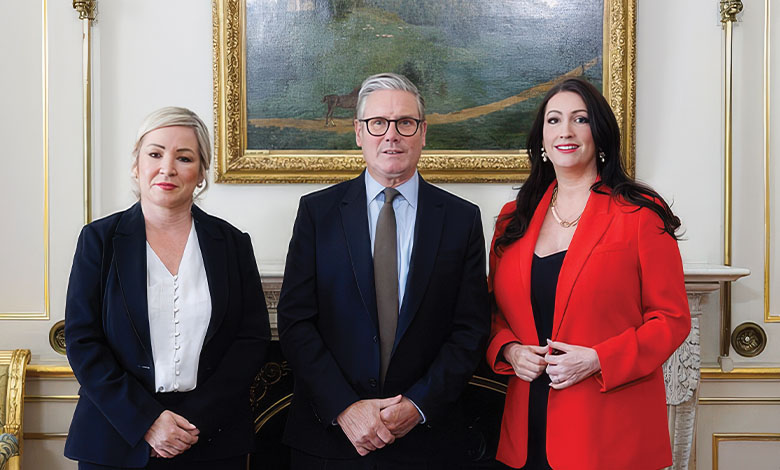
Emma Little-Pengelly MLA: Good Friday Agreement is a ‘political reality’ for the DUP

In an interview with eolas Magazine’s Joshua Murray, Northern Ireland’s deputy First Minister Emma Little-Pengelly MLA has said that the Good Friday Agreement is a “political reality” for her once-sceptical party, and that Taoiseach Micheál Martin TD “understands the stranded approach” to north-south relations better than Leo Varadkar.
Halfway through a turbulent, and as far as policy outcomes are concerned, anti-climactic term of government as the North’s deputy First Minister, Emma Little-Pengelly MLA is in reflective mood, discussing north-south relations and detailing the DUP’s nuanced views on the Good Friday Agreement.
Much like her party’s relationship with the agreement, Little-Pengelly’s political path has been choppy, having lost both a seat each in the Northern Ireland Assembly and the British Parliament, spending three years outside politics, before being co-opted into an Assembly seat which had been won in 2022 by her former party leader Jeffrey Donaldson.
While significant fanfare surrounded the history in Michelle O’Neill becoming the first nationalist First Minister, there was less enthusiasm for the equally notable history being made by Little-Pengelly in February 2024, as she became the first unionist deputy First Minister of the North. In practical terms, this means little beyond symbolism as the Executive Office is a joint office that is co-led by both O’Neill and Little-Pengelly.
The last 10 years have been, to put it mildly, challenging for the DUP. Since the Brexit vote, the party has seen its vote share decline from a peak of 36 per cent to the low 20s, has been forced to concede on issues ranging from abortion and same-sex marriage to Irish language rights. Adding insult to this already significant injury was the imposition of customs checks on goods travelling between Britain and Northern Ireland, as the UK Government under Boris Johnson prioritised ensuring that there was no hard border on the island of Ireland.
A political survivor, Little-Pengelly presents a more positive outlook on north-south relations than virtually all of her unionist predecessors, and while failing to explicitly say she supports the Good Friday Agreement, reveals a tacit support which again was absent from most of her predecessors.
North-south relations
Asked about her relationship with Taoiseach Micheál Martin, Little-Pengelly says that she has “engaged very constructively” with the Taoiseach, adding: “I do believe engagement with the Taoiseach is incredibly important and the Irish government is incredibly important, that that is respected when there is not overreach.”
Expanding on this ‘overreach’, the deputy First Minister says: “We have seen that overreach before with the likes of Leo Varadkar, whereas I think with Micheál Martin, he understands the stranded approach much better.
“The Republic of Ireland are our closest neighbours, and we are theirs. I think it makes sense to have positive and constructive relationships when we can. But of course, we will also call out where we believe that there is overreach, and where we believe that they are wrong.”
Rationalising the need for a level of north-south interaction, Little-Pengelly says: “The Belfast-Good Friday Agreement sets out the stranded approach, the parameters of engagement.”
“At times, some people might find that frustrating. They want to push the boundaries of that. They want to have more engagement on more areas and issues. The reality is that those parameters create the space for constructive engagement in a very structured way which recognises that there are certain issues in which we engage with the Irish government, but there are other issues which are entirely matters internal to Northern Ireland or internal to the United Kingdom.”
Good Friday Agreement
Arguably the main reason for the DUP usurping the Ulster Unionist Party as the leader of unionism in 2003 was the former opposition to the Good Friday Agreement under Ian Paisley’s leadership. Since then, the party has negotiated reforms to the agreement, most notably in 2007 and 2015, but has fallen short of ever outlining support for the agreement under its five leaders since Paisley.
While Little-Pengelly does not explicitly say she supports the agreement, she also refuses to dismiss support for it: “The Belfast-Good Friday Agreement is a political reality. It was voted on by people in Northern Ireland and the Republic of Ireland. It is in place. When I refer to the Belfast-Good Friday Agreement. I refer to it as a legal reality. It is the context in which we operate, and it is the document that created the structures that we have here in Northern Ireland.”
She adds: “When people say, ‘Look, do you support the Belfast-Good Friday Agreement?’ What we operate right now is the Belfast Agreement as amended by and, in my view, improved by the St Andrews Agreement.”
The deputy First Minister is keen to convey the message that her party was opposed to the agreement, rather than the peace process. “The DUP opposed the Belfast-Good Friday Agreement at the time not because we opposed peace; we were very supportive of [peace] and in fact we always believed that there was no justification for the violence.
“Our concern was around some of the compromises and the balance within that document. We did not believe it was right, for example, that you would have a political party come into the executive without decommissioning. We did not agree that it was right that you had all of those [paramilitary] prisoner releases.
“I think when you saw it played out with the triumphalism around that. We did not believe it was right that you would have some of those pathways set out, and disagreeing with some of the substance of that does not mean that the DUP was against peace.”