Bio-based and circular solutions for retrofit
Bebhinn Kennedy, project officer at the TUS Sustainable Development Research Institute, discusses how TUS is developing bio-based retrofit solutions and how they can be applied to heritage buildings.
Kennedy outlines two projects: DeCO2 (Dynamic Decarbonization Pathways Framework: Integrating Technological, Social, and Policy Innovations for Sustainable Renovations in the Built Environment) and HeriSol (HeriSol – Prosumer Solutions for Listed Buildings Based on Building-integrated photovoltaics BIPV).
DeCO2, funded by the European Commission under Horizon 2020, is a European project that focusses on creating a decarbonisation pathways framework “integrating technological, social, and policy innovations for sustainable renovations in the built environment.” Kennedy outlines the project objectives:
- showcase and implement circular and technological innovations that contribute to the decarbonisation of the built environment;
- foster social innovation by people-centred, inclusive, creativity-driven, participatory processes and activities;
- promote policy innovation by providing practical guidelines to public authorities;
- demonstrate the effectiveness and viability of innovative digital solutions within the three demonstrator sites; and
- assess the scalability and replicability of the demonstrated built environment decarbonisation pathways.
The demonstration building in Ireland is O’Connell Avenue FET Campus, owned and operated by Limerick and Clare Education and Training Board (LCETB). This building is “large-scale” and comprises “mainly heritage buildings”.
“We are looking at a location-based, user-centric portfolio of materials and renovation systems that is built to embrace local industrial ecosystems and verticals,” explains Kennedy.
Digital tools for decarbonisation
DeCO2 digital tools aim to “speed up the transition of the construction industry towards decarbonisation through Construction 4.0 enablers”. Construction 4.0 refers to digital advancements to progress the construction industry. Kennedy explains that the regulatory sandboxes in DeCO2 “establish safe spaces for legal and regulatory testing of innovations”.
Bio-based measures
As part of the project, TUS aims to improve the energy efficiency of the campus. Ian Major’s team at the Polymer, Recycling, Industrial, Sustainability and Manufacturing Research Institute (PRISM) at TUS is developing bio-based insulation installations that sequester carbon for the site.
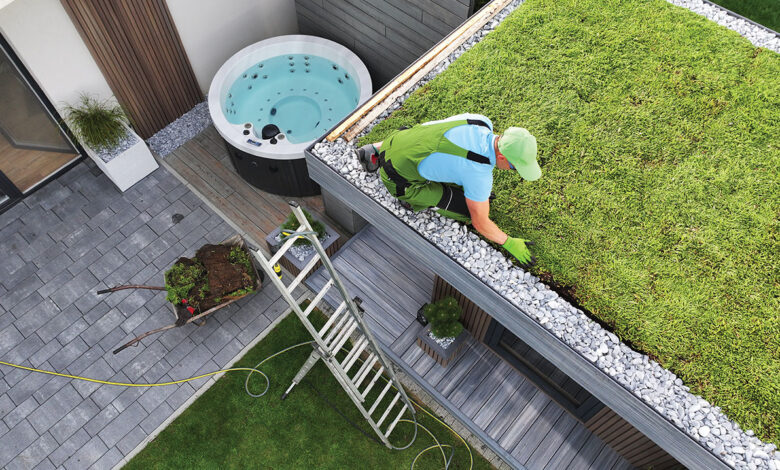
TUS will also assess installing green roofs, vegetated roof systems, at the site. “There are huge benefits to green roofs, but when you actually look at their build-up, there are lots of plastic-based components,” says Kennedy. “The question that must be asked is: how green is the green roof you are installing?”
TUS-PRISM is examining how polymer-based layers in green roofs can be replaced with bio-based solutions. Green roof testbeds will be installed on the roof of the FET College campus’ gymnasium with bio-based components replacing the plastic elements and their performance will be monitored.
Additionally, as part of other retrofit upgrades, light fittings are being upgraded to LEDs and more energy efficient windows are being installed. TUS-SDRI and LCETB will utilise digital twin technology to monitor these retrofit upgrades and assess feasibility of other measures at the site.
Continuing, Kennedy says: “We are developing practical retrofitting and circular guidelines for the construction industry and building owners. Within the DeCO2 project, TUS recently developed a circular toolkit and that is looking at materials and how we can replace those materials as well.”
She explains that TUS-PRISM has created a panel that will simulate the performance of an insulated plaster slab which was installed in the gymnasium building. Heat loss from the panel will be tested for 10 days and this data will then be analysed to understand its performance before the next insulation sample is installed and monitored.
Kennedy also discusses the HeriSol project which aims to provide “prosumer solutions for heritage buildings based on building integrated photovoltaics (BIPV)”. Herisol is co-funded under the Clean Energy Transition Partnership.
“The overall objective of HeriSol is to demonstrate the innovative integration of clean energy solutions into architectural heritage, converting heritage buildings from consumers to prosumers and thus into active elements of the energy system,” outlines Kennedy.
The project includes the creation of a digital twin, which enables real time monitoring of a heritage building’s energy performance and turns a historical site into a smart, active participant in efficient energy management.
She indicates that solar panels “are not the most aesthetically pleasing”, adding that people are unsure whether to install solar panels on heritage buildings. However, she explains how BIPV can address this problem.
“The BIPV product that is being worked on in this demo site is going to morph onto the roof and take on the slate or tile finish.”
Kennedy explains that solar PV will be installed on the Limerick City Gallery of Art along with bio-based insultation. Samples of tiles have been taken from the site and sent to project partners in Germany. BIPV panels using morpho film technology are being developed to mimic existing materials.
Additionally, TUS is developing a bio-based polyurethane (PU) panel which will be installed at the art gallery. “We are evaluating the insulation performance versus standard foams using the formulas they are developing at TUS PRISM,” says Kennedy.
TUS-PRISM is investigating the feasibility of non-isocyanate bio-based PU foam. Furthermore, panels are being analysed to discern their physical and thermal performance.
The team is also developing a mycelium-based insulation which is a “complete bio non-chemical alternative to PU”. Next, PRISM aims to test full-scale prototype panels which will require scaling up of mycelium growth.
“This product is almost ready to come to market; it just needs some more feasibility testing. Give it a few more years and you never know; you might be buying mycelium-based insulation,” says Kennedy.