Delivering the future
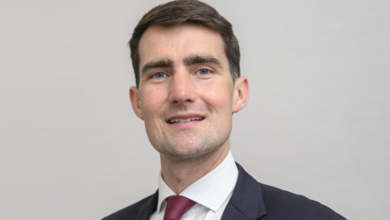
Mike Healy, Programme Director for Strategic Projects in Uisce Éireann, talks to eolas Magazine about two of the largest infrastructure projects in the State’s history: the Water Supply Project and Greater Dublin Drainage.
As Ireland prepares for the next generation of strategic water and wastewater infrastructure, Uisce Éireann is advancing two of the largest projects in the State’s history: the Water Supply Project Eastern and Midlands Region (WSP EMR) and the Greater Dublin Drainage (GDD) project.
Mike Healy discusses how these transformational projects are progressing, why they matter, and what lies ahead.
As an architect by profession, Healy has built his career on the core principle of safe delivery. He is focused on getting projects safely delivered, on time, to a high standard, and with real and lasting legacy.
“Our job is to deliver,” Healy says. “These projects matter to communities, to the economy, and to the country’s future, and delivery is how we make the difference.”
It is an approach shaped by an impressive portfolio. Before joining Uisce Éireann, Healy worked on some of the UK’s most high-profile engineering undertakings, including London 2012, Heathrow Terminal 5, and London Bridge Station. He also spent nearly a decade in the water sector, working with Thames Water and later leading Affinity Water’s capital programme.
Healy first collaborated with Uisce Éireann in 2013 as part of the national domestic metering programme and joined the organisation five years ago.
The desire to deliver as quickly as possible is supported by key stakeholders. Building on the initiatives of the Accelerating Infrastructure Taskforce, the Government is very supportive in removing the numerous barriers to these projects.
For Healy, the focus remains firmly on progress: securing contractors, building market confidence, maintaining the project’s current momentum, and realising benefits. The goal is not just to deliver infrastructure, but to unlock housing, enable economic development, and ensure resilient services for decades.
The Water Supply Project
The Water Supply Project is the largest and most strategically important water infrastructure project in the history of the State. Its purpose is to deliver a new, sustainable, secure and climate resilient water source for the Greater Dublin Area (GDA) and the wider Eastern and Midlands Region, with the capacity to support the water supply needs of up to 50 per cent of Ireland’s population.
Water supply across the GDA is on a knife edge. Almost 85 per cent of the region’s drinking water currently comes from a single source (the River Liffey) and the two major treatment plants at Ballymore Eustace and Leixlip are operating at or near their maximum sustainable capacity.
Without a new source, the region faces increasing risks of water restrictions, supply outages, and an inability to support housing and economic development.
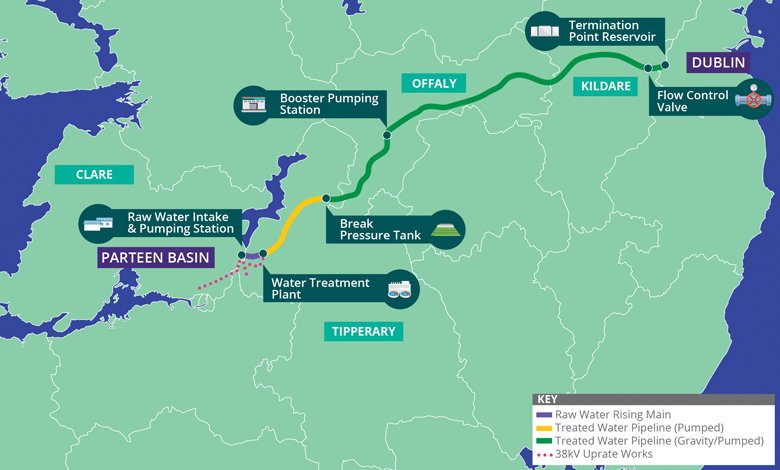
The WSP will provide the first major new water source for the region in 60 years. A new abstraction point will be developed at the Parteen Basin on the River Shannon (using a maximum of 2 per cent of long-term average flow).
The project will deliver a new water treatment plant near Birdhill, County Tipperary and a 172km pipeline transporting treated water through Tipperary, Offaly, and Kildare to a new termination reservoir at Peamount in South Dublin. This will create capacity for future regional offtakes, enabling supply to communities in Tipperary, Offaly, Westmeath, and increased resilience for Meath, Kildare, Carlow and Wicklow.
In December 2025, the planning application was submitted to An Coimisiún Pleanála (ACP) after extensive non statutory public consultation. ACP’s statutory seven week public consultation closed on 25 February 2026.
Nearly 80 per cent of landowners have already signed voluntary wayleave agreements, while dedicated community clinics continue throughout 2026. “Building trust with landowners and communities is essential. Their cooperation and insights are shaping this project.
“Stakeholders view WSP as critical national infrastructure, central to housing, climate resilience and economic growth. Engagement is strong, informed and increasingly proactive. While community level concerns remain, we want to work with those communities and we have a Community Liaison Officer appointed to give information to them throughout the process,” Healy says.
A planning decision is expected within 48 weeks. If granted and if there is no legal challenge, construction is scheduled to begin in 2028, with water entering supply in 2032.
Greater Dublin Drainage: Moving into delivery
The Greater Dublin Drainage (GDD) project is another one of Uisce Éireann’s most significant national infrastructure programmes. Its purpose is to provide a new regional wastewater treatment facility and supporting network infrastructure in Clonshaugh to serve north Dublin and parts of Meath and Kildare, addressing longstanding capacity constraints across the Greater Dublin Area.
Demand for wastewater services in the GDA is rising sharply due to population growth, economic expansion and climate pressures. Wastewater volumes in the region are projected to increase by over 50 per cent by 2050. Existing treatment infrastructure, particularly the Ringsend Wastewater Treatment Plant, which currently treats 40 per cent of all wastewater nationally, is operating at capacity. Without GDD, new housing and economic development could face restrictions as soon as 2028, due to insufficient treatment and network capacity.
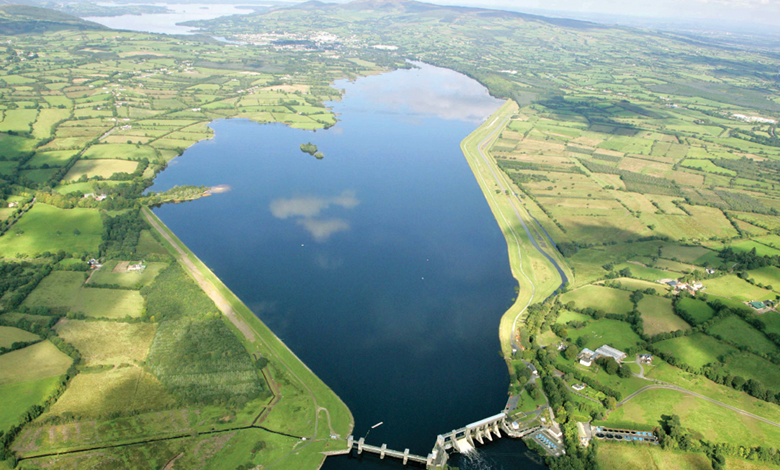
Once operational, GDD will have the capacity to treat wastewater for the equivalent of up to 500,000 people, relieving pressure across the wider network and enabling growth across the region.
Following its planning milestone in December 2025, the GDD project is now entering its next critical phase. Preliminary construction works are scheduled to commence in late 2026 or early 2027.
Construction is expected to take approximately three years once commenced, with the project required to be operational by 2032 to avoid network and development constraints.
A unified vision for Ireland’s water future
While the Water Supply Project and GDD serve different technical functions, Healy sees them as complementary pillars of the strategic national infrastructure long term plan. “When you step back, both projects are about ensuring Ireland has the essential water and wastewater infrastructure needed for the next century,” he explains.
“That is why we have a joint procurement approach which will be launching soon. We have listened to the market, engaged extensively with industry, and structured our approach to provide confidence, clarity and momentum.
“Delivery of water and wastewater infrastructure and services delivery underpins Project Ireland 2040 and is the backbone to social and economic development,” he says.
Healy concludes: “These projects will define Ireland’s water landscape for generations. It is a privilege to help deliver them and to work with communities, colleagues and stakeholders who share the same commitment to Ireland’s future.”
W: www.water.ie