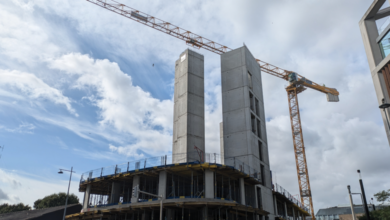
The case for a state construction company

A state builder, if well designed and implemented, could address a number of the structural problems in the market for housing supply, writes Tom McDonnell, co-director of the Nevin Economic Research Institute (NERI).
That we have a housing crisis is well understood. We can see it in rising rents, high house prices, young people stuck in the family home or emigrating, and record levels of homelessness.
The reality is that the housing market has been in some form of dysfunction for fully a quarter of a century if we include the pre-2008 housing boom. Systemic under-building in the wake of the construction sector’s devastating boom and bust of the early 2000s coincided with significant pent-up demand from a growing economy and rapid population growth. This led to a major mismatch of supply and demand and to the current crisis.
Our seemingly intractable supply shortfall is caused by a variety of factors including a large deficit of skilled labour, high construction and financing costs, weak productivity, ongoing issues of dereliction and land hoarding, and an extremely cumbersome and unpredictable planning system.
The housing crisis is fundamentally a dysfunction of coordination and of capacity. Supply is burdened by a number of challenging structural problems and a fragmented delivery system. While there is certainly no silver bullet to end the crisis, it is surely time to at least consider alternatives or modifications to our current approach.
One notable policy option we have yet to fully explore is a state builder or state construction company (SCC). There are a number of potential advantages. A state builder if well designed and implemented could address a number of the structural problems in the market for housing supply.
Such an entity could be a completely new body or it could be a transformed Land Development Agency (LDA) given its own direct build capacity. Either way, a state builder would have to eventually employ thousands of direct employees if it were to become a meaningful actor. Crucially, we would want it to provide additional capacity to private builders and certainly not replace them.
The potential advantages include guaranteed minimum output during downturns and restraint during private booms in housing output. This would help smooth the economic cycle and housing output. Secondly, a state builder would lead to less fragmented delivery by providing a single, scalable, and reliable delivery arm for building on state-owned land. Even so, supply would realistically only be gradually ramped up over a three-to-seven-year period with a focus on pilot projects and learning in its earliest years. Third, a state builder could train apprentices at scale and make construction a less volatile and therefore more attractive career prospect by placing a floor on annual construction output. In this way it would help calibrate labour supply and labour demand in the construction sector over the medium term.
Fourth, through removing developer profit margins, through central procurement and bulk purchasing of materials, through investing in R&D and productivity, and through the utilisation of a very small number of standardised reusable designs, it could reduce build costs and bring down prices. Its scale and long-term reliability as a buyer of standardised components would also improve the viability of building one or more large-scale modular factories in Ireland using modern methods of construction.
The state builder could conceivably even own and operate a modular factory itself as part of its supply chain strategy. Finally, working with the LDA and local authorities it could ensure housing is built where it is most needed rather than where the market decides it is most profitable.
There are of course a number of challenges and risks. Establishing a state construction company of meaningful size would be very expensive. It would eventually have an annual capital spend running into the billions of euro. New legislation would be required either to amend the LDA Act 2021 to expand the LDA’s function to provide for direct construction or, alternatively, to enact a new SCC act to establish a new semi-state akin to the ESB.
The state builder’s activities and structure and its interaction with public procurement rules would need to be compatible with EU and domestic law. In practice, it would probably be restricted to building on public land as a direct builder for public authorities (mainly local authorities using the Teckal exemption) and even then, only for cost rental and/or social housing. Political interference and bureaucratic sprawl would need to be robustly countered.
In addition, there would likely be significant recruitment challenges in the early years. But even success in recruitment carries its own risks in our current full employment labour market. A major concern is that the state builder might crowd out small builders, particularly those reliant on public contracts. Thus, the establishment and ramping up of a state builder would need to be accompanied by a campaign to nudge new people into construction trades via an expanded apprenticeship programme and via an attractive and well advertised package of terms and conditions aimed at construction workers living outside Ireland.
An SCC is not a panacea for the immediate crisis. Many additional problems need to be resolved including the slow and unpredictable planning process and the infrastructure and utility connection bottlenecks.
The reality is that a state builder would take a number of years to establish itself and its formation would be hotly contested and derided by private developers and vested interests keen to keep away competition. But these drawbacks do not make it a bad idea and we should at least debate its merits and risks.
In my view, if we had had the foresight to set up a state construction company in 2016 we would be in a better place today. Let us hope we do not have the same regrets in 2036.