State unlikely to meet social housing retrofitting target

The target to retrofit 36,500 social housing units to a B2 standard by 2030 in line with the Climate Action Plan is unlikely to be met, a report by the National Oversight and Audit Commission (NOAC) has found.
The Local Authority Performance Indicator Report, published in September 2025, finds that current annual retrofit completions must double to reach the target. It adds that “it is not certain that it can be accomplished”.
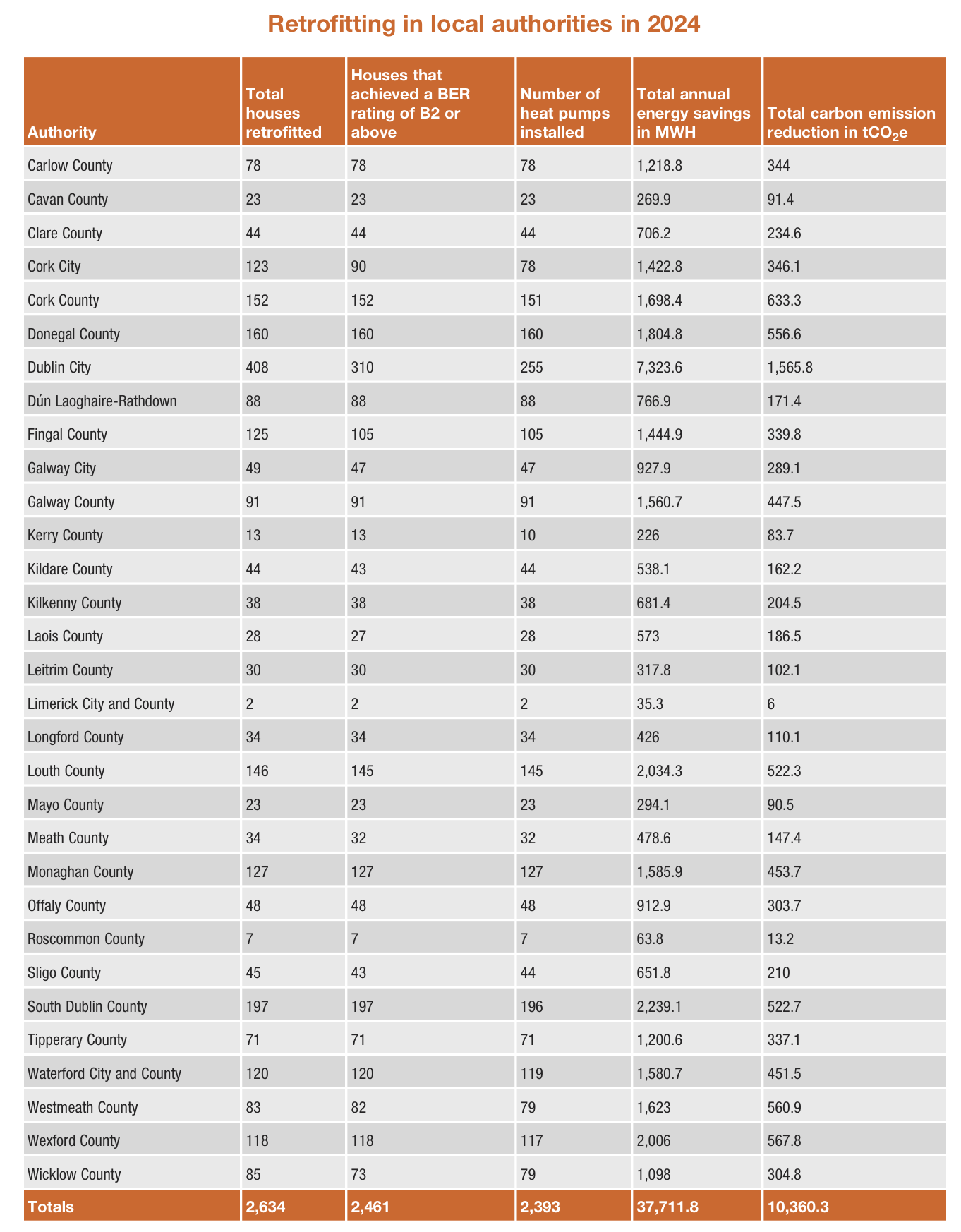
There were 2,634 units retrofitted in 2024 of which 2,461 achieved a BER rating of B2 or above. This included the installation of 2,393 heat pumps. In 2023, there were 2,445 housing units retrofitted of which 2,315 achieved a BER rating of B2 or above. Houses retrofitted in 2024 delivered energy savings of 37,711.8 MWh and carbon emissions reductions of 10,360.3 tCO2e.
The National Residential Retrofit Plan 2026, published in January 2026, states that Department of Housing has funded more than 11,000 local authority retrofits to BER B2 level “or cost optimal equivalent” between 2021 and 2025.
Retrofitting of social housing is supported by the Department through the Local Authority Energy Efficiency Retrofit Programme (EERP). A total of €140 million has been provided under the EEPR for 2026 aimed at delivering around 3,500 upgrades. The plan states that €90 million was spent under the programme in 2025 to delivery 2,673 home retrofits.
In the NOAC report, local authorities advised that houses retrofitted to date were the “low hanging fruit” of housing stock, those that are easier and less expensive to retrofit. The report states: “As they progress with their programmes, they will be dealing with the older, more technically difficult, and more costly to retrofit units.”
Barriers to progress include insufficient financial and human resources and the operation of the retrofit scheme on an annual rather than multi-annual work programme.
“Furthermore, the major urban authorities are faced with additional financial and technical challenges, in that they are required to retrofit old multi-storey flat complexes, and there is a question as to whether the existing retrofit scheme is appropriate for such units,” the report says.
Dublin City retrofitted the most homes in 2024 with 408 units, up from 259 in 2023. The report finds that many local authorities including Donegal, Cavan, Galway County, Louth, and Laois had capacity to carry out additional retrofits which they proceeded with in some instances. However, due the lack of funding, they were unable to include any additional units in their 2024 results.
Limerick City and County reported the lowest number of retrofits with two, while Roscommon was second lowest with seven, and Kerry was third with 13. The report outlines that Limerick City and County sad that it did not have the claims submitted for the 2024 programme. Therefore, units completed in 2024 will now be counted in 2025.
“Cavan, Galway County and Leitrim expressed concern about the way the programme is funded and found it a challenge and at the current rate of progress they were doubtful of reaching their target,” the report adds.