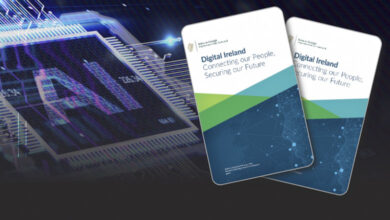
The critical foundations for Ireland’s Digital Public Services Plan 2030

Ireland’s Digital Public Services Plan 2030 represents the most ambitious digital transformation agenda the Irish public sector has ever undertaken, writes Ailish Hansen, Chief Commercial Officer, Fexco Managed and Advisory Services.
The targets are clear: 100 per cent of key public services available online and 90 per cent digital consumption by 2030. The vision is compelling: a life events approach that reimagines how citizens interact with government around the moments that matter most in their lives.
But ambition without enablement risks becoming aspiration without achievement. As public bodies begin implementing this transformative agenda, the question is not whether the vision is right, it is whether the enablers for success are in place.
The challenge ahead
The plan identifies 189 key public services across 17 life events, from the birth of a child to supporting the bereaved. While 58 per cent of these services are already online or due to be by the end of 2026, being ‘online’ is merely the starting point. True transformation requires services that are integrated, intuitive, and designed around user needs, not around the internal structures of government departments.
Consider the life event of becoming employed. This currently involves engaging with up to 22 separate services. Even when digitally available, these services remain disconnected. Citizens must repeatedly provide the same information, navigate different systems, and understand which department does what. The ambition is to transform this into a seamless journey where government proactively offers relevant supports at the right time.

Delivering this ambition requires more than technology upgrades. It demands fundamental shifts in capability, culture, and collaboration. The plan acknowledges these complexities explicitly, recognising that life events-based services are inherently challenging because they span multiple departments, systems, and legislative frameworks.
What, then, are the critical enablers that will determine whether Ireland achieves its 2030 targets?
Enabler one: Structured governance and clear accountability
Strong governance structures are essential to ensure digital transformation initiatives are delivered in line with policy commitments. The plan establishes a clear governance framework: the Public Service Leadership Board providing oversight, a strategic working group for Pillar One coordinating delivery, and Life Events Working Groups bringing together stakeholders across departments and agencies.
This structure is sound, but success depends on execution. Each life event has a lead department responsible for coordinating efforts across multiple public service bodies. These leaders must navigate complex stakeholder landscapes, align competing priorities, and maintain momentum across organisations with different cultures, systems, and constraints.
Effective governance requires more than formal structures. It demands dedicated resources, clear decision-making authority, and mechanisms for resolving blockers quickly. It also requires transparency: regular reporting through tools like the ePPM project management building block ensures progress is visible and issues are surfaced early.
For senior civil servants and technology leaders, the question is whether their organisations have allocated sufficient leadership attention and resources to these coordination roles. Transformation at this scale cannot succeed as a side-of-desk activity.
Enabler two: Service design capability at scale
At the core of the life events approach is user-centred design, a fundamental shift from process-oriented service delivery to understanding and meeting citizen needs. The plan recognises this explicitly, committing to build service design capability across the public sector through training programmes, design playbooks, a service standard, and a central design team in DPER.
These are necessary foundations, but the scale of the challenge is significant. Delivering 17 life events by 2030, each involving multiple services across numerous public bodies, requires design capability that is widespread, embedded, and continuously improving.
Building this capability takes time. Training programmes and recruitment of designers at all grades will strengthen internal expertise, but capacity constraints remain. The plan’s ‘learning by doing’ approach, where teams gain expertise through practical application, is pragmatic. However, it requires supporting structures: access to experienced practitioners who can guide teams, frameworks and tools that accelerate design work, and protected time for staff to develop new skills.
The design procurement framework outlined in the plan provides an important mechanism for accessing external expertise when needed. Public bodies should view this not as outsourcing design work, but as a capacity multiplier that enables internal teams to deliver more ambitious transformation while building long-term capability.
The Accessing Social Housing case study demonstrates what is possible when rigorous design methods are applied. The ‘as is’ analysis identified 12 key operational and technological challenges, from inconsistent processes across 31 local authorities to manual effort required by both citizens and staff. The target service offer defined a transformed experience: centralised information, online applications, streamlined back-office processing, and automated updates. This work provides a template for other life events, but replicating it across all 17 priority areas demands substantial design capacity.
Enabler three: Digital infrastructure and building blocks
The plan’s emphasis on shared digital infrastructure is one of its strongest elements. Rather than each public body building bespoke systems, DPER (OGCIO) is providing reusable digital building blocks with identity management through MyGovID, a life events portal, a government digital wallet, data collection tools, payment systems, and more.
This approach offers significant advantages: consistency of user experience, interoperability across services, cost efficiency, and faster time to market. The successful digital wallet pilot demonstrated the potential of these building blocks to enable trusted, user-friendly digital interactions.
However, infrastructure is only as valuable as its adoption and integration. Public bodies must design services to leverage these building blocks effectively, ensuring they are not simply bolted onto existing processes but integrated into redesigned service journeys. This requires technical capability: understanding how to implement these tools, integrate them with legacy systems, and ensure data flows securely across government.
It also requires standards and governance around data sharing. The Plan references the Public Service Data Strategy 2030 as a key enabler, establishing secure data infrastructure and interoperable standards. Realising the ‘once only’ principle, where citizens provide information once for reuse across services, depends on responsible data sharing with appropriate safeguards and compliance with GDPR regulations.
The ePPM project management building block deserves particular attention. By providing a common tool for tracking progress, milestones, and resources, it creates transparency and enables coordinated delivery across departments. But its value depends on adoption and discipline: consistent use, accurate reporting, and embedding it into regular governance processes.

Enabler four: Funding and resource allocation
Digital transformation requires investment. The plan notes that departments and public service bodies will continue to fund their own digitalisation efforts as part of business as usual. Additionally, DPER has established a targeted Public Service Digital Transformation Fund for 2024 to 2026 to drive cross-cutting collaboration and accelerate priority life events.
This blended funding model is pragmatic, but it creates coordination challenges. With multiple funding streams and competing priorities, there is a risk of fragmented delivery or duplication of effort. Strong programme management and visibility of investment across life events will be essential to ensure resources are deployed where they deliver greatest impact.
The fund’s focus on co-design, skills transfer, and outcome-based partnerships is particularly important. Funding should not simply pay for deliverables but should build capability and drive measurable improvements in service experience and operational efficiency. Structuring investments to reward adoption and user satisfaction, not just activity or outputs, will focus effort on what matters most: delivering value for citizens.
As the plan evolves beyond 2026, sustainable funding mechanisms will be crucial. Transformation is not a one-off investment but an ongoing commitment. Public bodies must embed transformation capability into their operating models, ensuring they can continue innovating beyond the initial programme phases.
Enabler five: Strategic partnerships
The scale and complexity of the Digital Public Services Plan mean that public bodies cannot deliver it alone. Strategic partnerships with experienced advisory and consultancy providers offer critical enablers: proven expertise in service design and agile delivery, capacity to surge resources at critical moments, and cross-pollination of best practice across Life Events and organisations.
The most effective partnerships are genuinely collaborative. Rather than transactional outsourcing, where work is simply handed off to external providers, successful engagements involve co-design, joint problem-solving, and explicit knowledge transfer. Partners work alongside internal teams, building capability while delivering tangible outcomes.
Fexco’s experience demonstrates the value of this approach. Our strategic partnership with the Sustainable Energy Authority of Ireland, recognised with the CCMA Outsource Partnership of the Year award in 2024, exemplifies how collaboration focused on the right blend of people, process, and technology can deliver sustainable transformation. Similarly, our work with The PrizeBonds Company, a 50:50 joint venture with An Post operating since 1989, shows how long-term partnerships can reliably deliver complex services.
For public bodies navigating the Digital Public Services Plan, the question is not whether to engage external partners, but how to structure those partnerships to maximise value. Relationships should be aligned around outcomes, designed to build internal capability, and flexible enough to adapt as priorities evolve.
This is where Fexco Advisory Services can play a key role in supporting Digital Public Services Plan. Our approach to Advisory services is grounded in decades of hands-on expertise in running multinational financial service operations and providing outsourced managed service operations primarily to irish public sector partners. our advisory Services leverage all this practical, real-life experience to support clients in achieving tangible outcomes that align with their strategic objectives.
The plan’s life events working groups provide an ideal structure for collaborative partnerships. With lead departments coordinating efforts across multiple agencies, there is both the governance framework and the practical imperative for partners who can work effectively in complex, multi-stakeholder environments.
Enabler six: Continuous learning and adaptation
The plan is designed as a dynamic framework, intended to evolve based on feedback, emerging challenges, and new opportunities. This adaptive approach is essential in a rapidly changing technological and policy landscape.
Enabling continuous learning requires several elements: mechanisms to capture insights from early life events and propagate lessons to later phases, regular evaluation of what is working and what needs adjustment, transparency in reporting progress and challenges, and openness to changing course when evidence suggests a better path.
The plan’s phased approach, with priority life events scheduled for delivery in 2026, 2027, and 2028, creates natural learning cycles. Insights from Phase One life events like birth of a child and accessing social housing should directly inform Phase Two and Phase Three delivery. But this only happens if there are structured processes for knowledge capture and transfer.
Advisory partners working across multiple life events can play a valuable connective tissue role, identifying patterns and helping propagate effective approaches across government. Combined with the plan’s commitment to monitoring and evaluation, this creates the conditions for an increasingly sophisticated and effective transformation programme.
The plan’s emphasis on the OECD recommendation on human-centred public administrative services provides an important North Star. The recommendation urges governments to design services around people’s needs and life events rather than institutional silos, reduce administrative burden, enhance access, and improve equity. Regular benchmarking against these principles and against peer countries pursuing similar approaches ensures Ireland learns from international best practice.
Looking ahead
The Digital Public Services Plan 2030 is bold and necessary. The life events approach has the potential to fundamentally improve how citizens experience government services while driving efficiency through reduced duplication and better use of public resources.
But vision must be matched with pragmatism about delivery. Success depends on getting the enablers right: clear governance and accountability, service design capability at scale, robust digital infrastructure, sustainable funding, strategic partnerships, and mechanisms for continuous learning.
These enablers are interconnected. Strong governance creates the conditions for effective partnerships. Digital building blocks enable service designers to deliver integrated experiences. Funding that rewards outcomes drives behaviour toward what matters most.
For senior civil servants and technology leaders across the public sector, the opportunity is significant and the challenge is real. The questions to ask are: Does my organisation have the governance, capability, infrastructure, and partnerships in place to deliver on our commitments? Where are the gaps, and how do we address them?
The pathway to success runs through deliberate attention to these enablers, treating them not as background conditions but as active priorities requiring leadership, investment, and sustained focus. Get these right, and Ireland’s digital transformation ambitions become achievable. Get them wrong, and 2030 targets remain aspirations rather than outcomes.
The plan provides the roadmap. The enablers will determine whether we reach the destination.
Fexco Advisory Services works with public and private sector organisations to design and deliver transformation programmes grounded in operational reality and focused on sustainable outcomes.

W: www.fexco.com/business-services/advisory-services/